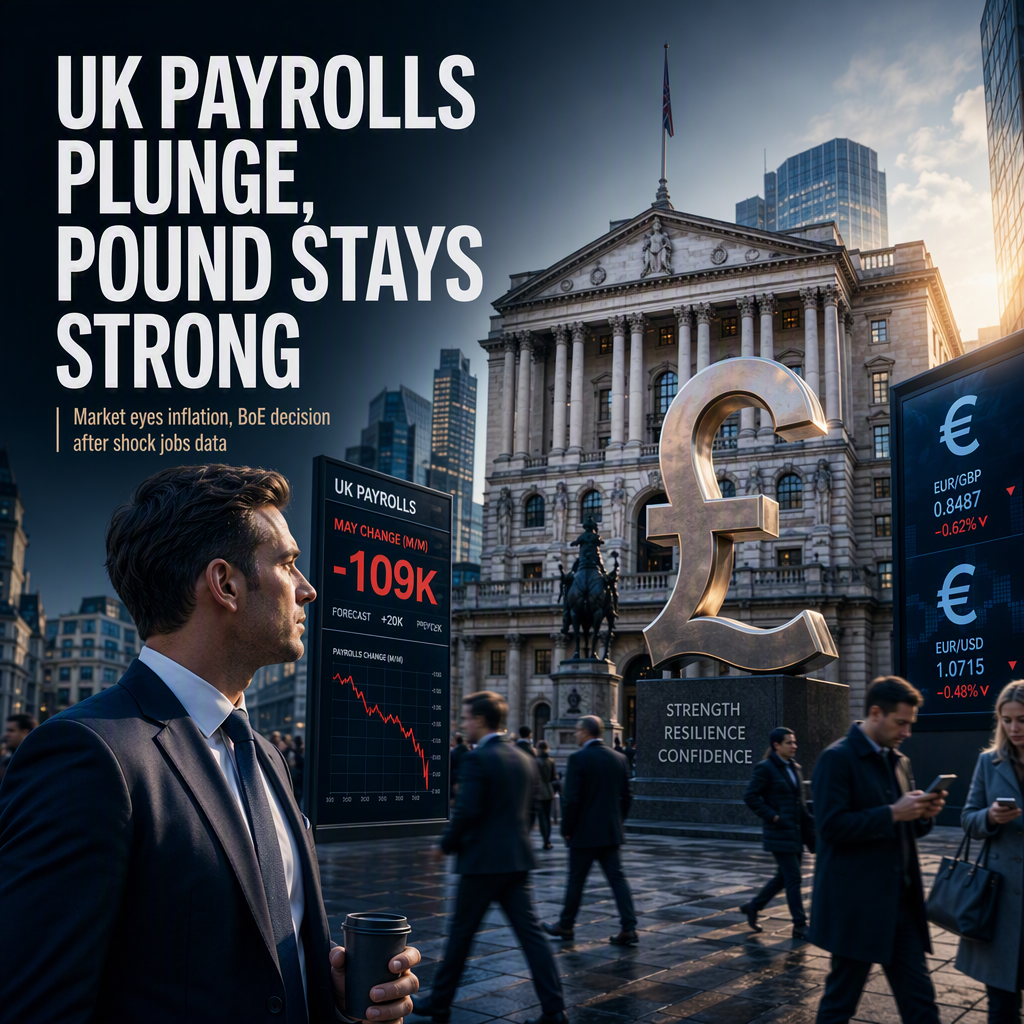
The UK jobs report for September 2026 revealed a notable decline in payrolled employment, with a drop of 26,000 in August—over five times the fall economists expected. This sharp decrease follows a revised July figure showing a 19,000 fall, and payrolls are now down 145,000 from a year ago, sitting at 30.2 million [1]. Despite these weak employment numbers, the unemployment rate held steady at 4.9% for the three months to July, beating the 5.0% forecast but still up from 4.7% a year earlier [1]. Vacancies also fell to 702,000 in the three months to August, marking the lowest level since 2021, while the claimant count rose to 1.692 million in August, up both month-on-month and year-on-year [1]. Regular pay grew 3.5% year-over-year, matching forecasts but close to its slowest pace since 2020 [1].
In the currency markets, the Pound has remained resilient despite the soft jobs report, holding firm against the Euro. EUR/GBP trades in the mid-0.8500s, specifically at 0.8558, unable to reclaim the 0.8600 barrier. The Euro has struggled even after the European Central Bank raised its three key rates by 25 basis points on September 10, lifting the deposit rate to 2.50% [2]. The wider draw for Sterling is attributed to the rate gap, and the upcoming UK inflation report on Wednesday is seen as a crucial test. Headline annual inflation is expected to edge up to 3.1% from 2.9%, with services prices remaining elevated. A reading at or above forecast could reinforce the Bank of England's hawkish minority and support the Pound further, potentially pressing EUR/GBP toward the lower end of its range [2].
Technical analysis indicates a bearish near-term tone for EUR/GBP, as it trades below both the 20-period and 100-period Simple Moving Averages at 0.8572 and 0.8575, respectively. The Relative Strength Index is slipping toward 35, hinting at persistent downside pressure. Immediate resistance is noted at 0.8559, with support at 0.8554, suggesting rallies are likely to meet supply and a break below support could extend the corrective phase [2].
Looking ahead, the Bank of England is set to deliver its rate decision on Thursday, with markets widely expecting rates to remain unchanged. The vote split and guidance will be more significant than the decision itself, especially as UK inflation data due Wednesday is likely to shape the outcome [1][2].
CONCLUSION
Despite a sharp drop in UK payrolls and rising claimant counts, the Pound has held firm against the Euro, supported by the rate gap and anticipation of upcoming inflation data. Market attention now turns to Wednesday's UK inflation report and Thursday's Bank of England rate decision, both of which are expected to influence Sterling's direction and broader market sentiment.