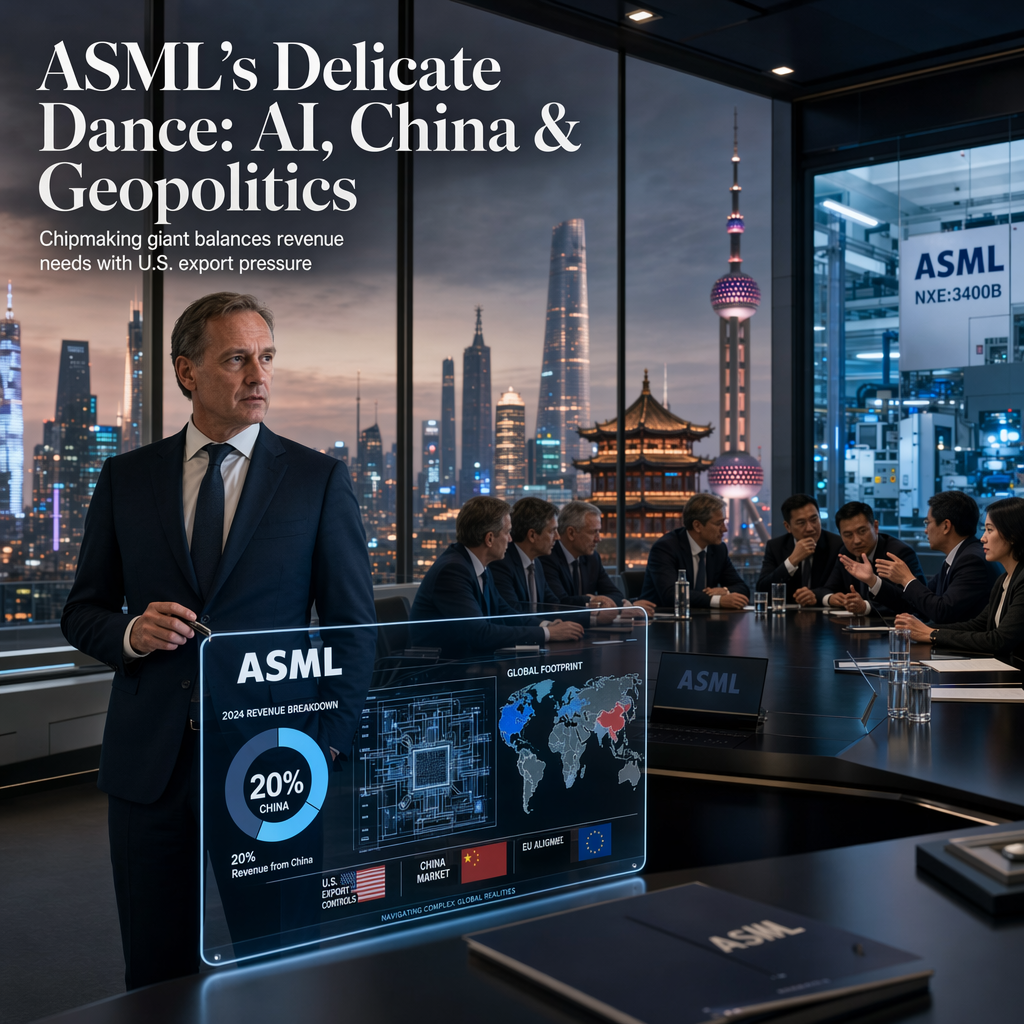
ASML, Europe's most valuable company, is facing increasing geopolitical pressure as the U.S.-China feud over artificial intelligence intensifies, prompting new calls for stricter export controls on chipmaking hardware sales to Beijing [1]. Despite these headwinds, ASML's Chief Financial Officer Roger Dassen stated that China will contribute around 20% of the company's net sales across the whole of 2026, a notable decrease from previous years but still a significant portion of revenue [1]. In the first six months of 2026, sales in China reached 2.9 billion euros ($3.3 billion), accounting for roughly 16% of total revenue, with projections indicating an increase in the second half of the year [1].
ASML does not ship its most advanced extreme ultraviolet lithography (EUV) machines to China due to longstanding export restrictions, but continues to sell less advanced deep ultraviolet (DUV) lithography machines, which are in high demand [1]. The company's CFO highlighted that the extra demand in China is primarily in the Logic business, catering to domestic-led demand [1].
On the financial front, ASML raised its guidance for the second time this year and reported stronger-than-expected quarterly results as customers ramp up production of AI chips [1]. Despite these positive earnings, the company's stock remained largely flat, a trend observed among AI firms this year [1].
Analyst Neil Shah, VP research at Counterpoint, emphasized that ASML is performing a delicate balancing act, trying to satisfy both Western governments and shareholders while navigating the complex geopolitical landscape between Beijing and Washington [1].
CONCLUSION
ASML continues to rely on China for a significant share of its revenue, even as U.S. political pressure mounts for stricter export controls. The company's strong financial performance and raised guidance underscore robust demand, but ongoing geopolitical tensions present challenges for future growth in the Chinese market.