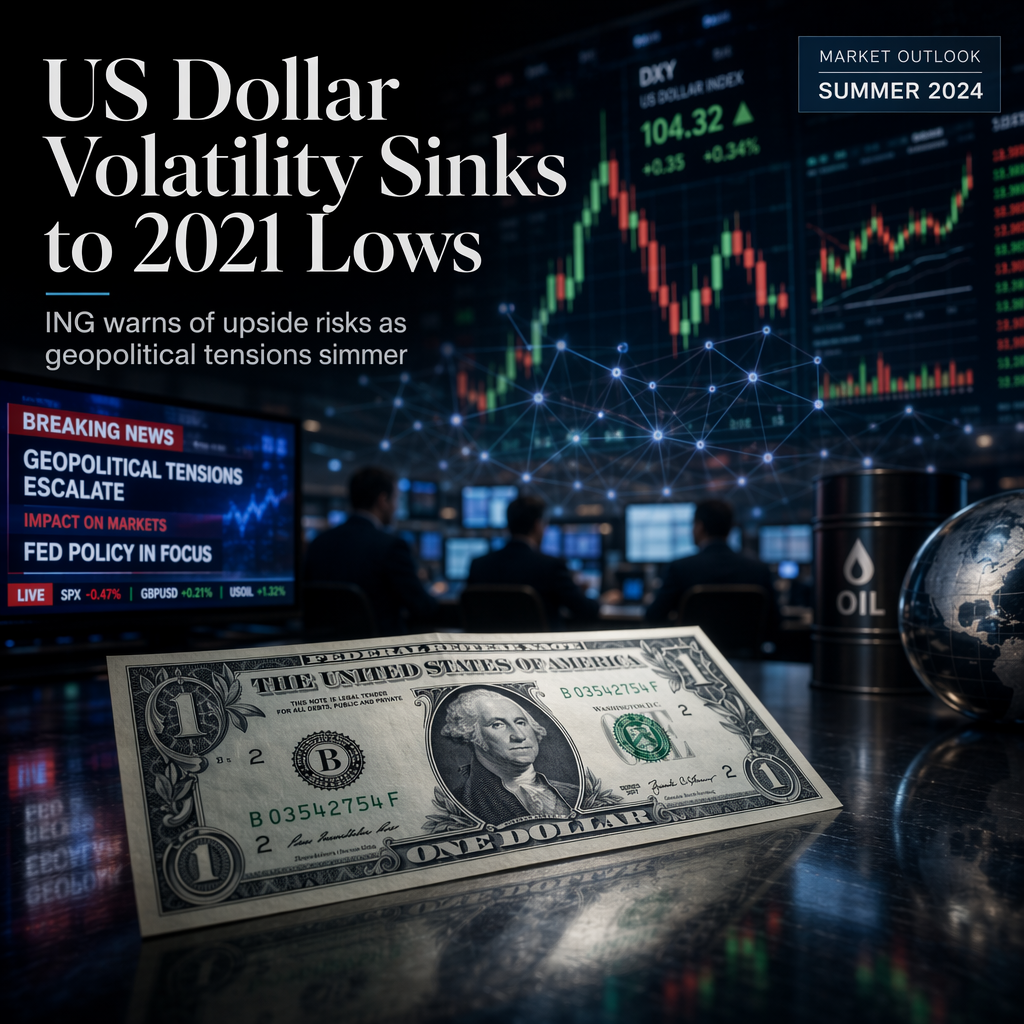
ING strategists Francesco Pesole and Frantisek Taborsky report that DXY-weighted one-month implied volatility has dropped below the 5.50 level, reaching its lowest point since 2021, excluding the Christmas 2025 dip, despite ongoing geopolitical tensions and risks related to the Federal Reserve [1]. This decline in volatility is notable given the recent military re-escalation between the US and Iran and the potential for a new Federal Reserve tightening cycle [1]. Pesole attributes the subdued volatility to AI-driven equity resilience, which is anchoring currencies and supporting carry trades, creating a self-reinforcing low-volatility environment [1].
The strategists highlight that risks are now skewed to the upside for both FX volatility and the US dollar. They caution that if oil prices continue to only partially reflect a new supply shock, there is an increased risk of sharp, non-linear rallies in the dollar [1]. However, they also outline a scenario where de-escalation in the Middle East, lower oil prices, and more dovish flexibility at the front end of the USD curve could lead to a weaker dollar after the summer [1].
Despite the current environment being less supportive for USD bears, ING maintains a baseline expectation for a weaker dollar across the board after the summer, contingent on easing geopolitical tensions and declining oil prices [1].
CONCLUSION
ING strategists note that US dollar volatility is at multi-year lows despite significant geopolitical and monetary risks. While near-term risks favor potential dollar gains and higher volatility, the baseline expectation is for a weaker dollar after the summer if tensions ease and oil prices fall.