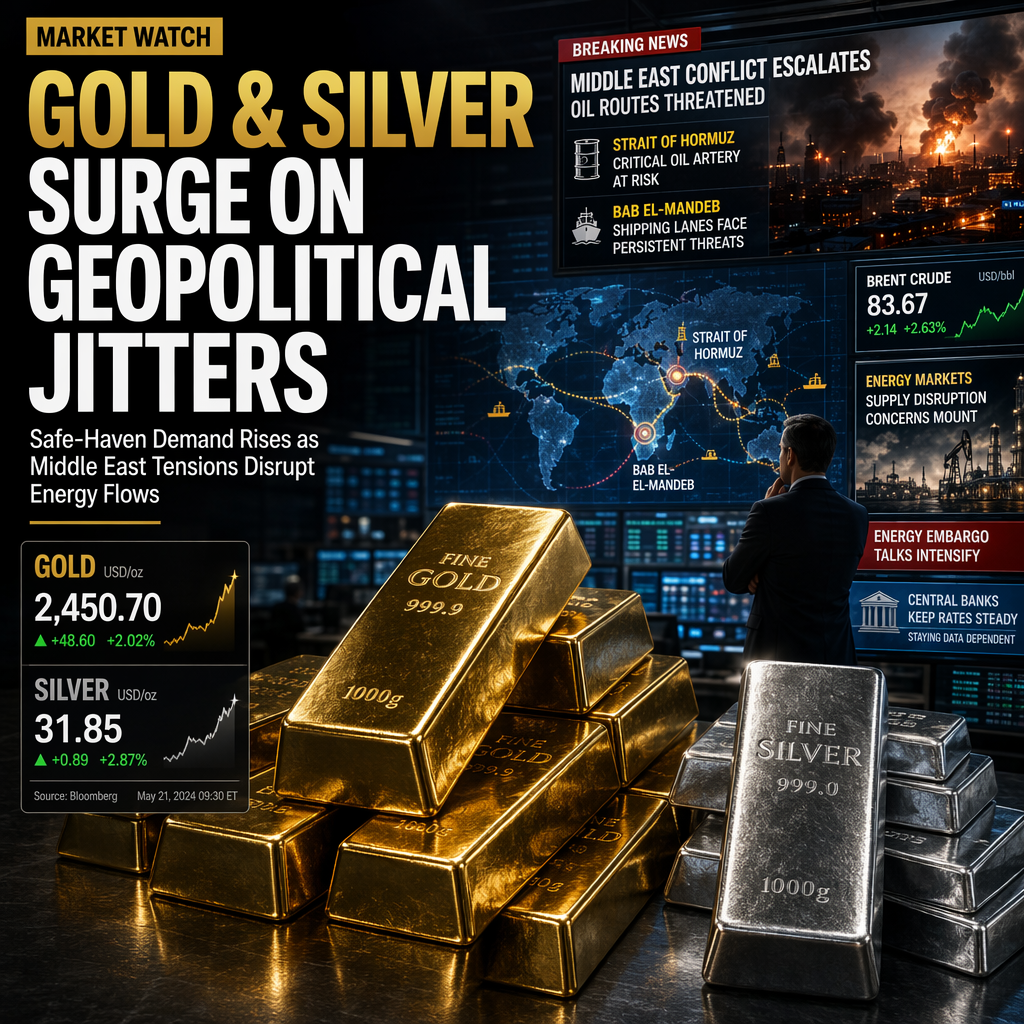
Gold (XAU/USD) surged to a two-week high on Wednesday, trading around $4,122 and up 1.10% on the day, as traders responded to escalating geopolitical risks in the Middle East and uncertainty over the Federal Reserve's monetary policy outlook [1]. Similarly, Silver (XAG/USD) edged higher to $59.35, gaining 0.94% on the day, with safe-haven demand offsetting the negative impact of rising inflation expectations [2].
The United States conducted its eleventh consecutive night of strikes on Iran, prompting retaliatory attacks from Tehran targeting Bahrain, Kuwait, and Jordan, which disrupted energy supplies through the Strait of Hormuz and pushed West Texas Intermediate (WTI) oil prices to $86.50–$86.60, their highest levels since June 11 [1][2]. Additionally, the closure of the Bab el-Mandeb Strait and a maritime embargo announced by Yemen's Iran-backed Houthi movement against Saudi Arabia further intensified concerns over global energy shipments [2].
Rising energy prices have heightened inflation concerns, supporting expectations that the Federal Reserve and other major central banks may keep interest rates higher for longer or even consider further hikes [1][2]. According to the CME FedWatch Tool, the probability of a July Fed rate hike increased to 28% from 10% a week ago, while the odds for a September hike stand at 69% [1]. Higher borrowing costs and a firm US Dollar typically reduce the appeal of non-yielding assets like Gold and Silver, but ongoing geopolitical uncertainty has sustained investor interest in these traditional safe havens [1][2].
Technical analysis for Gold indicates that XAU/USD remains below the 200-day and 100-day Simple Moving Averages (SMA) at $4,496 and $4,501, respectively, but is supported by the 21-day SMA at $4,065. The Relative Strength Index (RSI) is neutral at 49, and the MACD indicator is slightly positive, suggesting improving but still limited momentum [1]. For Silver, market participants are closely watching Thursday's European Central Bank (ECB) monetary policy decision, with attention on President Christine Lagarde's comments for insights into the inflation outlook and future policy direction [2].
US Secretary of State Marco Rubio stated that Washington would work to reduce Iran’s ability to target shipping and warned that a nuclear-armed Iran was intolerable [1].
CONCLUSION
Gold and Silver prices have risen as investors seek safe havens amid escalating Middle East tensions and energy supply disruptions, despite the headwind from rising inflation and expectations of prolonged restrictive monetary policy. The market remains focused on geopolitical developments and upcoming central bank decisions, which are likely to influence the near-term direction of precious metals.