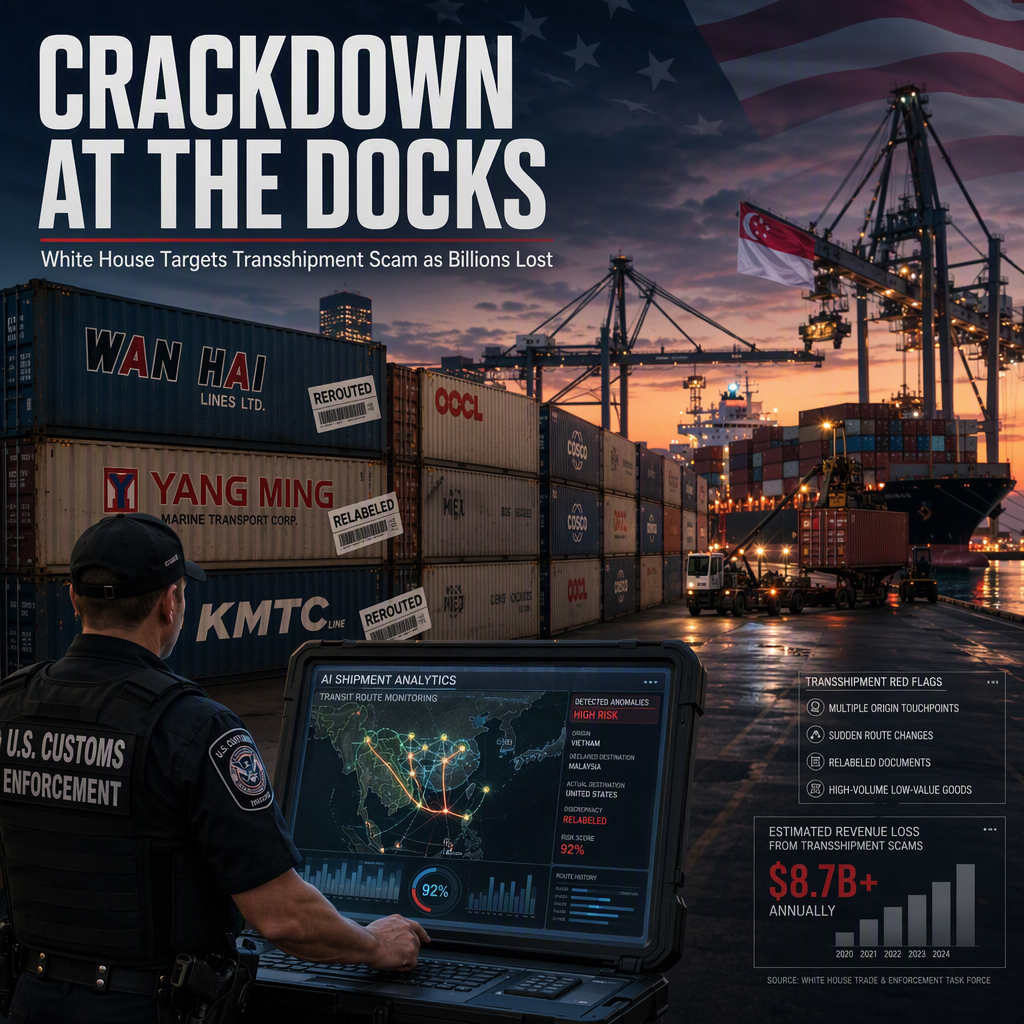
The White House has released a report alleging that the United States loses tens of billions of dollars in annual revenue and hundreds of thousands of jobs due to illegal transshipment practices, primarily involving Chinese goods rerouted through Southeast Asia and other markets to evade U.S. tariffs and trade restrictions [1]. The report specifically accuses trade partners in Southeast and Northeast Asia of facilitating the so-called 'Great Transshipment Scam,' with Vietnam, Malaysia, and Thailand identified as key hubs for these activities [1]. Shipping containers at the Port of Long Beach in California have become a focal point in the crackdown, as the U.S. customs enforcement teams increasingly deploy artificial intelligence and advanced data analytics to detect suspicious shipment patterns [1].
A senior administration official stated, 'We are aware of widespread efforts to circumvent U.S. tariffs through illicit transshipment, particularly by Chinese exporters working with networks across Southeast Asia,' emphasizing the government's commitment to enhancing enforcement and collaborating with trade partners to address the issue [1]. The report notes a sharp increase in exports from Vietnam, Malaysia, and Thailand to the U.S. following the imposition of tariffs on Chinese products, suggesting that much of this growth is attributable to rerouted goods [1].
Industry analysts cited in the report warn that the crackdown on illegal transshipment could have significant implications for global supply chains, potentially prompting companies to further diversify their manufacturing and logistics operations [1]. The White House underscores its commitment to toughening enforcement, protecting domestic industries, and safeguarding American jobs from unfair trade practices [1].
CONCLUSION
The White House's report highlights the substantial economic impact of illegal transshipment, with billions in lost revenue and jobs attributed to Chinese goods rerouted through Southeast Asia. The administration's increased use of AI and data analytics signals a high-impact crackdown that may reshape global supply chains. Market participants should anticipate heightened enforcement and potential shifts in manufacturing and logistics strategies.