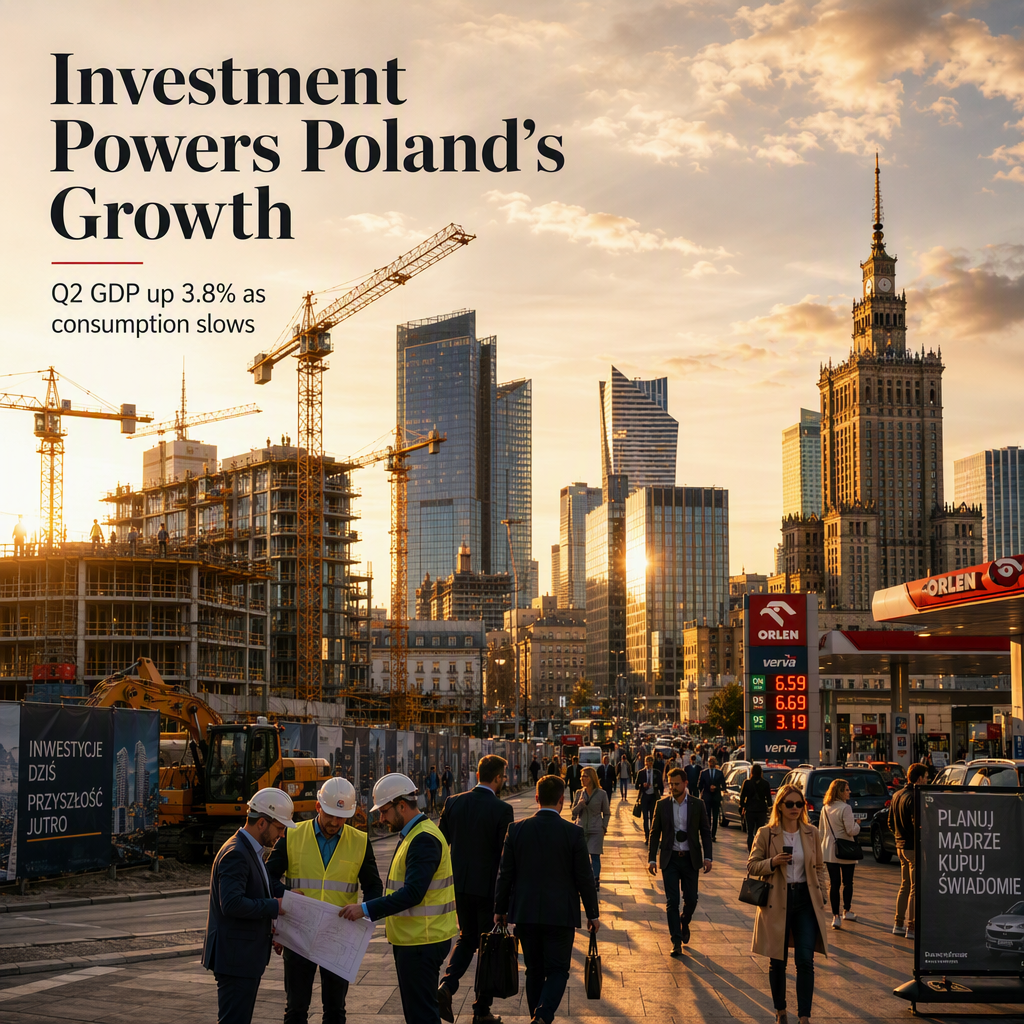
Poland's economic growth in the second quarter of 2026 is expected to be confirmed at 3.8% year-on-year, according to ING's Adam Antoniak. This growth is primarily attributed to a strong rebound in fixed investment, which rose by 8.5% year-on-year, a significant increase from the 2.4% year-on-year growth seen in the previous quarter. The surge in investment is largely driven by projects funded through the European Union and the Recovery and Resilience Facility (RRF), with data from large companies in the first half of 2026 indicating robust investment activity during the second quarter [1].
In contrast, private consumption growth is estimated to have slowed to 3.0% year-on-year from 3.3% in the first quarter of 2026. This deceleration is attributed to higher fuel prices and a further slowdown in wage growth, both of which have put pressure on household purchasing power [1].
On the inflation front, the August Consumer Price Index (CPI) is projected to have edged up to 3.1% year-on-year from 3.0% in July. Core inflation is estimated to have remained stable at 3.1% year-on-year. The slight increase in headline inflation is believed to be almost entirely offset by deeper food deflation, which counteracted the upward pressure from fuel prices [1].
Statistics Poland is set to confirm the flash estimate of Q2 2026 GDP on August 31, along with a detailed breakdown of economic growth components [1].
CONCLUSION
Poland's Q2 2026 economic performance is characterized by strong investment-led growth, offsetting softer private consumption due to higher fuel costs and weaker wage growth. Inflation remains contained, with core CPI stable and food deflation mitigating price pressures. The market outlook appears cautiously positive, supported by robust investment activity.