
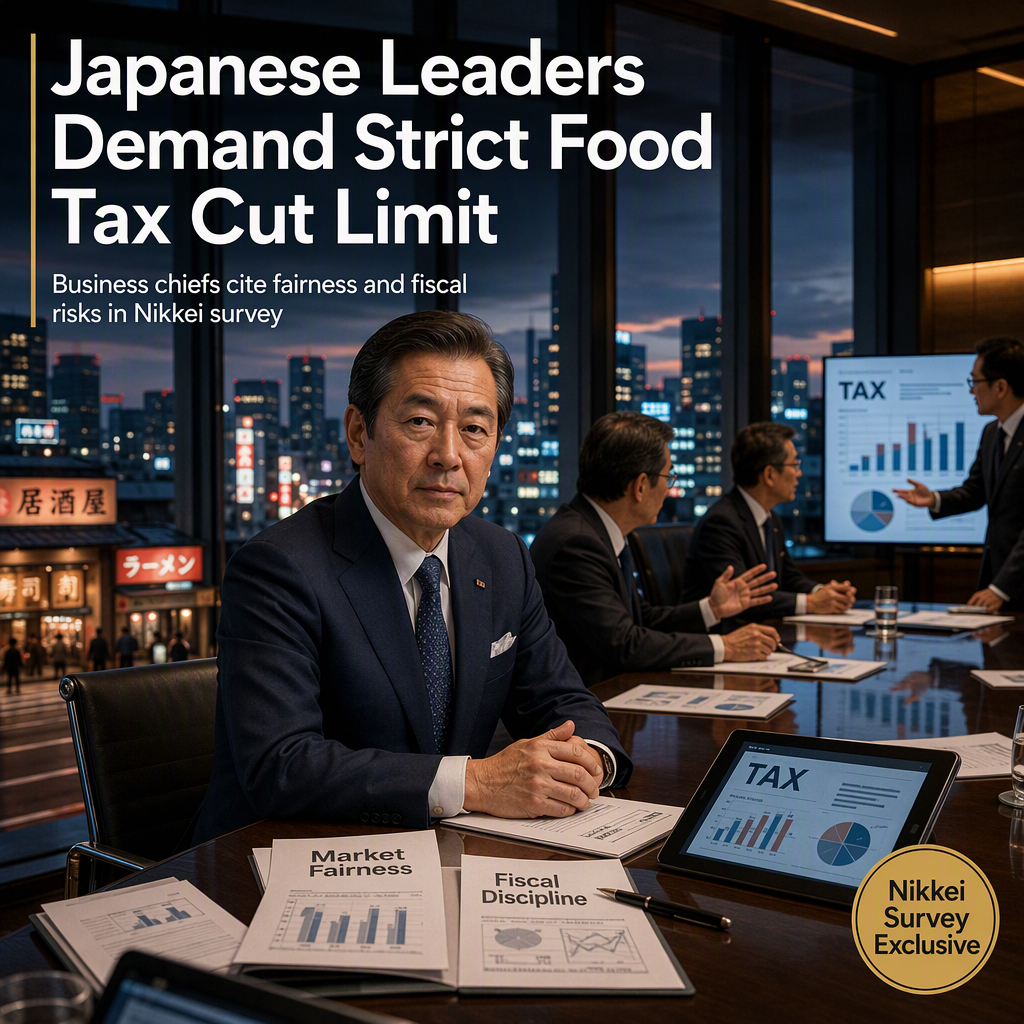
A recent Nikkei survey reveals that nearly three quarters of Japanese business leaders support a strict two-year limit on the government's planned consumption tax cut for food items, citing concerns about competition and fiscal discipline [1]. Executives expressed apprehension that extending the tax cut beyond the proposed period could disrupt market dynamics, potentially benefitting certain industries while adversely affecting others, such as restaurants, which are not included in the tax reduction [1].
The survey underscores worries within the business community about the risk of undermining competitive balance and threatening fiscal discipline if the tax cut is prolonged [1]. Respondents stressed the necessity of maintaining a well-defined policy framework to prevent unintended consequences, particularly for sectors excluded from the tax cut, with the restaurant industry highlighted as a potential casualty [1].
No specific financial data, trading advice, or technical analysis was provided in the article [1].
CONCLUSION
Japanese business leaders are largely in favor of a strict two-year limit on the food consumption tax cut, emphasizing the need to preserve market fairness and fiscal discipline. The survey indicates concerns about potential negative impacts on sectors not covered by the tax cut, especially restaurants. Market participants should monitor government policy developments, as any extension of the tax cut could have broader implications for industry competition and fiscal stability.