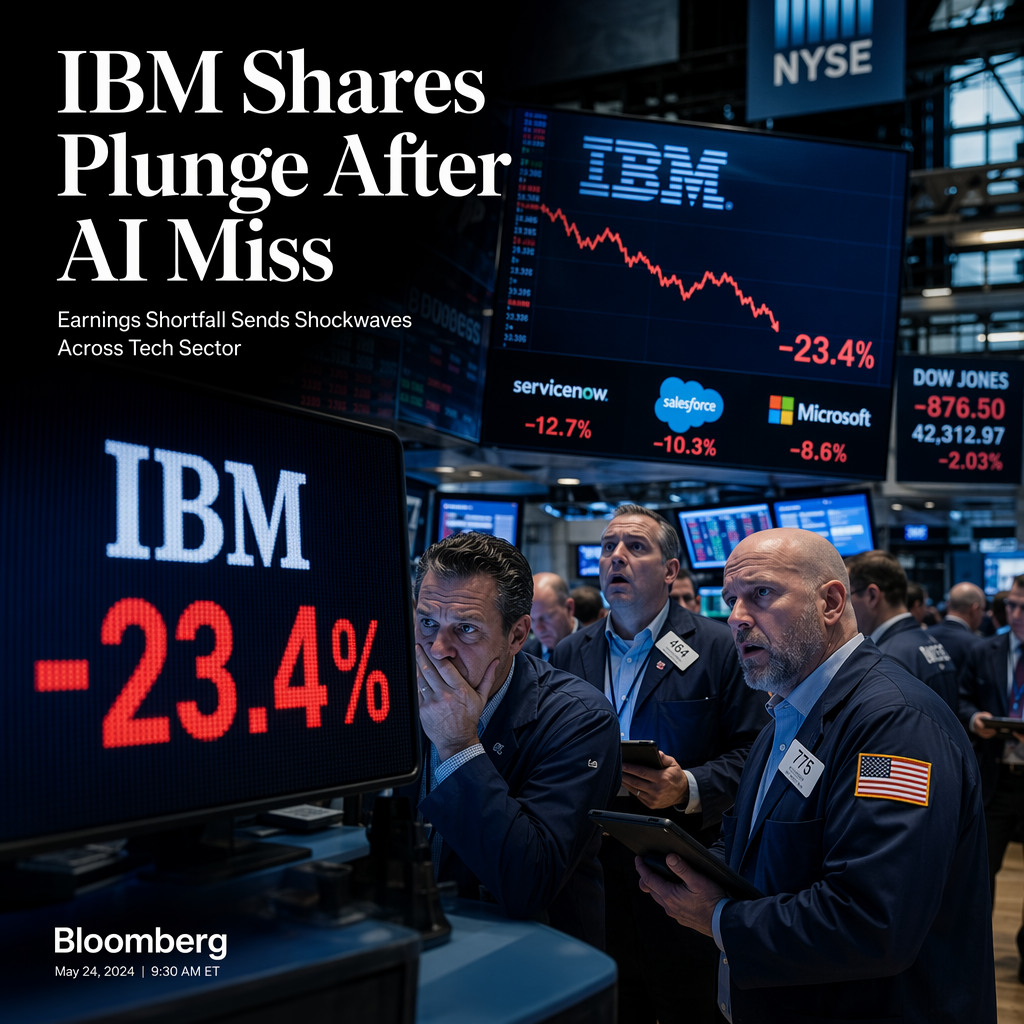
IBM shares fell more than 23% at market open on Tuesday, marking what is described as the worst day for the company in decades, after its second-quarter earnings results missed analysts' profit and revenue forecasts [1]. IBM reported adjusted earnings of $2.93 per share on $17.2 billion in revenue, falling short of Wall Street estimates of $3.01 per share and $17.86 billion in revenue, as reported by CNBC [1].
CEO Arvind Krishna attributed the shortfall primarily to weaker-than-expected performance in IBM's Z mainframe business and its associated software stack, particularly in Transaction Processing. Krishna noted that, despite the z17 mainframe being positioned as a leader in real-time fraud detection with embedded AI, the Infrastructure revenue decline was worse than anticipated [1]. He explained that, in the last weeks of June, clients shifted their capital expenditures toward servers, storage, and memory to secure supply-constrained infrastructure ahead of expected price increases, which significantly impacted IBM's results [1].
The negative surprise from IBM's earnings and AI warning sent a 'shock wave' through the technology sector, with notable declines in software stocks such as ServiceNow, Salesforce, and Microsoft, according to FOX Business host Maria Bartiromo [1]. The report highlights that IBM's performance was the biggest drag on the Dow Industrials that morning, underscoring the broader market impact [1].
No forward-looking statements or analyst opinions beyond the CEO's commentary on client spending patterns and supply chain dynamics were provided in the article [1].
CONCLUSION
IBM's significant earnings miss and AI-related warning triggered a sharp selloff in its shares and negatively impacted the broader tech sector. The results highlight concerns about near-term returns from AI investments and shifting client spending priorities, leading to heightened market volatility.