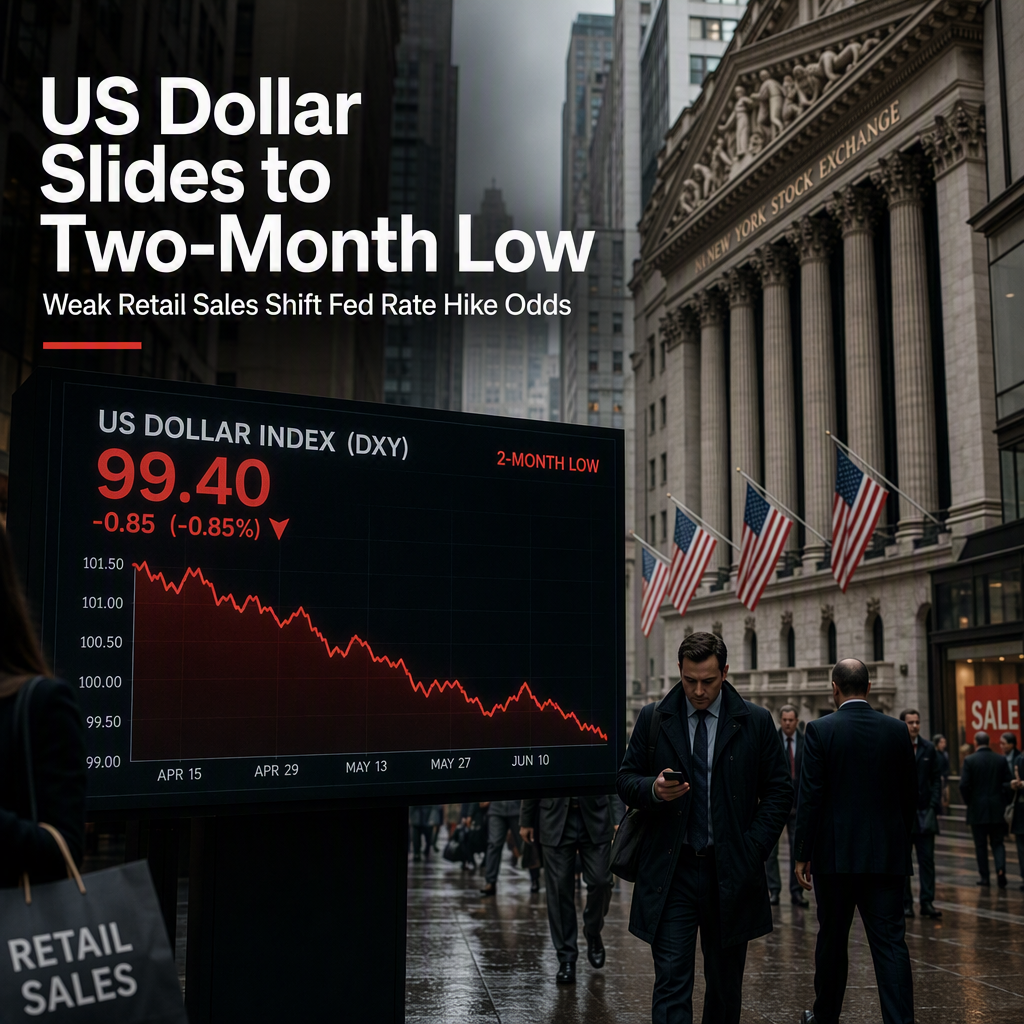
The US Dollar Index (DXY) extended its decline for a third consecutive day on Monday, falling below 99.40 to test two-month lows during the European session [1]. This downward move was driven by weaker-than-expected US economic data, particularly July Retail Sales, which contracted by 0.6% month-over-month, missing market expectations for a 0.1% gain and reversing June's 0.2% increase [1][2]. On an annual basis, Retail Sales rose 5.0% in July, a slowdown from the previous month's 6.8% expansion [2].
The disappointing data has led investors to reassess the likelihood of near-term interest rate hikes by the US Federal Reserve. According to the CME Group's FedWatch Tool, the probability of a September rate hike has dropped to around 30%, down from over 50% a week ago [1][2]. This shift in expectations has contributed to the broad-based weakness in the US Dollar, with strategists at Brown Brothers Harriman noting that the decline was triggered by the downward adjustment to Fed funds rate expectations, though they observed no fresh catalyst behind Monday's slump [1]. Technical analysis shows the DXY trading near its 200-day simple moving average at 99.15, with momentum indicators pointing lower and key support levels identified at 99.15 and 98.75-98.90 [1].
In equity markets, Dow Jones futures declined by 0.12% to around 53,740, while S&P 500 futures edged higher and Nasdaq 100 futures surged by 0.5% [2]. The mixed performance reflects investor uncertainty amid shifting Fed policy expectations. Fed’s Goolsbee delivered a more dovish message than usual, highlighting "a little bit better" inflation readings and suggesting that recent price pressures may be temporary, though he maintained a cautiously hawkish tone by describing the US economy as "steady" [2]. The FXS Fed Sentiment Index fell 2.36 points to 134.61, indicating a modest pullback in perceived hawkishness, but still signaling restrictive policy expectations [2].
Looking ahead, investors are awaiting earnings reports from major US retailers, including Home Depot, Lowe's, and Walmart, as well as the release of the Federal Reserve’s latest meeting minutes for further guidance on monetary policy [2].
CONCLUSION
Weaker-than-expected US retail sales and easing inflation have led investors to scale back expectations for imminent Fed rate hikes, pushing the US Dollar Index to two-month lows and prompting mixed reactions in equity futures. While the Fed maintains a cautious stance, the market is now focused on upcoming retail earnings and Fed minutes for additional policy signals.