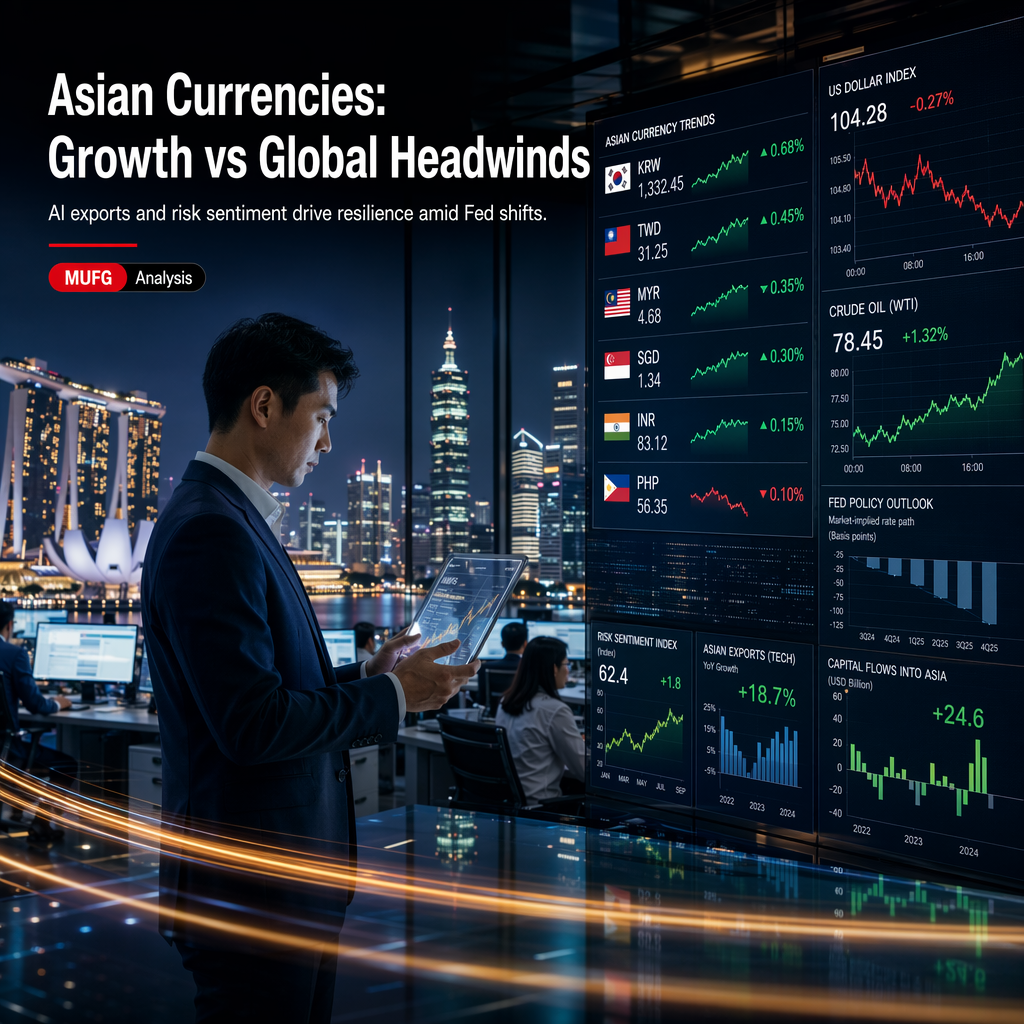
According to MUFG’s Michael Wan, Asian currencies are currently experiencing a tug of war between the positive effects of stronger regional growth differentials versus the US and the headwinds from a stronger US Dollar, persistent US yields, and evolving Federal Reserve policy under Chair Kevin Warsh [1]. Wan specifically highlights that economies with significant AI-related exports, such as South Korea, Taiwan, Malaysia, and Singapore, are likely to benefit from these growth differentials [1].
Oil prices have recently risen, which has weighed somewhat on market sentiment; however, the overall level of oil prices remains low enough to continue supporting risk sentiment in the region [1]. The resilience of previously underperforming currencies like the Indian Rupee (INR) and Philippine Peso (PHP) is attributed to lower oil prices, while some underperformance has been observed among low-yielding Asian currencies as market drivers shift towards rate differentials [1].
Wan notes that while yield differentials are important, growth differentials and risk sentiment are equally, if not more, significant in influencing Asian currencies, based on MUFG’s analysis of past Fed rate cycles [1]. He cautions that if the Federal Reserve adopts a materially more hawkish stance, leading to a decline in market risk appetite, this would negatively impact Asian currencies [1]. However, MUFG’s base case anticipates that strong Asian growth and improving risk sentiment should offset the effects of expected Fed policy changes [1].
CONCLUSION
MUFG expects Asian currencies to find support from robust regional growth and improving risk sentiment, particularly in AI-exporting economies, despite ongoing challenges from US monetary policy and oil price fluctuations. The outlook remains cautiously optimistic unless the Federal Reserve turns significantly more hawkish, which could dampen risk appetite and weigh on Asia FX.