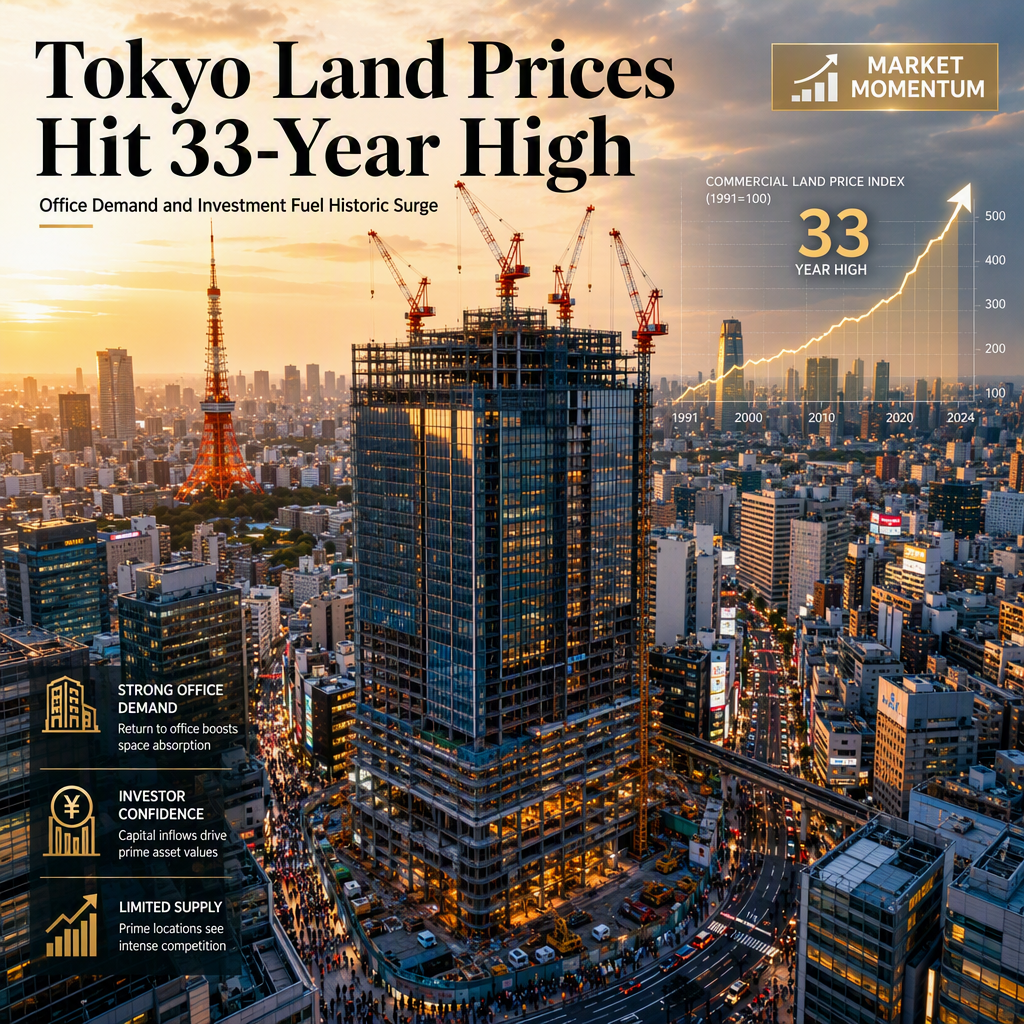
Commercial land prices in Tokyo have reached their highest levels in over three decades, driven by a strong resurgence in demand for office space as remote workers return to company buildings [1]. Office vacancy rates in Tokyo wards are now well below the 5% threshold considered balanced for supply and demand, with the current vacancy rate at 1.5%, the lowest among major global cities [1]. This tight supply has led to a significant increase in both commercial land prices and office rents, marking fresh highs not seen since the early 1990s [1].
The bullish trend is further supported by a surge in tourism and sustained demand for housing, with Japanese life insurers expanding their property investments amid inflation, signaling continued confidence in the sector [1]. Developers, including Hulic and its peers, have recently invested $1.5 billion in a Tokyo office tower deal, highlighting the robust activity in the property market [1].
Tokyo office vacancies have fallen below 2% for the first time since the pandemic, reflecting a notable shift as remote workers return to physical office spaces [1]. Rising interest rates are prompting Japanese banks to reconsider their mortgage strategies, while the government is contemplating changes to condominium sale taxes to curb speculation [1].
Japan's land prices have increased for the fifth consecutive year, propelled by housing and tourism demand [1]. Technical indicators suggest continued momentum, with tight supply and high investor confidence fueling further price growth [1].
CONCLUSION
Tokyo's commercial property market is experiencing a historic surge, with land prices and rents reaching levels not seen in over thirty years. The combination of low vacancy rates, robust demand, and significant investments underscores a bullish outlook for the sector. Market sentiment remains positive, and technical indicators point to sustained momentum as supply stays tight and investor confidence remains high.