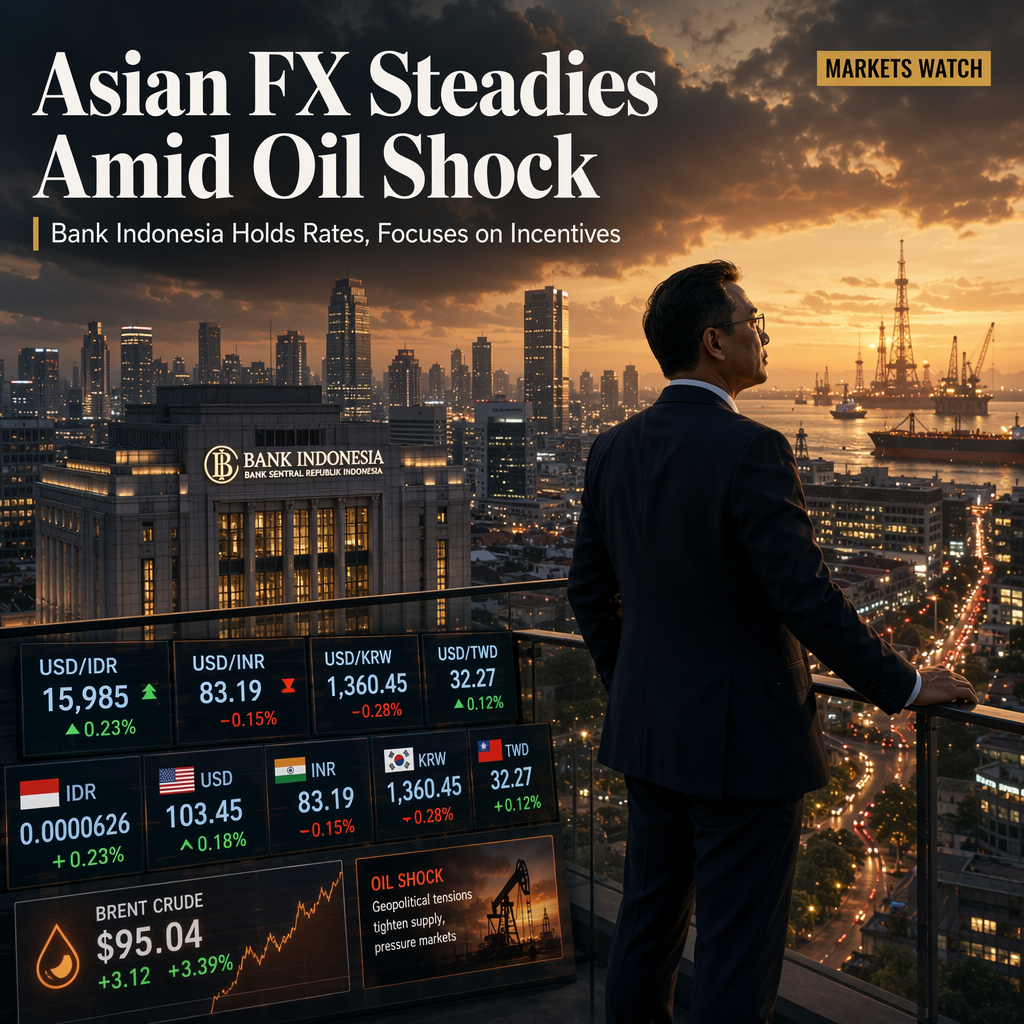
Asian foreign exchange markets are experiencing pressure from higher oil prices, with Brent crude near $95 per barrel posing a shock for energy importers in the region. However, BNY’s Geoff Yu asserts that this is not expected to trigger a broad balance-of-payments crisis, citing stronger current-account buffers in ASEAN and India, prior fiscal consolidation, and lighter FX positioning as key supports. He emphasizes that while the oil spike is significant, the region’s balance-of-payments position remains relatively robust, with ASEAN and India running the highest current-account surpluses in a decade prior to the recent conflict. Yu also notes that vigilance is warranted, recommending close monitoring of central bank intervention and reserve data to detect any signs of deterioration. He highlights that Taiwan and South Korea were already experiencing capital outflows, and a lack of dollar liquidity could exacerbate currency weakness, but overall destabilizing pressure or a financial-stability event is not anticipated at this stage. Bank Indonesia’s recent policy decision is cited as an example of the region’s proactive approach, with the central bank calling for 'closer fiscal-monetary policy synergy' to bolster external resilience, a trend expected to continue in the near term [1].
Focusing on Indonesia, Commerzbank’s Charlie Lay reports that Bank Indonesia (BI) kept its policy rate unchanged at 5.75%, opting for targeted capital-flow incentives rather than further tightening to support the Indonesian Rupiah (IDR). BI reduced hedging costs and enhanced macroprudential liquidity tools, mirroring strategies used by the Reserve Bank of India. The decision followed a period of pressure on the rupiah, which has been affected by higher oil prices and concerns over fiscal discipline and policy credibility. Governor Perry Warjiyo acknowledged that another rate hike was considered, but the board was concerned about the negative impact on domestic borrowing costs and consumption, especially after a cumulative 100bp hike in the past two months. The recent pullback in USD/IDR from above 18,200 to around 17,900 has provided some relief, but Lay warns that the rupiah remains vulnerable and a further 25bp rate hike later this year cannot be ruled out if depreciation pressures return. Risks cited include higher oil prices, renewed safe-haven demand for USD, and ongoing concerns over fiscal management [2].
Both sources agree that while the oil shock is significant for Asian FX, especially for energy importers like Indonesia, the region’s improved external buffers and targeted policy responses are helping to manage the situation. However, continued vigilance and policy flexibility are emphasized as necessary to maintain stability.
CONCLUSION
Asian FX markets are under pressure from higher oil prices, but improved current-account positions and targeted policy measures are supporting resilience. Bank Indonesia’s decision to hold rates and use incentives reflects a cautious but proactive stance. While the immediate risk of a crisis appears low, ongoing monitoring and policy adaptability remain crucial.