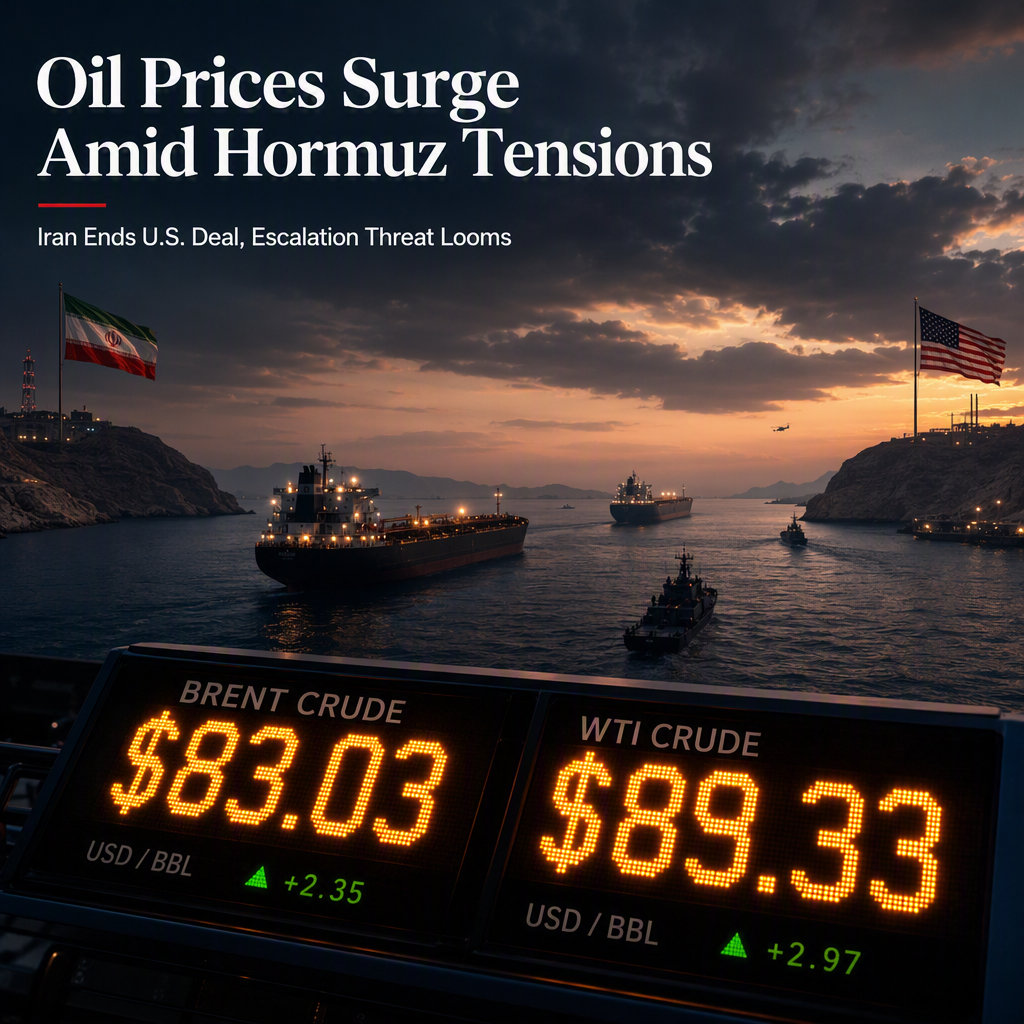
Crude oil prices rose on Monday following Iran's announcement that it would not engage in talks with the United States to extend the memorandum of understanding (MoU) regarding the Strait of Hormuz. The MoU, agreed upon on June 17, was intended to keep the strategic waterway open while both countries negotiated a final agreement on Iran's nuclear program within a 60-day window, which expires Monday [1].
U.S. crude oil futures increased by 0.76% to $83.03 per barrel, while Brent crude, the international benchmark, rose 0.92% to $89.33 per barrel [1]. Iran's Foreign Ministry spokesman, Esmaeil Baqaei, stated that there were no negotiations to extend the MoU, asserting, 'We did not start any negotiations at all, and the U.S. violated the understanding from the very beginning; therefore, the 60-day issue is not relevant,' according to the state news agency Tasnim [1].
A senior Iranian official told Reuters that if diplomacy with the U.S. fails, Tehran would shift to offense rather than relying on defense, signaling a potential escalation in the region [1]. The market responded to these developments with higher oil prices, reflecting concerns over possible disruptions to oil flows through the Strait of Hormuz, a critical chokepoint for global energy supplies [1].
No forward-looking statements or analyst opinions were provided in the source article [1].
CONCLUSION
Oil prices moved higher as Iran ruled out extending the Strait of Hormuz agreement with the U.S. and threatened to escalate if diplomacy fails. The market reaction underscores heightened concerns over regional stability and potential supply disruptions.