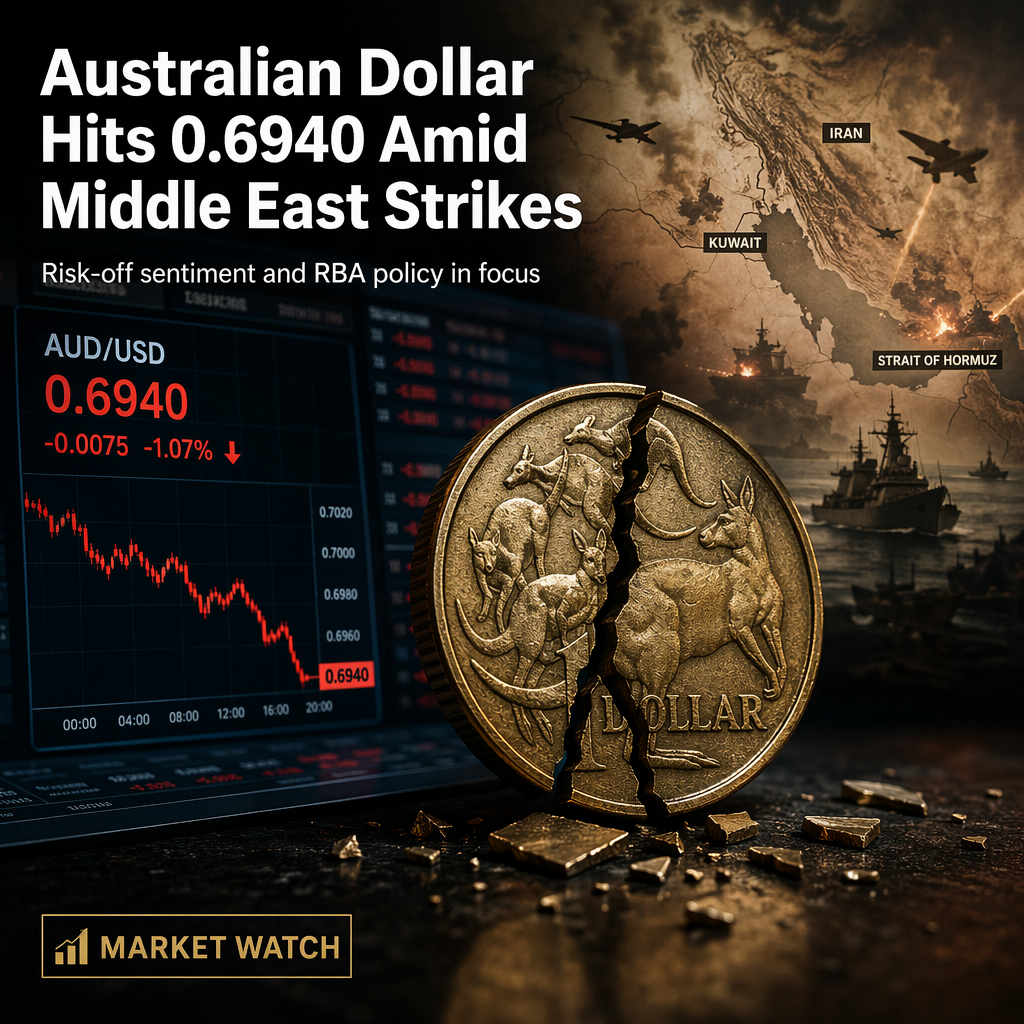
The Australian Dollar (AUD) declined against the US Dollar (USD), with the AUD/USD pair dropping to near 0.6940 during the early Asian session on Monday. This movement was primarily driven by renewed tensions in the Middle East, as the US Central Command (CENTCOM) launched new strikes against Iran on Sunday, targeting the Islamic Republic’s ability to strike civilian vessels in the Strait of Hormuz. In response, Iran’s Islamic Revolutionary Guard Corps (IRGC) retaliated with drone and missile attacks on American allies in the region, including Kuwait, Jordan, and Qatar [1].
The escalation in geopolitical risk weighed on risk-sensitive assets such as the Australian Dollar, as investors shifted towards safer assets. Market participants are also awaiting the release of the US Consumer Price Index (CPI) inflation data, scheduled for Tuesday, which could further influence currency movements [1].
Despite the AUD’s decline, hawkish commentary from the Reserve Bank of Australia (RBA) provided some support. RBA Assistant Governor Sarah Hunter stated last week that the central bank would act as needed to return inflation to its target, warning that further tightening may be required if the oil shock lifts inflation expectations. The RBA has already raised interest rates three times this year by 25 basis points each, bringing the Official Cash Rate (OCR) to 4.35%. However, market expectations for another rate hike at the upcoming August meeting remain low, with ASX 30-day Interbank Cash Rate Futures indicating only a 19% probability of an increase to 4.60% [1].
CONCLUSION
The Australian Dollar weakened amid heightened Middle East tensions and risk-off sentiment, though hawkish signals from the RBA helped limit further losses. Market focus now shifts to upcoming US inflation data and the RBA’s policy outlook, with geopolitical developments continuing to pose downside risks for the AUD.