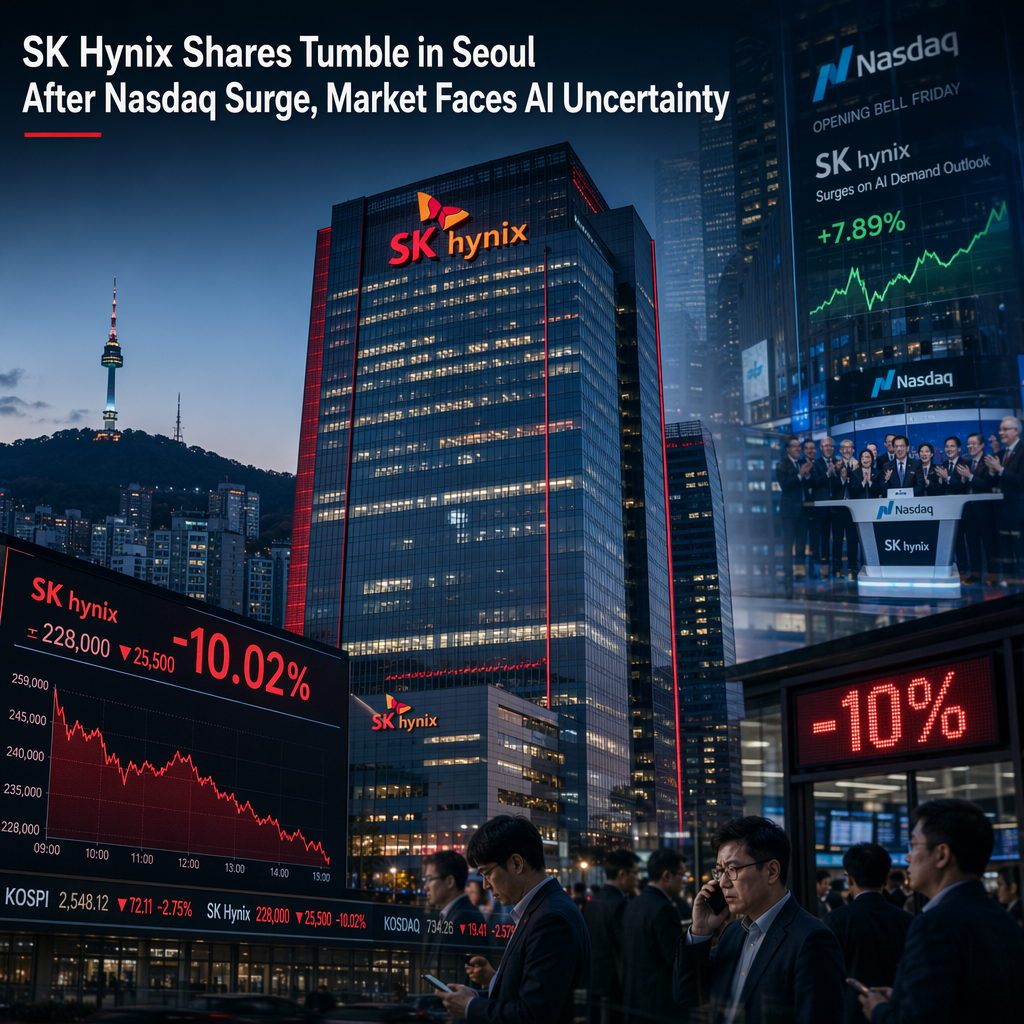
SK Hynix Inc. shares fell over 10% in Seoul on Monday following a stellar Nasdaq debut, where the stock surged 13% on Friday, reflecting strong appetite from U.S. investors for AI-linked semiconductor stocks [1]. The sharp decline in Seoul was attributed to profit-taking and investor uncertainty regarding the valuation of SK Hynix's U.S.-listed shares compared to its Korean stock [1]. Analysts noted that the ADR debut has established a new benchmark for assessing the company's valuation, with a discount rate of more than 20% between its U.S. and Korean listings, in contrast to Taiwan Semiconductor Manufacturing Co.'s ADRs, which trade at a 13% to 14% premium to domestic shares [1].
Daniel Yoo, global strategist at Yuanta Securities, explained that the sell-off was partly due to the mechanics of the offering, which involved additional share issuance and increased the supply of stock available to investors [1]. Yoo described the market reaction as a correctional period for SK Hynix domestically, but emphasized that the pullback is likely temporary, given that structural AI demand continues to outpace supply. He expects shares to move "in the right direction" over the next six to twelve months despite near-term volatility [1].
Phillip Wool, chief research officer at Rayliant Global Advisors, downplayed the recent weakness in Asian AI hardware names, characterizing it as a portfolio rebalancing exercise rather than a sign of deteriorating industry outlook [1]. Wool stated that the selling was driven by prudent risk management, as investors scaled back outsized positions in South Korean and Taiwanese AI chipmakers after strong gains. He added that the excitement about AI hardware remains intact and that the AI investment trend is broadening beyond semiconductors, which should continue to benefit memory suppliers like SK Hynix [1].
CONCLUSION
SK Hynix's sharp drop in Seoul follows a strong Nasdaq debut, with analysts attributing the decline to profit-taking, valuation uncertainty, and increased share supply. Despite near-term volatility, experts remain optimistic about the company's prospects, citing robust structural AI demand and ongoing investor enthusiasm for AI hardware. The market is expected to stabilize as investors adjust their portfolios and reassess valuations.