
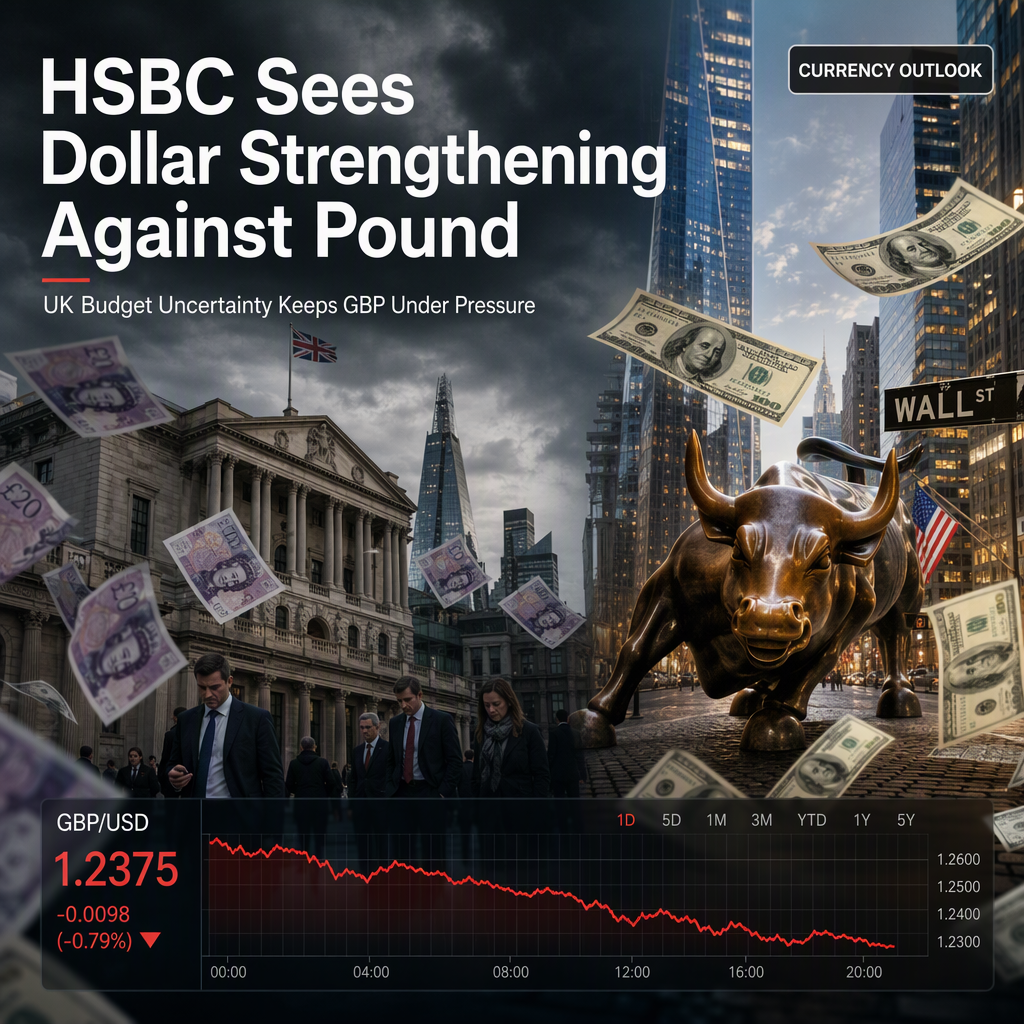
HSBC strategists report that the British Pound (GBP) is under pressure against the US Dollar (USD) due to resilient US economic data, a more hawkish Federal Reserve, and narrowing UK-US interest rate differentials [1]. The GBP/USD exchange rate has fallen this month to its lowest level since June, with the US side of the equation being the primary driver [1]. HSBC Economics expects UK growth to slow, and the Bank of England is described as cautious ahead of its meeting on 5 November [1].
The market reaction to UK Prime Minister Andy Burnham’s keynote speech at the Labour Party conference on 29 September was muted, as the speech outlined a broad vision for the economy but lacked detail on economic growth or fiscal strategy ahead of the 28 October Budget [1]. Investors remain focused on cyclical drivers, including US data and Federal Reserve policy, rather than domestic UK political developments [1].
Markets are currently pricing in around 21 basis points of tightening for November, but this expectation is heavily dependent on developments in energy markets and the Middle East [1]. HSBC analysts suggest that for GBP/USD to find greater domestic support, the upcoming UK Budget would need to deliver a positive surprise, particularly in terms of productivity, regional investment, and growth potential [1].
Until there is clarity on how the UK government will manage public debt and encourage private sector expansion, GBP/USD is expected to remain influenced by cyclical factors, with the US Dollar likely to strengthen gradually against the Pound in the near term [1].
CONCLUSION
HSBC anticipates continued pressure on the British Pound due to stronger US economic fundamentals and policy divergence. Unless the upcoming UK Budget provides a significant positive surprise, the Dollar is expected to strengthen further against the Pound. Market sentiment remains cautious, with attention focused on US data, Federal Reserve policy, and energy market developments.