
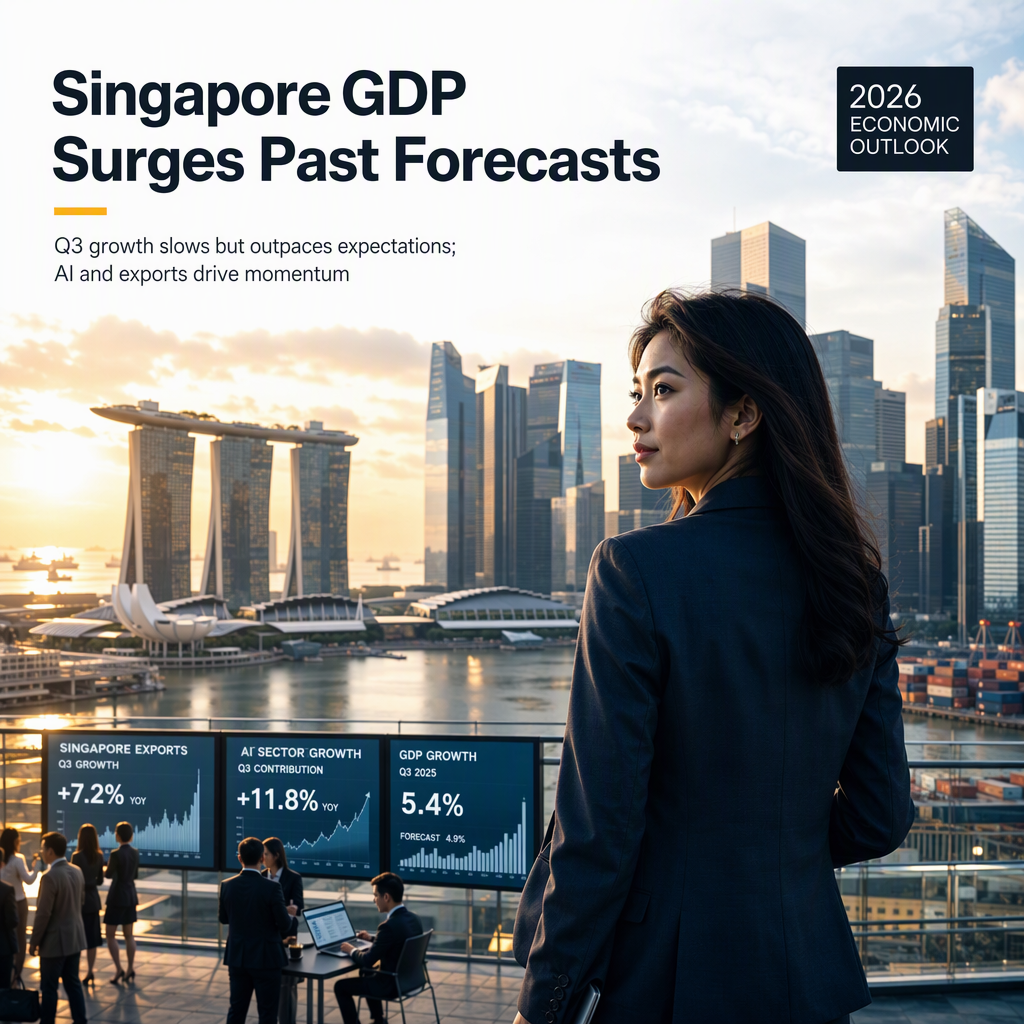
Singapore's economic growth moderated in the third quarter of 2026, with GDP expanding by 5.4%. This marks a slowdown from the previous quarter, which saw a four-year high in growth, but the latest figure still exceeded economists' expectations of 5% as polled by Reuters [1]. The robust performance was attributed to continued strength in AI-related sectors and exports, which had prompted Singapore to raise its annual growth forecast in August. The government now expects full-year GDP growth for 2026 to be between 4.5% and 5.5%, more than double the lower end of its earlier forecast of 2%-4% [1].
This is the second upward revision to Singapore's growth outlook in 2026; at the beginning of the year, the Ministry of Trade and Industry had projected growth at just 1%-3% [1]. The positive momentum in the economy comes as the Monetary Authority of Singapore (MAS) decided to keep its monetary policy unchanged, pausing after two consecutive rounds of tightening in April and July. The earlier tightening moves were implemented in response to inflation risks stemming from higher energy prices [1].
Unlike many central banks, Singapore does not use interest rates to set monetary policy. Instead, it manages the Singapore dollar against a basket of currencies from its major trading partners, allowing the exchange rate to fluctuate within a confidential policy band [1].
No specific market reactions or analyst opinions were cited in the article. However, the maintenance of the upgraded growth forecast and the MAS's decision to pause tightening suggest a cautiously optimistic outlook for Singapore's economy heading into the final quarter of 2026 [1].
CONCLUSION
Singapore's Q3 GDP growth slowed but still outperformed expectations, prompting the government to maintain its upgraded annual forecast. The central bank's decision to pause monetary tightening reflects confidence in the economy's resilience, supported by strong export and AI sector performance.