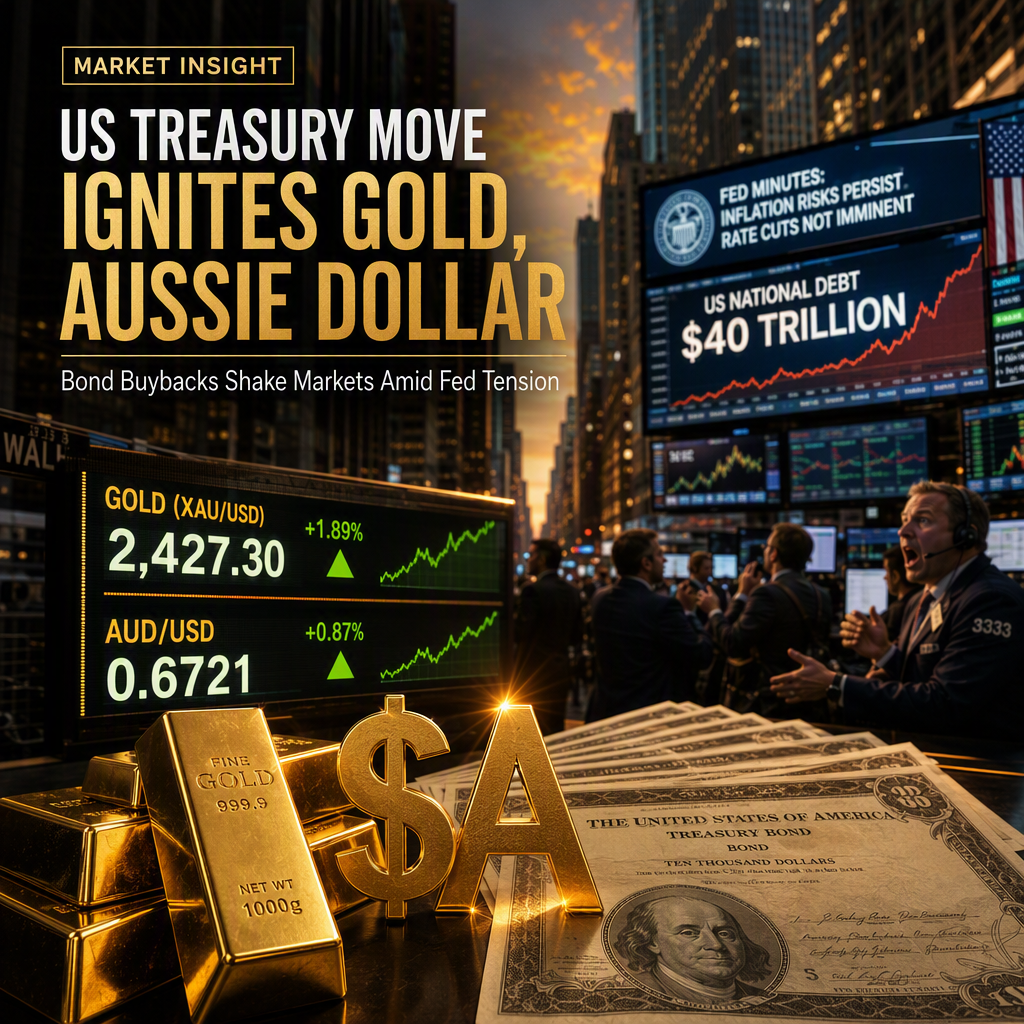
The US Treasury Department announced it will at least double the maximum size of its liquidity-support buyback operations for longer-dated nominal securities, increasing from $2 billion to at least $4 billion per operation, in an effort to curb rising borrowing costs [1][2][3]. This program is scheduled to run from September 9 to November 4 [3]. The Treasury's move comes as US public debt has surpassed $40 trillion for the first time, having surged by a third in less than five years [1].
The announcement triggered notable market reactions. Gold prices (XAU/USD) surged, rising 4.17% on the day to $4,515 according to one report [1], and reaching around $4,520 during the early Asian session, marking the highest level since early June [2]. TD Securities commented that the Treasury's buyback program gave metals a "jolt of life," suggesting gold investment could quickly return amid Treasury liquidity support, a Fed willing to look through an energy shock, and a growing stagflation narrative, which should all ultimately see lower real rates [2]. Technical analysis indicates gold retains a bullish near-term bias, with price holding above key moving averages and approaching resistance at $4,550 [2].
The Australian Dollar (AUD/USD) also advanced, up over 0.56% to 0.7127, as the US Dollar weakened following the Treasury's buyback announcement, despite hawkish Federal Reserve minutes from the July meeting [3]. The Fed's minutes revealed policymakers' concerns about broad-based inflation and a preference for more restrictive policy if inflation does not decline [2][3]. The new Fed Chair, Kevin Warsh, proposed holding six meetings per year, with the 2026 schedule unchanged [3]. Traders are now watching for Warsh's speech at the Jackson Hole Symposium at the end of August, which may outline future interest rate policy [3].
Technical outlook for AUD/USD remains constructive, with price above key support levels and bullish momentum indicated by the Relative Strength Index at 66 [3]. In Australia, employment data is expected to show a deceleration in job losses, with the unemployment rate steady at 4.4% [3]. In the US, upcoming economic releases include Initial Jobless Claims, a speech by St. Louis Fed President Alberto Musalem, and S&P Global Flash PMIs [3].
CONCLUSION
The US Treasury's decision to double long-term bond buybacks has significantly impacted financial markets, boosting gold prices and the Australian Dollar as investors anticipate lower real rates and increased liquidity. Despite hawkish signals from the Federal Reserve, market participants are focusing on Treasury support and stagflation concerns, driving safe-haven flows. Forward-looking attention is now on upcoming Fed communications and economic data releases.