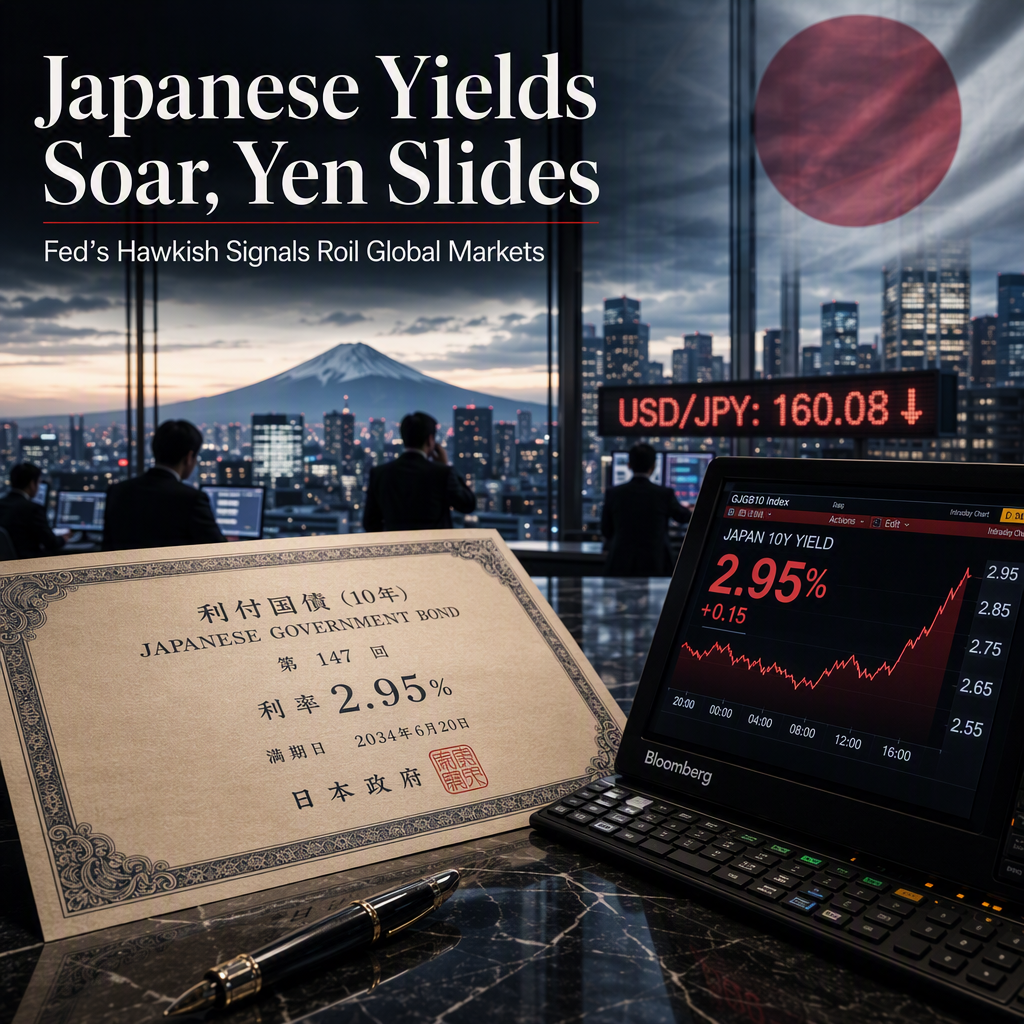
Yields on the benchmark Japanese government bond surged to 2.95% on Monday, reaching their highest level in three decades, as the yen weakened past 160 per dollar for the first time since the joint intervention, following hawkish signals from U.S. Federal Reserve Chair Kevin Warsh at the Jackson Hole Economic Symposium on August 28, 2026 [1]. Warsh's remarks left the door open for further U.S. interest rate hikes if above-target inflation persists, which contributed to global market volatility and heightened expectations for tighter monetary policy both in the U.S. and Japan [1][2].
Market participants interpreted Warsh's speech as unexpectedly hawkish, with Deutsche Bank maintaining its forecast for a total of 50 basis points in Fed rate hikes this year, expecting increases at the September and December FOMC meetings [2]. Traders of fed funds futures now see a 60.4% chance of a quarter-point hike in September, up from around 56% on Friday, according to the CME's FedWatch tool [2]. Analysts from UOB and Nomura highlighted Warsh's emphasis on inflation risks and the importance of the 2% inflation target, suggesting a high sensitivity to near-term inflation data and reinforcing the risk of further policy tightening [2].
The yen's depreciation was driven by expectations that U.S. interest rates may remain elevated, while the Bank of Japan remains cautious about hiking its own rates. BOJ Deputy Governor Himino addressed inflation risks but did not provide a clear signal regarding a rate hike, leaving markets uncertain about the central bank's next steps [1]. Japan recently disclosed a $96 billion yen-buying intervention in July-August to stem the currency's weakness, but market participants remain divided on the effectiveness of such interventions [1]. Technical analysis indicates strong resistance for the yen at the 160 level against the dollar, with support near 158, and trading sentiment remains cautious as investors monitor global central bank signals and upcoming policy meetings [1].
Warsh's speech also had broader market implications, with gold prices falling and Asian stocks declining on Monday [2]. Some analysts, such as Matthew J. Maley of Miller Tabak + Co., expressed skepticism about the need for a rate hike, citing weak labor market data and better-than-expected inflation data since the last FOMC meeting [2]. Warsh's emphasis on the Fed's independence and commitment to the 2% inflation target was seen as reassuring markets that monetary policy would not be swayed by fiscal pressures [2].
CONCLUSION
The combination of hawkish signals from Fed Chair Warsh and ongoing caution from the Bank of Japan has driven Japanese bond yields to a 30-year high and weakened the yen, reflecting heightened global monetary policy uncertainty. Market participants are closely watching upcoming central bank meetings and inflation data for further direction, with expectations for U.S. rate hikes now significantly elevated. The effectiveness of Japan's currency interventions remains in question as volatility persists.