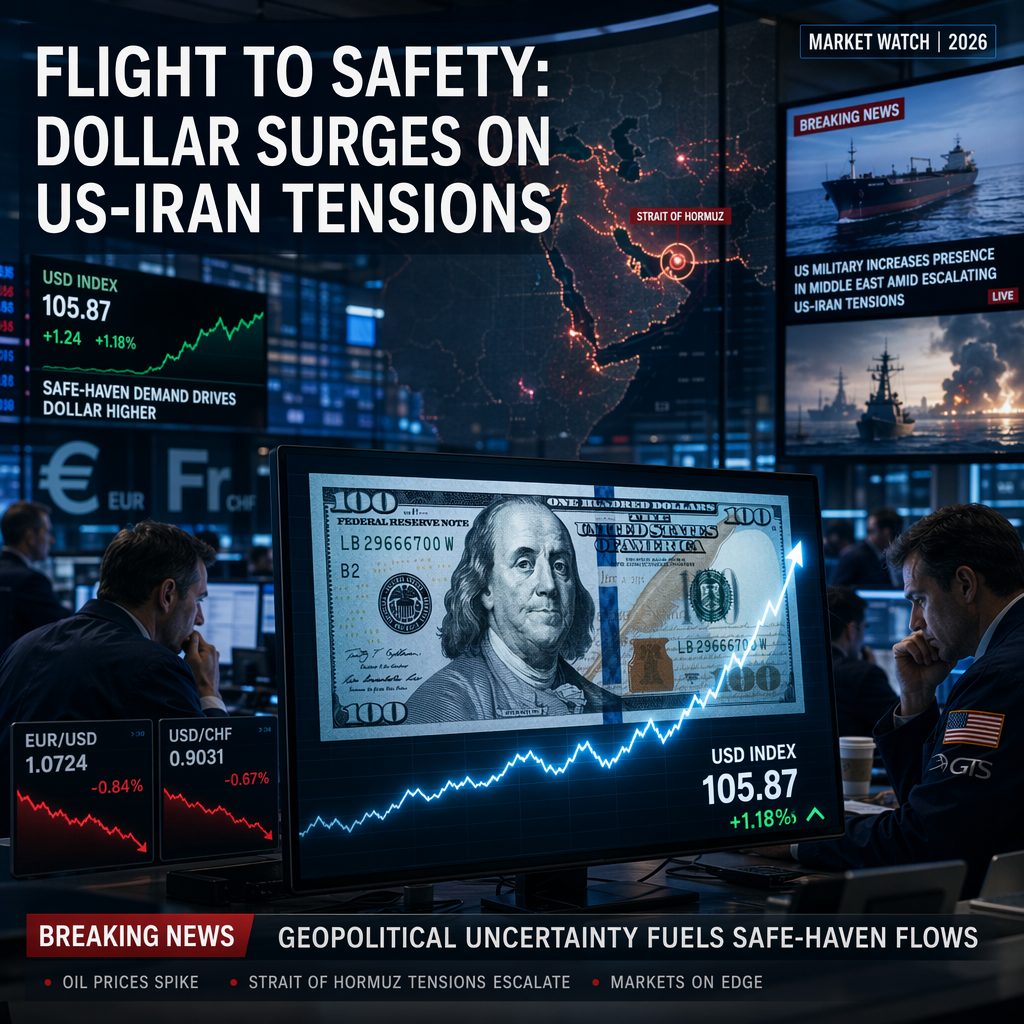
The US Dollar gained ground at the start of the week, driven by heightened safe-haven demand as geopolitical tensions escalated between the United States and Iran. USD/CHF advanced for the second consecutive day, trading around 0.8100 during Asian hours on Monday, as the US Dollar benefited from increased risk aversion following US Central Command (CENTCOM) strikes targeting Iranian assets. According to Bloomberg, these strikes aimed to weaken Iran's ability to target civilian vessels in the region, while Reuters reported that US forces hit more than 300 Iranian targets over three nights, including 140 on Saturday alone. There were conflicting statements from Washington and Tehran regarding the operational status of the Strait of Hormuz, a critical chokepoint for global energy supply [1][2].
The US Dollar Index (DXY) rose 0.2% to near 101.15, reflecting the Greenback's broad-based strength against major currencies, including the Euro and Swiss Franc. The Euro traded lower at around 1.1390 against the US Dollar, pressured by the same safe-haven flows and a bearish technical setup, with the EUR/USD pair holding beneath the 20-period Exponential Moving Average at 1.1443 and the Relative Strength Index near 38, indicating persistent downside momentum. Key support levels for EUR/USD are identified at 1.1324 and 1.1300 [2].
The surge in safe-haven demand also pushed oil prices higher, raising concerns about inflation and the potential for further Federal Reserve interest rate hikes. Market participants are closely watching the upcoming US Consumer Price Index (CPI) data for June, scheduled for release on Tuesday. The headline CPI is expected to decline by 0.1% month-on-month, while core CPI is projected to rise by 0.3%. Traders anticipate that the Federal Reserve may deliver one more interest-rate increase before the end of the year. Additionally, Fed Chair Kevin Warsh's first official appearance before Congress, a two-day testimony starting Tuesday, is in focus for further policy signals [1][2].
In Switzerland, the consumer confidence index fell to -36 in June 2026, down from -32 a year earlier and below the market forecast of -35. Swiss inflation remained subdued, flatlining at 0.5% annually in June. With domestic sentiment deeply negative and inflation contained, the Swiss National Bank faces no pressure to raise rates, and weak data could open the door for rate cuts or intervention to weaken the franc, making it less attractive to yield-seeking investors [1].
CONCLUSION
Escalating US-Iran tensions have triggered a flight to safety, strengthening the US Dollar while weighing on the Swiss Franc and Euro. Market participants are now focused on upcoming US inflation data and Federal Reserve commentary for further direction. The combination of geopolitical risk and central bank outlooks is likely to keep volatility elevated in the near term.