
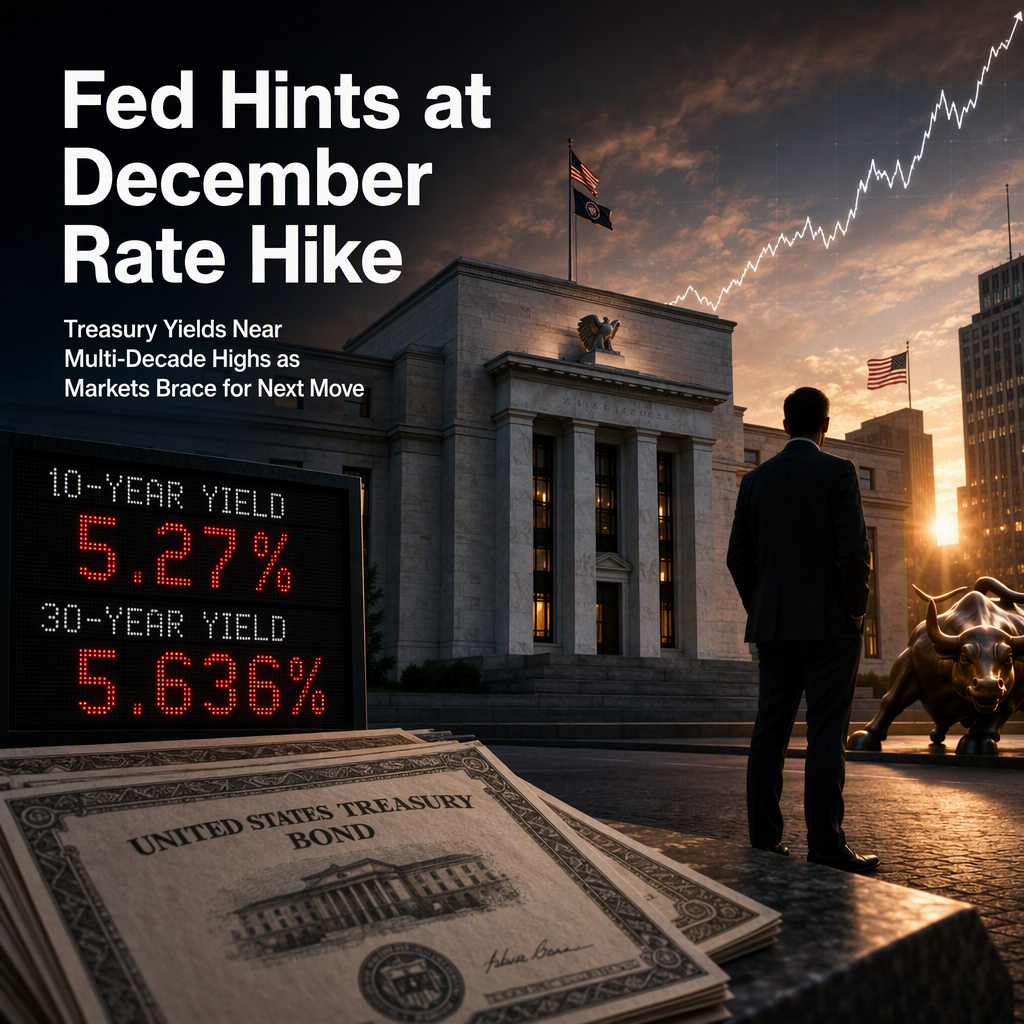
The US Federal Reserve's hawkish stance continues to support elevated US Treasury yields and a strong US Dollar, with the benchmark 10-year yield easing to 5.27% on Thursday after reaching 5.36%—its highest level since 2002—on Wednesday [1][3]. The 30-year Treasury bond yield also remained near a 24-year high, trading at 5.636% [3]. Fed Governor Christopher Waller reinforced the need for further rate hikes to combat persistent inflation, stating that increases do not need to occur at consecutive meetings but should be implemented within an acceptable timeframe [1][2][3]. Waller described the US labor market as 'solid and stable' in September, despite slower job creation, and emphasized that inflation remains too high [1][3].
The Minutes from the September Federal Open Market Committee (FOMC) meeting revealed unanimous support for a 25-basis-point rate hike, bringing the benchmark rate to a range of 3.75%-4.00% [1]. Most policymakers considered another increase appropriate before year-end, with nearly all seeing inflation risks tilted to the upside [1][3]. However, there was no explicit commitment to a hike at the October 27-28 meeting, and money markets now price in only an 18% chance of an October hike, with December odds at 87% according to Prime Terminal [2]. Investors expect the Fed to keep rates on hold at its next meeting and potentially raise them in December [2][3].
US economic data continues to show resilience, with initial jobless claims falling to 197,000 for the week ending October 3, below both the previous week's 199,000 and market expectations of 200,000 [1][2][3]. This supports the Fed's view of a stable labor market and gives policymakers room to maintain a restrictive monetary policy [1][2][3].
In the bond market, the Treasury's $39 billion 10-year note auction saw strong demand from global central banks, which accounted for over 80% of the auction—well above the average of 72.4% [3]. The 10-year auction was the highest-yielding since November 2000, and attention now turns to the $22 billion 30-year bond auction as a key test of demand amid concerns over US fiscal deficits [3].
In Australia, rising consumer inflation expectations (up to 5.3% in October from 4.9%) have fueled speculation about another Reserve Bank of Australia rate hike, with markets pricing in a 27% chance of an increase to 4.85% at the next policy meeting [1].
CONCLUSION
The Federal Reserve's continued hawkish messaging and strong US economic data have kept US Treasury yields at multi-decade highs, with markets now expecting the next rate hike in December rather than October. Robust demand for US debt persists despite deficit concerns, while global currencies and central banks remain sensitive to evolving rate expectations. The market remains focused on inflation and upcoming central bank decisions.