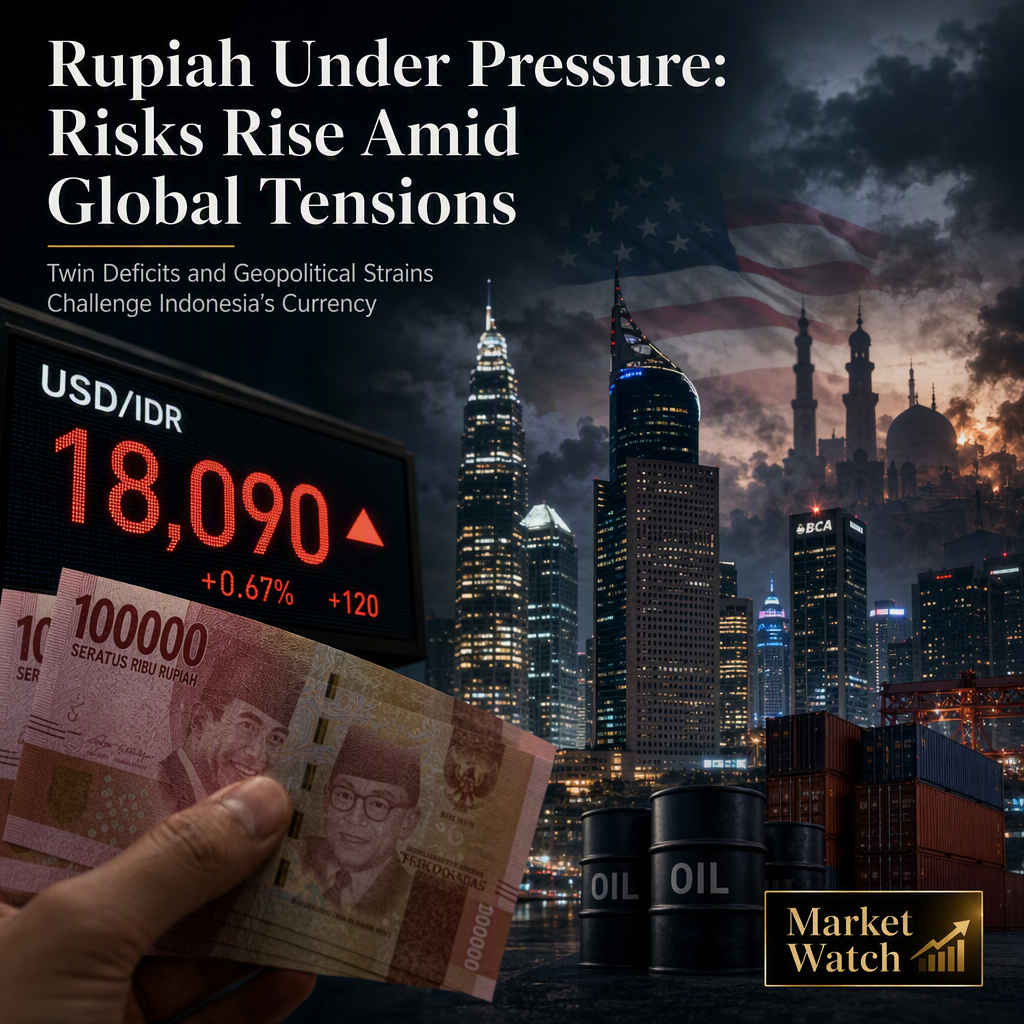
The Indonesian Rupiah (IDR) is under renewed pressure, with the USD/IDR currency pair halting its four-day losing streak and trading around 18,090 during Asian hours on Tuesday [1]. Economists from UOB, Enrico Tanuwidjaja and Vincentius Ming Shen, highlight Indonesia's vulnerability to ongoing geopolitical instability and energy market volatility, despite the country's downstream nickel initiatives and industrialization efforts supporting export performance [1]. Immediate benefits from energy security programs are not expected until major domestic refinery projects are completed [1].
In the short term, Indonesia faces increasing risks of a twin deficit, with pressures mounting on both its current account and fiscal balance [1]. However, continued investment in downstream projects and export security initiatives are seen as potential sources of long-term structural resilience for the Indonesian economy [1].
The US Dollar remains firm against the Rupiah amid heightened diplomatic tensions following US President Donald Trump's characterization of his latest offer to Iran as a 'last chance' for negotiations, after calling off a major military strike [1]. Iranian leadership, represented by General Mohsen Rezaei, swiftly rejected the proposal and warned against foreign military presence in the Strait of Hormuz [1].
Market participants are adjusting their expectations after the Indonesian central bank's decision to keep interest rates unchanged in July [1]. The CME FedWatch tool indicates that markets are pricing in a roughly 65% probability of a 25-basis-point rate hike at the US Federal Reserve's upcoming September meeting [1]. Fed's Williams delivered a moderately hawkish message, emphasizing a 'higher-for-longer' stance on rates, but also noted optimism about easing inflation pressures and the cooling impact from Middle East risks [1]. The FXS FedSentiment Index slipped by 1.47 points, reflecting a slight easing in market hawkishness [1].
CONCLUSION
The Indonesian Rupiah remains under pressure due to geopolitical volatility and concerns over twin deficits, while the US Dollar holds firm amid global tensions and expectations of a potential Fed rate hike. Market sentiment is cautious, with analysts highlighting Indonesia's long-term resilience but acknowledging near-term vulnerabilities.