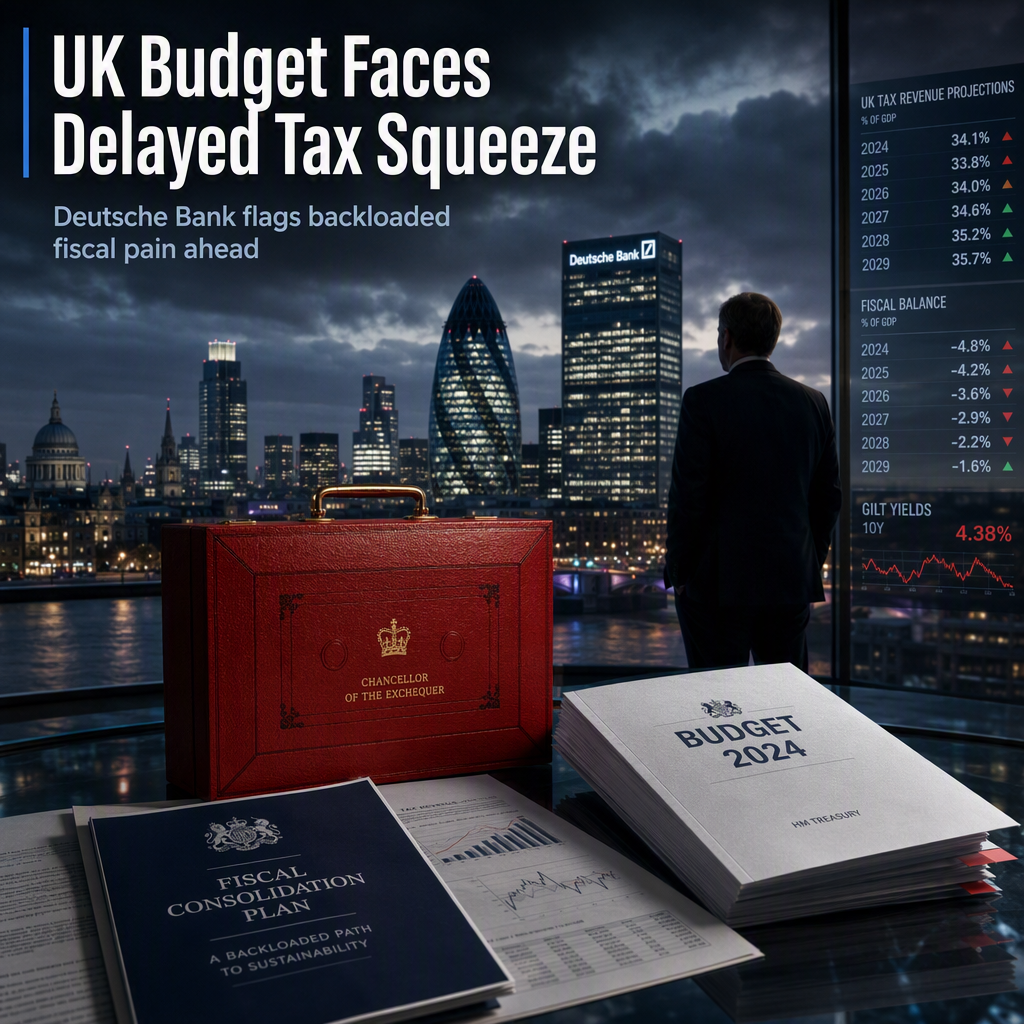
Deutsche Bank’s UK Chart Of The Week, authored by Sanjay Raja, Shreyas Gopal, and Maui Brennan, highlights that the United Kingdom's fiscal consolidation following the 2024 election is primarily driven by tax increases and is heavily backloaded, meaning the majority of the consolidation measures are scheduled for later years rather than immediately [1]. The analysis notes that spending decisions over the last four fiscal events have added an average of GBP 82 billion per annum on a net basis, while tax rises account for an average of GBP 52 billion [1].
The report emphasizes that gross tax consolidation is projected to be 2.3 times larger in 2029/30 compared to 2025/26, underscoring the significant reliance on future tax measures rather than immediate action [1]. Deutsche Bank warns that the limited fiscal headroom will constrain the upcoming Budget under Chancellor Healey, with fiscal headroom likely to be nearly halved [1].
Despite Chancellor Healey's more optimistic tone in his first set-speech on 7 September, the authors caution that the headwinds to public finances are substantial [1]. They suggest that, with the Chancellor adhering to fiscal rules and manifesto pledges, there is very little room for maneuver in the forthcoming Budget. The report anticipates that the government will likely continue its strategy of delaying consolidation, pushing for efficiency savings, and relying on a handful of peripheral tax measures when the Budget is presented on 28th October [1].
CONCLUSION
Deutsche Bank's analysis signals that the UK's fiscal consolidation is heavily reliant on future tax increases, with limited immediate action and constrained fiscal headroom. Markets should expect a cautious Budget with little flexibility, as the government maintains its commitment to fiscal rules and manifesto pledges.