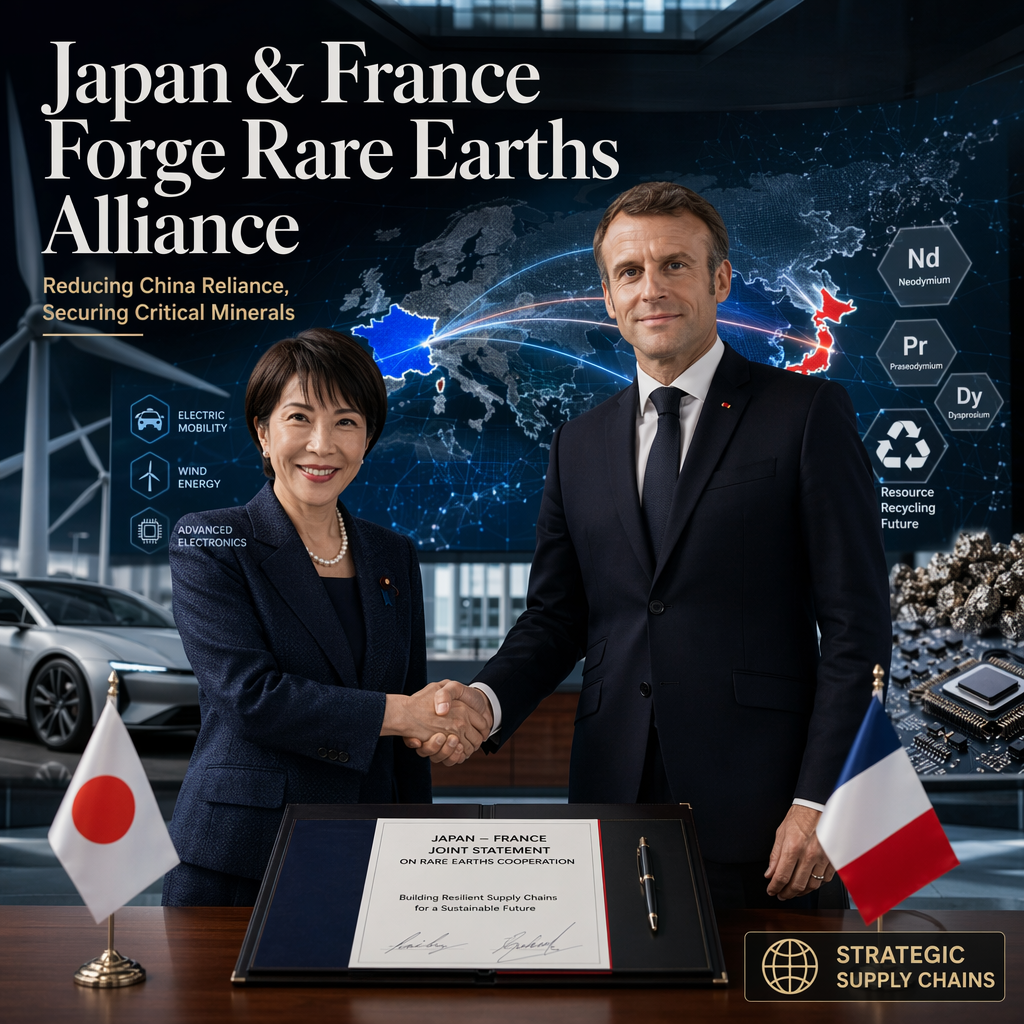
Japan and France have announced a significant expansion of their cooperation in the field of critical minerals, with a particular focus on rare earths. This collaboration includes joint investment in a rare-earth recycling project, which aims to secure stable and sustainable supplies of these essential minerals. Rare earths are crucial for the production of high-tech products such as electric vehicles, wind turbines, and defense applications [1].
The partnership is part of a broader effort by both countries to strengthen economic security and diversify supply chains, especially as global powers seek to reduce reliance on China for strategic resources. French President Emmanuel Macron and Japanese Prime Minister Sanae Takaichi underscored the importance of this initiative in a joint statement signed in April, emphasizing their mutual commitment to securing critical mineral supplies [1].
France has also advocated for the creation of international clubs to facilitate information sharing about rare earths, reflecting a wider G7 trend toward building alliances that decrease dependence on China. While no specific financial figures or technical details were disclosed in the announcement, market analysts suggest that such collaborations could influence global rare-earth prices and reshape the competitive landscape over the medium to long term [1].
This partnership is viewed as a strategic move by middle powers like Japan and France to increase their influence over global supply chains amid rising geopolitical tensions [1].
CONCLUSION
Japan and France's joint investment in rare-earth recycling marks a strategic effort to enhance economic security and reduce reliance on China for critical minerals. While immediate market impacts are not quantified, analysts anticipate potential effects on rare-earth prices and supply chain dynamics in the future. The partnership signals a growing trend among G7 nations to secure diversified and resilient resource networks.