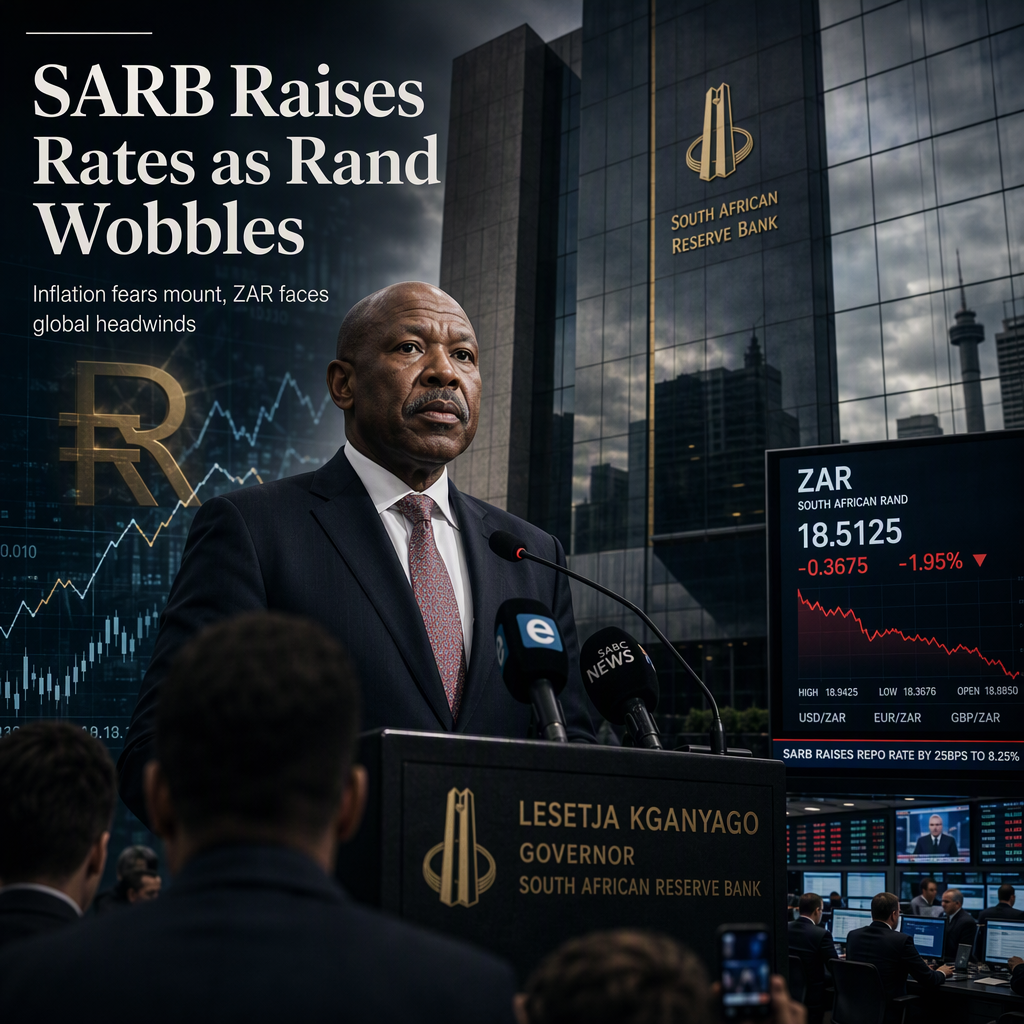
The South African Reserve Bank (SARB) raised its benchmark interest rate by 25 basis points to 7.25%, marking the second rate hike this year, following an earlier increase in May [1]. This decision comes as previous expectations for rate cuts have faded, largely due to the Iran conflict and the resulting rise in oil prices [1]. Despite the rate hike, the South African Rand (ZAR) weakened by just over 1% on the day, although most of this decline occurred before the rate decision was announced and was attributed primarily to a stronger US dollar rather than the SARB's action [1].
During the press conference, SARB Governor Kganyago emphasized the central bank's resolve, highlighting downside risks to economic growth and upside risks to inflation, which is expected to rise to over 5% year-over-year from the current 4.4% [1]. The SARB indicated that the threshold for further rate hikes is now higher, and in its baseline scenario, it does not foresee another rate hike unless inflation rises sharply beyond current projections [1].
Commerzbank's Volkmar Baur noted that the environment remains challenging for the ZAR, with rising US interest rate expectations and upcoming local elections in November posing additional risks [1]. The SARB's cautious stance and the ongoing geopolitical and economic pressures suggest continued volatility for the South African currency [1].
CONCLUSION
The SARB's latest rate hike underscores its concern over inflation risks, but the Rand remains vulnerable to external factors such as US dollar strength and geopolitical tensions. With no further hikes expected unless inflation accelerates sharply, and political risks looming, the outlook for the ZAR remains challenging in the near term.