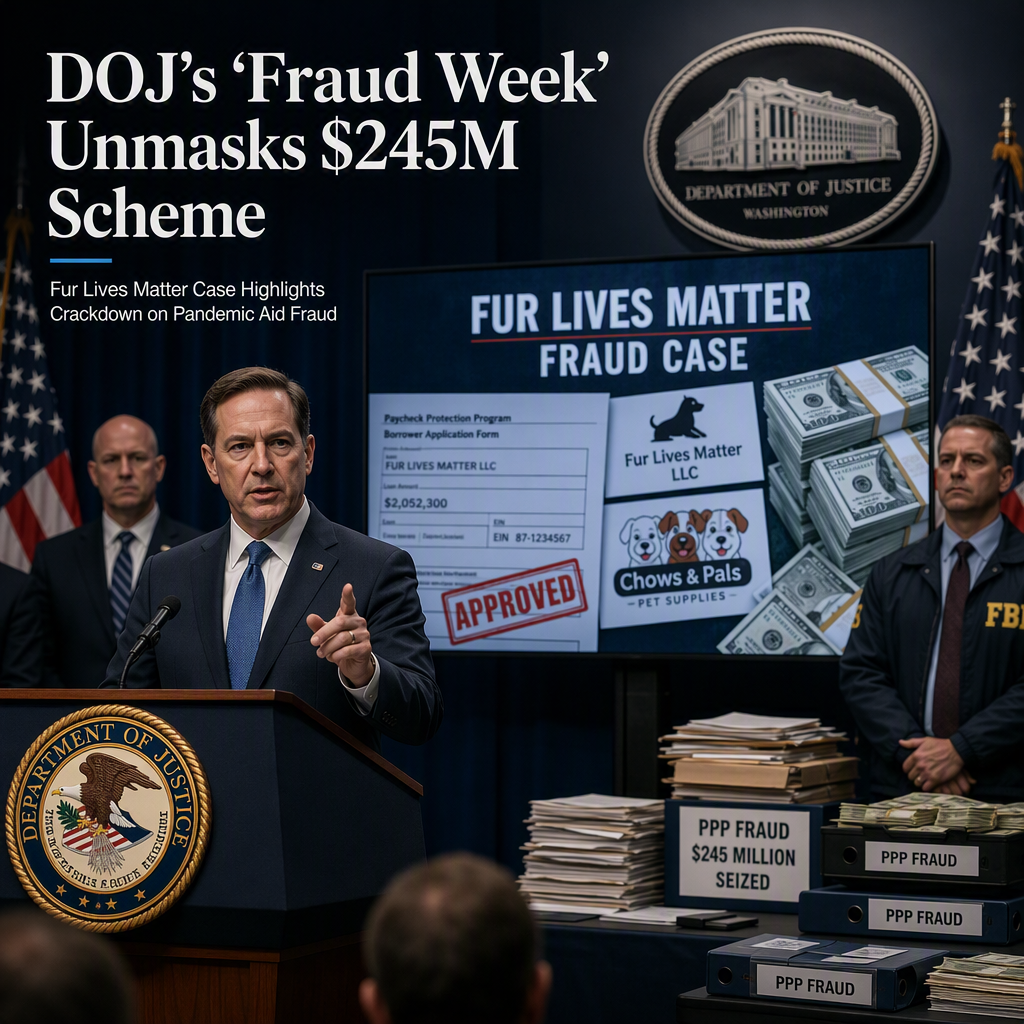
The Department of Justice (DOJ) announced a nationwide crackdown on business-aid fraud as part of its 'Fraud Week' initiative, targeting schemes that defrauded taxpayer-funded programs. The enforcement surge, led by the National Fraud Enforcement Division, resulted in charges against more than 160 criminal defendants and uncovered approximately $245 million in intended losses to taxpayers, according to DOJ statements. The crackdown spanned from Los Angeles to Philadelphia and involved 44 offices, including the Western District of Missouri, as part of the 'Heartland Fraud Surge' conducted from June through September 1 [1].
A standout case in the crackdown involved a Missouri man, Jamie Gray, who allegedly claimed to operate 19 separate businesses, including pet care entities such as 'Fur Lives Matter,' 'Fur Lives Matter LLC,' 'Chows & Pals,' and 'God’s Chow Chow.' Prosecutors assert that Gray used the real company name 'Fur Lives Matter,' which was operational in another state and had no connection to him, to fraudulently apply for nearly $56 million in Paycheck Protection Program (PPP) and Economic Injury Disaster Loan (EIDL) funds through 29 applications. The DOJ alleges that most of the businesses were fictitious and that Gray fabricated claims about ownership, employees, revenue, and operations. Despite these fabrications, Gray received about $820,000 in SBA funds [1].
U.S. Attorney Matt Price emphasized the scale of the problem, likening the coordinated anti-fraud response to the post-9/11 national security pivot. Price noted that the effort is expanding beyond the SBA-focused 'Operation No Doze' and that the crackdown is a direct response to widespread fraud in taxpayer-funded programs over the previous four years. Vice President JD Vance commented on the broader crackdown, stating, 'If you screwed the American taxpayer, the federal government is now going to say you're cut off, no more,' and warned that those who attempt to apply for benefits fraudulently will be denied [1].
The DOJ's actions signal an intensified focus on prosecuting fraud in pandemic-era relief programs, with ongoing efforts expected to expand further. The 'Fur Lives Matter' case was highlighted for its unusual details and as an example of the types of schemes being targeted in the current enforcement wave [1].
CONCLUSION
The DOJ's 'Fraud Week' crackdown underscores a significant federal effort to combat fraud in taxpayer-funded business aid programs, resulting in over 160 defendants and $245 million in intended losses identified. The highlighted 'Fur Lives Matter' case exemplifies the scale and creativity of alleged fraud schemes. Market participants should expect continued and possibly expanded enforcement actions in this area.