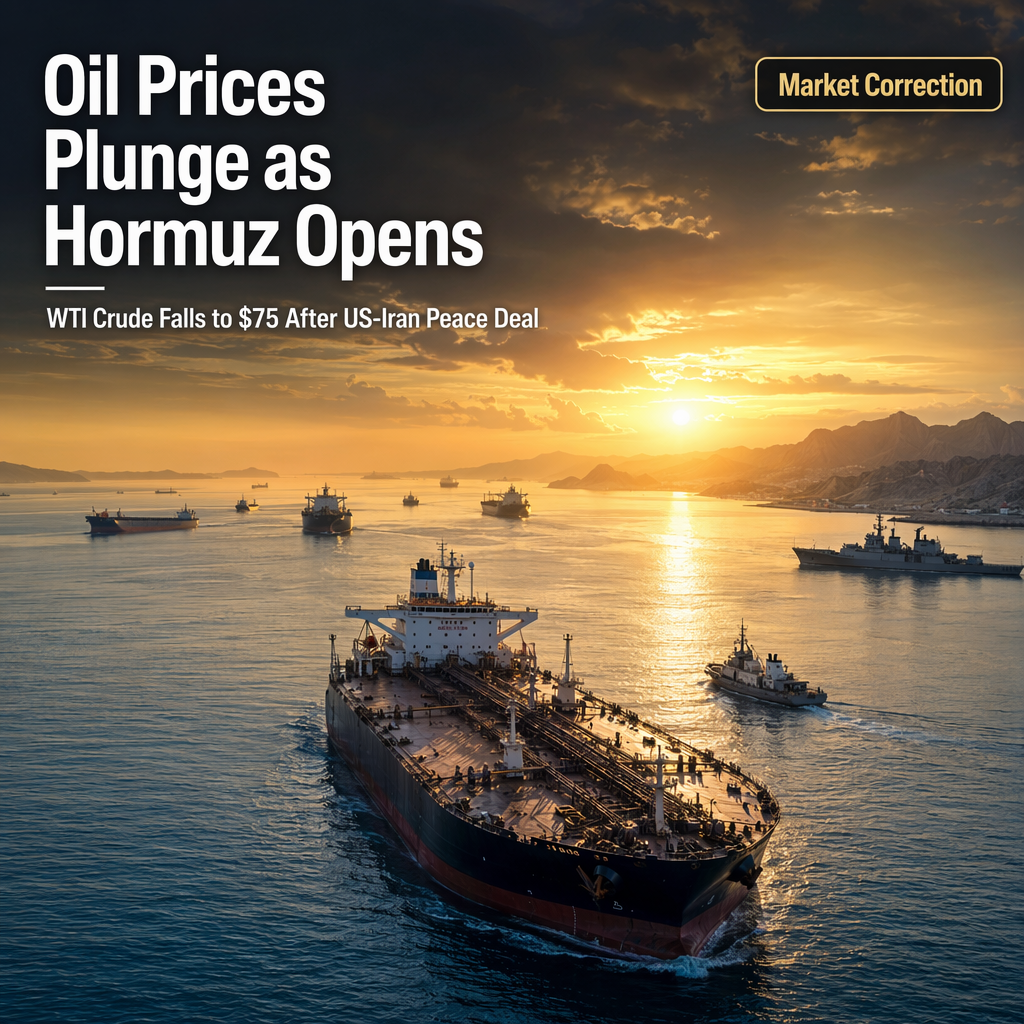
West Texas Intermediate (WTI) crude oil prices declined to approximately $75.10 per barrel during Friday's Asian trading session, reversing previous gains and positioning the US oil benchmark for a significant weekly loss of about 9.5% [1]. This sharp downturn is attributed to rapidly improving shipping conditions in the Strait of Hormuz following the implementation of an interim peace agreement between the United States and Iran, which has substantially reduced geopolitical risk premiums in the energy sector [1].
The diplomatic breakthrough ends a prolonged regional conflict that had previously caused the largest oil supply disruption on record [1]. In response, the US Central Command (CENTCOM) lifted all maritime restrictions on traffic to and from Iranian ports and coastal waters, while the Joint Maritime Information Center advised commercial vessels to adjust routes closer to Oman’s coastline to avoid residual risks from sea mines [1].
A surge of supply is entering the market as tankers carrying previously stranded crude oil began exiting the strategic chokepoint on Thursday, and Kuwait announced plans to ramp up domestic production [1]. As a result, global oil prices have erased nearly all risk-driven gains accumulated since the Middle East conflict began in late February [1]. US Vice President JD Vance highlighted the improved situation, noting that 12.5 million barrels of oil passed through the waterway overnight without any vessels being targeted by Iranian forces [1].
Iran's Supreme Leader Mojtaba Khamenei confirmed his approval of the interim plan, characterizing the agreement as a result of US President Donald Trump's 'desperation' and warning that future diplomatic talks should not be seen as acceptance of the American position [1]. The interim deal is expected to pave the way for direct negotiations between Washington and Tehran [1].
CONCLUSION
The rapid improvement in shipping conditions and the US-Iran interim peace agreement have triggered a sharp decline in WTI oil prices, erasing nearly all recent risk-driven gains. With supply disruptions easing and additional production from Kuwait, the market is reacting with a significant price correction and reduced geopolitical risk premiums.