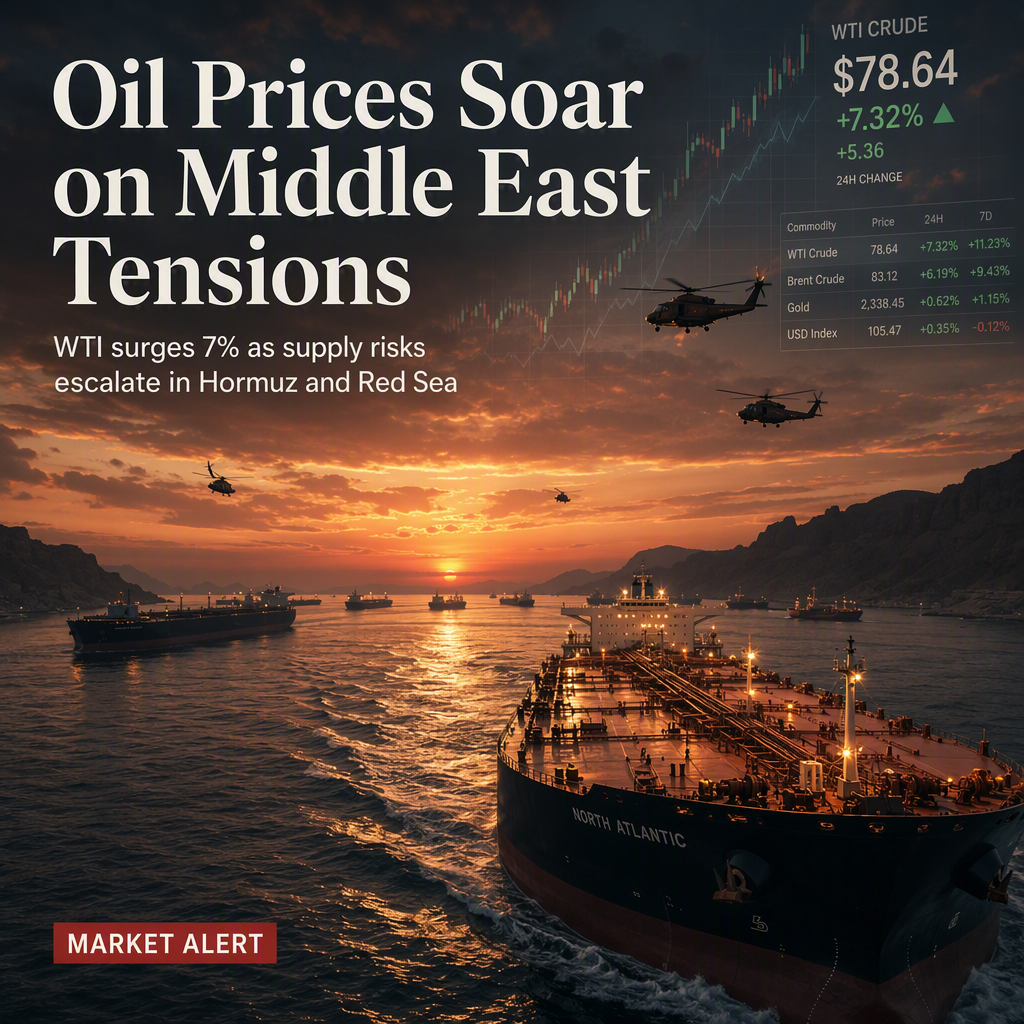
WTI Oil prices surged by more than 7% on Wednesday, reaching $85 per barrel according to one source [1], and trading around $84 per barrel according to another [2], as geopolitical tensions in the Middle East intensified following Iran’s Islamic Revolutionary Guard Corps (IRGC) missile strikes on a US military base in Jordan [1][2]. US President Donald Trump responded by threatening further retaliatory attacks against Iran and announced new sanctions targeting eight tankers and ten entities linked to Iranian Oil shipments [1][2]. Trump also stated in a Fox interview that talks with Iran would continue, but warned, 'we’ll be hitting Iran hard' [1].
The escalation in the conflict has heightened supply risks, particularly in key energy routes. Iran rejected Oman’s proposal to jointly manage shipping through the Strait of Hormuz, and the IRGC claimed to have struck and halted three Oil tankers in the waterway after they ignored warnings [2]. Additionally, Reuters reported that Yemen’s Iran-aligned Houthis are considering charging commercial ships using the Bab el-Mandeb Strait, further spreading supply risks to the Red Sea [2]. These developments have dampened hopes for normalisation of shipping through the Strait of Hormuz and contributed to expectations of continued volatility and further upside in Oil prices [2].
Market data also supported the rally, as the US Energy Information Administration (EIA) reported a significant drawdown in Crude Oil inventories, with a decrease of 7.167 million barrels last week, far exceeding the expected 2.5 million-barrel decline [2]. This followed a 2.011 million-barrel build in the previous week [2].
The British Pound (GBP/USD) held below 1.3300, trading at 1.3282, and remained largely unchanged despite the Oil price surge and geopolitical uncertainty [1]. The subdued movement was attributed to a scarce economic schedule in both the US and UK, with traders focused on upcoming monetary policy decisions by the Federal Reserve (Fed) and the Bank of England (BoE) [1]. The swaps market expects the Fed to hold rates unchanged, with odds near 59%, though the chances of a 25-basis-point rate hike are rising to 41% [1]. Speculation is growing that Fed Chair Kevin Warsh could persuade the board to delay a rate hike as the Committee assesses inflation risks, especially given the jump in Oil prices [1]. In the UK, the BoE is projected to hold rates unchanged, with the vote split to be closely watched, and the decision will be the first under new Prime Minister Andy Burnham [1].
Technical analysis shows GBP/USD trading at 1.3282, below its key Simple Moving Average (SMA) cluster around 1.3361 and under a descending trendline barrier near 1.3375, suggesting a capped, bearish near-term tone. The Relative Strength Index (14) hovers in the low-40s, indicating subdued upside momentum [1].
CONCLUSION
Escalating US-Iran tensions and supply disruptions in key energy routes have driven a sharp rally in WTI Oil prices, with market participants expecting continued volatility and further upside. The British Pound remained steady amid geopolitical uncertainty, as traders await central bank decisions. The combination of geopolitical risks and significant inventory drawdowns has resulted in high market impact, particularly for Oil.