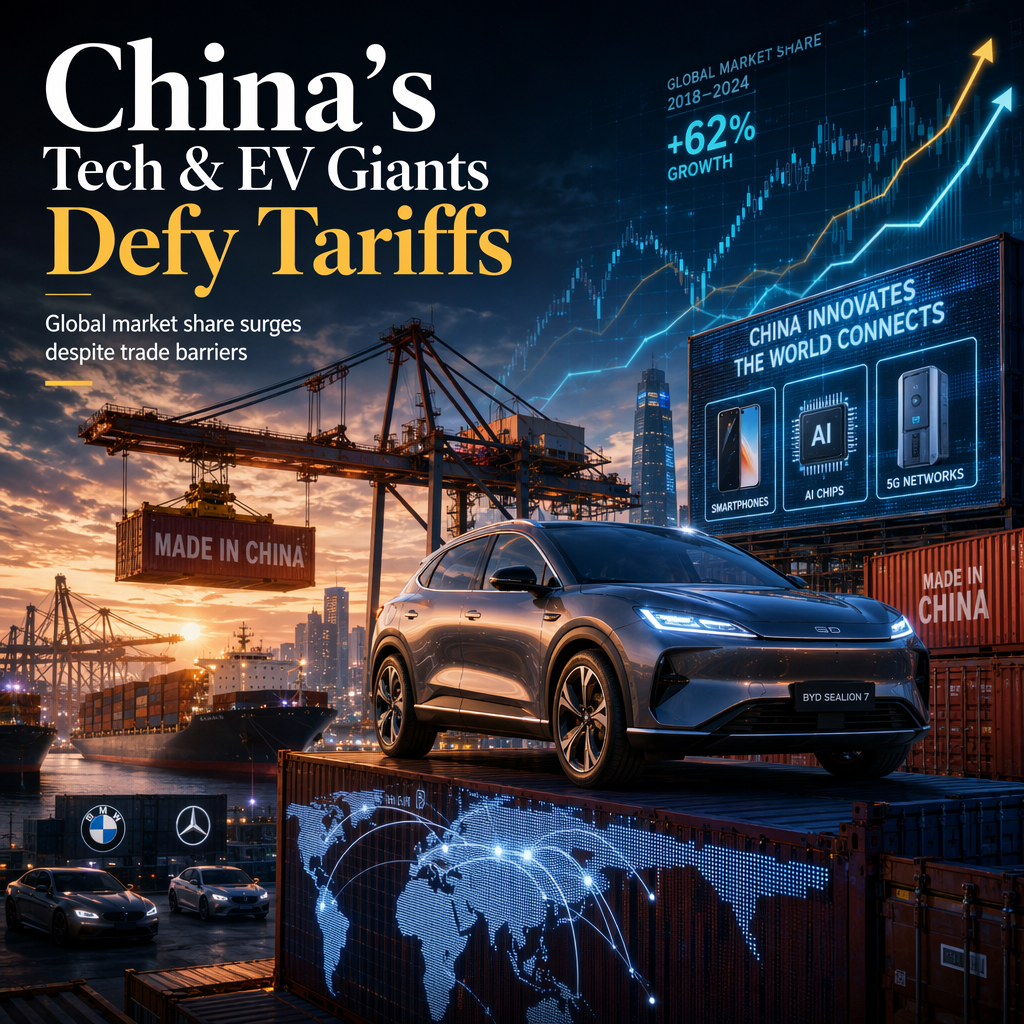
Chinese companies expanded their global market share in nearly 40% of major goods and services last year, according to a Nikkei analysis, with particularly strong gains in electric vehicles (EVs) and digital products such as smartphones and network equipment [1]. This expansion occurred despite the U.S. imposing tariffs of up to 145% on Chinese goods during the same period [1]. The survey found that Chinese firms not only maintained but grew their presence in the global marketplace, even as trade tensions and regulatory challenges persisted, including accusations of overcapacity by both the U.S. and EU [1].
Market analysis indicates that Chinese companies are compensating for weaknesses in certain sectors with robust performances in areas driven by technological innovation, notably artificial intelligence (AI) and EVs [1]. The AI boom has contributed to the expansion of China’s trade, helping to offset sluggish growth in other sectors [1]. Industry leaders in Southeast Asia, such as a Thai auto firm CEO, emphasized the necessity of collaborating with Chinese EV makers to remain competitive, stating, "Collaborate with Chinese EV makers or suffer," which underscores the significant impact Chinese competition is having on regional automotive markets [1].
Transportation market data reveals that China-US container shipping rates have reached a two-year high ahead of anticipated tariff changes, a trend attributed to global supply chain adjustments and increased demand for Chinese goods despite ongoing protectionist policies [1]. In the luxury automobile segment, Chinese EVs are directly challenging established brands like BMW and Mercedes-Benz, particularly in the Thai market, while CATL, a leading Chinese battery manufacturer, continues to perform well even as some Chinese EV makers face supply chain constraints and weaker domestic demand [1].
The broader implication, as highlighted by the Nikkei survey, is that Chinese manufacturers are leveraging technological advancements, cost advantages, and aggressive expansion strategies to grow their global market share, even in the face of Western tariffs and regulatory barriers [1]. Technical analysis and chart descriptions suggest that Chinese product exports remain resilient, supported by strong government backing and ongoing innovation, with market sentiment remaining positive on the continued global spread of China-made goods despite cautiousness due to trade tensions [1].
CONCLUSION
The Nikkei survey demonstrates that Chinese firms are increasingly influential in the global economy, expanding their market share across key sectors despite significant trade barriers. Market sentiment remains cautiously optimistic, with Chinese innovation and cost advantages driving continued growth and reshaping competitive dynamics worldwide.