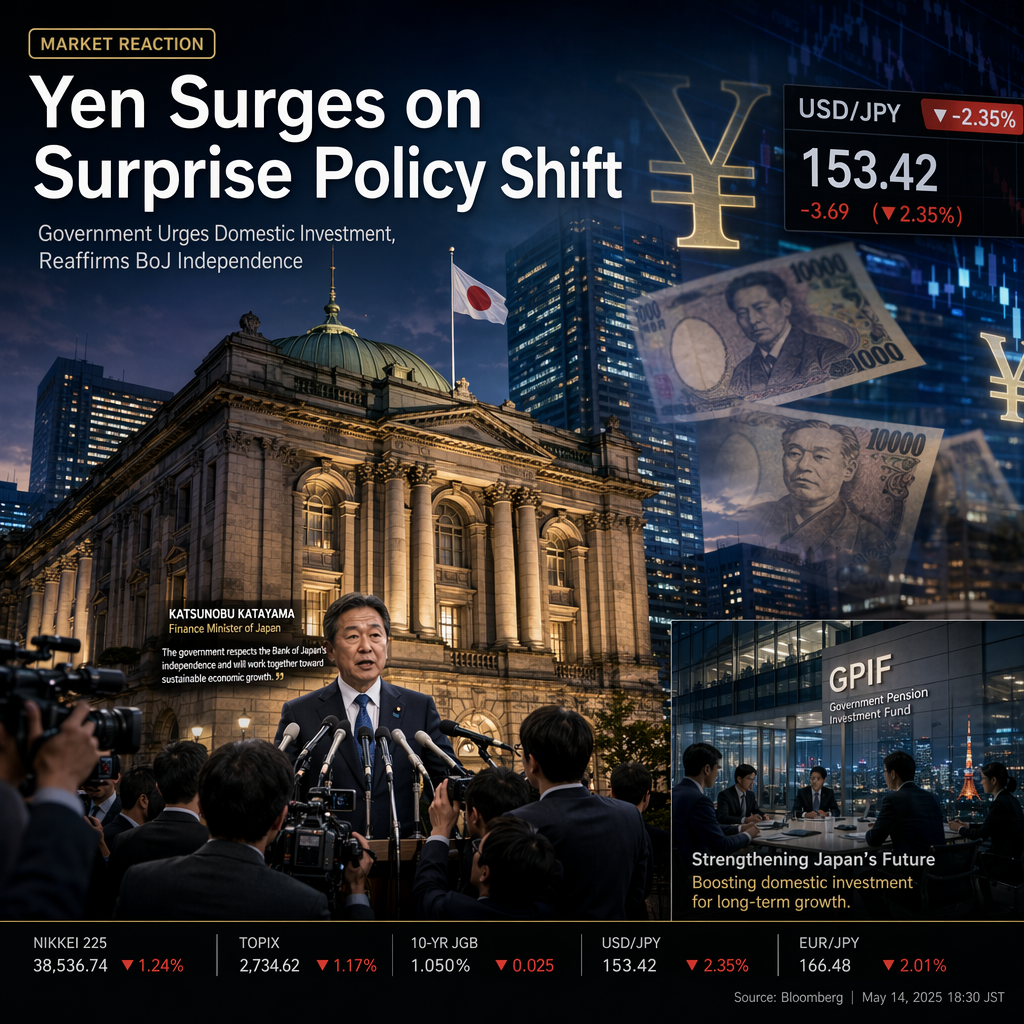
The Japanese Yen (JPY) led G10 currency gains following unexpected remarks by Finance Minister Katayama, who urged households and the Government Pension Investment Fund (GPIF) to increase investments in Japanese financial assets. This statement, made during a regular press conference, was described as a surprise and had a notable impact not only on the Yen but also on equities and Japanese Government Bonds (JGBs), with yields falling by over 10 basis points [1]. MUFG’s Derek Halpenny highlighted that while these policy shifts could influence markets over time, their immediate effect may be limited due to the need for increased confidence in the Bank of Japan (BoJ) and reduced concerns about the BoJ lagging behind the curve [1].
In a related development, Chief Cabinet Secretary Minoru Kihara stated that the specifics of monetary policy should be left to the BoJ, signaling to global markets that the government does not intend to interfere with the central bank’s operations [2]. Despite Kihara’s remarks, there was no immediate reaction in the Yen; however, at press time, USD/JPY was trading 0.43% lower near 161.70, reflecting the Yen’s outperformance on the day [2].
The market reaction to Katayama’s comments was significant, with the Yen strengthening and JGB yields dropping, indicating increased demand for domestic assets [1]. Analysts, including Halpenny, caution that for a sustained shift of capital from foreign assets to JGBs by domestic investors, greater BoJ credibility is essential [1]. Kihara’s emphasis on BoJ independence further reinforces the central bank’s role in shaping monetary policy and influencing the Yen [2].
Looking ahead, MUFG suggests that while government encouragement could eventually have a meaningful impact, it is likely too soon to expect lasting effects on the Yen without further developments in BoJ policy and credibility [1].
CONCLUSION
The Japanese Yen experienced a notable rally after Finance Minister Katayama’s surprise call for increased domestic investment, while government officials reiterated the BoJ’s independence in setting monetary policy. Although the immediate market reaction was strong, analysts emphasize that lasting effects depend on improved confidence in the BoJ and further policy evolution.