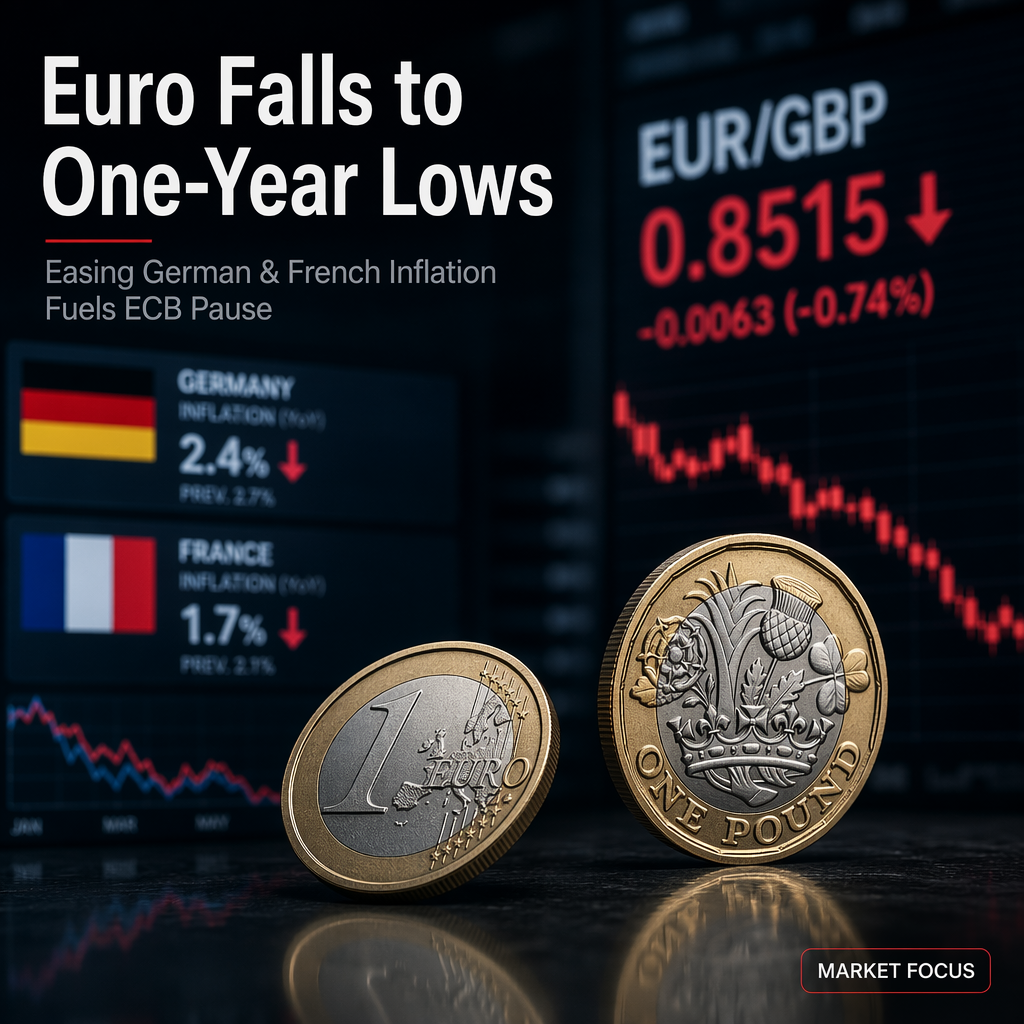
The Euro (EUR) remains at one-year lows against the British Pound (GBP), with the EUR/GBP pair trading around the 0.8515 level on Friday. This weakness follows the release of inflation data from Germany and France, which confirmed a moderation in price pressures for June. In Germany, the final Harmonized Index of Consumer Prices (HICP) showed a year-over-year increase of 2.4%, down from 2.7% in May and 2.9% in April. Monthly inflation contracted by 0.2%, matching preliminary estimates and following a 0.1% contraction in May [1]. Similarly, France's Consumer Price Index (CPI) revealed that annual inflation eased to 2% in June, compared to 2.8% in May. Monthly inflation in France contracted by 0.3%, after a 0.1% uptick in the previous month [1].
These figures have reinforced expectations that the European Central Bank (ECB) will pause rate hikes at its July meeting, allowing policymakers to monitor developments in energy markets and their effects on the Eurozone economy [1]. The subdued inflation readings are seen as bearish for the Euro, contributing to its continued weakness against the Pound [1].
Meanwhile, the Pound has found support from comments by Bank of England (BoE) Chief Economist Huw Pill. Pill, one of two hawkish dissenters at the latest BoE monetary policy meeting, stated on BBC's 'Walescast' programme that interest rates should rise before year-end, arguing that the central bank has been 'running the economy a little bit hotter than the supply side' [1]. This hawkish stance has bolstered the GBP, further pressuring the EUR/GBP pair.
The market implications are clear: the Euro's decline is tied to moderating inflation and expectations of an ECB pause, while the Pound is buoyed by prospects of further BoE rate hikes. No analyst opinions or forward-looking statements beyond these central bank expectations were provided in the source article [1].
CONCLUSION
The Euro's slide to one-year lows against the Pound is driven by easing inflation in Germany and France and expectations of an ECB rate pause. In contrast, hawkish signals from the Bank of England support the Pound. The market takeaway is a bearish outlook for the Euro and a relatively stronger Pound amid diverging central bank policies.