
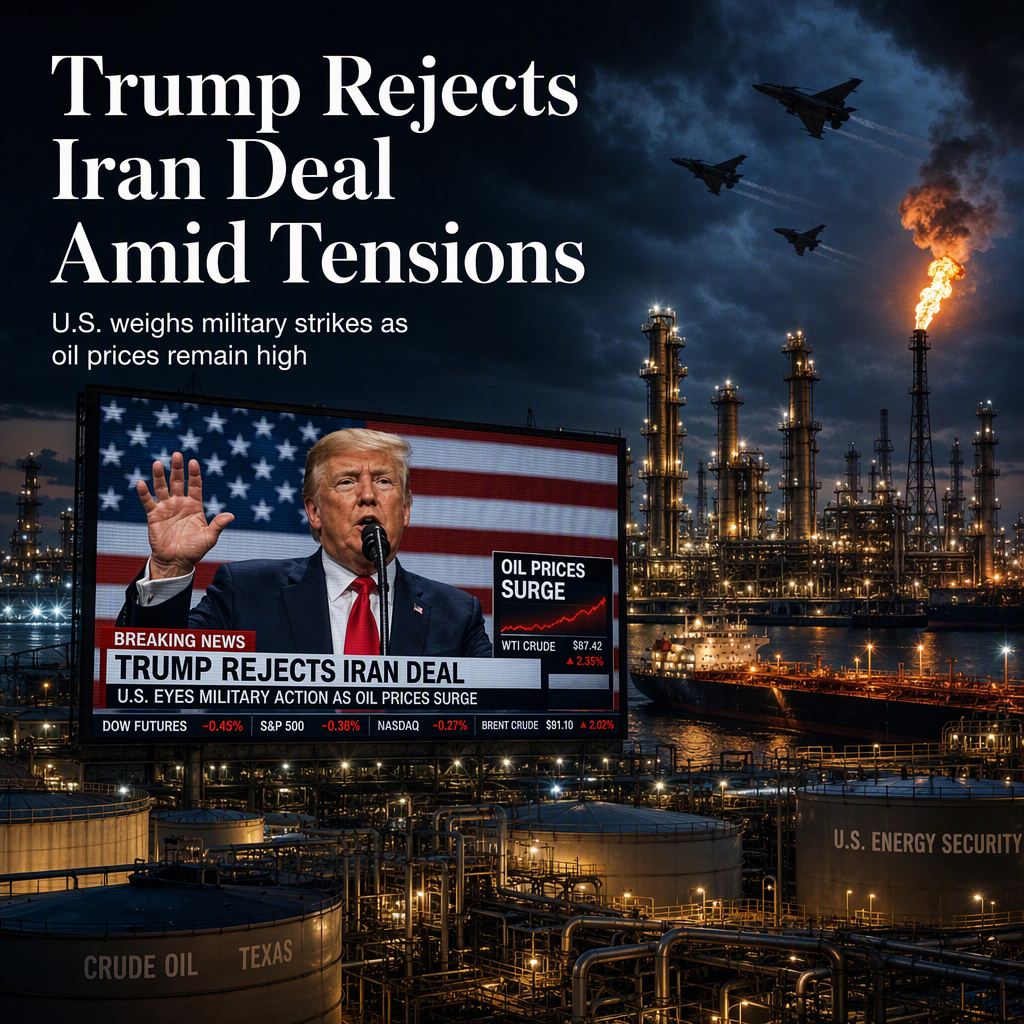
U.S. President Donald Trump announced that he no longer seeks a deal with Iran, following reports that the U.S. military is preparing for possible large-scale strikes against Iranian targets, potentially before the upcoming midterm elections [1]. Trump made these remarks during a campaign rally in San Antonio, Texas, stating, "I think the deal isn't really something that I want to do, but they're willing to offer us anything to stop" [1]. He also noted that Steve Witkoff, the U.S. special envoy to the Middle East, has been working on the deal and "doing very well" [1].
According to NBC News, Trump and his national security team have discussed the potential resumption of significant U.S. military operations in the coming weeks, with Axios reporting that this could involve "massive bombing" of Iranian energy, infrastructure, and nuclear sites [1]. The timing of such military action is seen as potentially influential on the outcome of the midterm elections [1].
Crude oil prices have remained elevated despite Middle East exports recovering to near pre-war levels, with combined crude volumes from the Gulf (excluding Iran), Saudi Arabia, and the United Arab Emirates reaching around 18.5 million barrels per day, according to Kpler [1]. High gasoline and diesel prices have contributed to a record low in Trump's approval ratings, reflecting domestic economic pressures tied to the geopolitical situation [1].
Iranian officials have pushed back against Trump's claims regarding confusion over Iranian leadership during negotiations, with Foreign Ministry spokesperson Esmaeli Baghaei stating that the "problem is actually the opposite" and highlighting "contradictory positions and mixed messaging from U.S. officials" [1]. Kpler's lead freight analyst, Matt Wright, commented that "normalisation no longer needs to wait for a deal," forecasting "slower, uneven normalisation" in oil traffic under continued conflict, with recovery driven by operational adaptation rather than diplomatic breakthroughs [1].
CONCLUSION
President Trump's rejection of a new Iran deal and the possibility of imminent U.S. military action have kept oil prices elevated, despite recovering Middle East exports. The situation has contributed to domestic economic pressures and political uncertainty, with analysts expecting a slow and uneven return to normal oil flows absent a diplomatic resolution.