
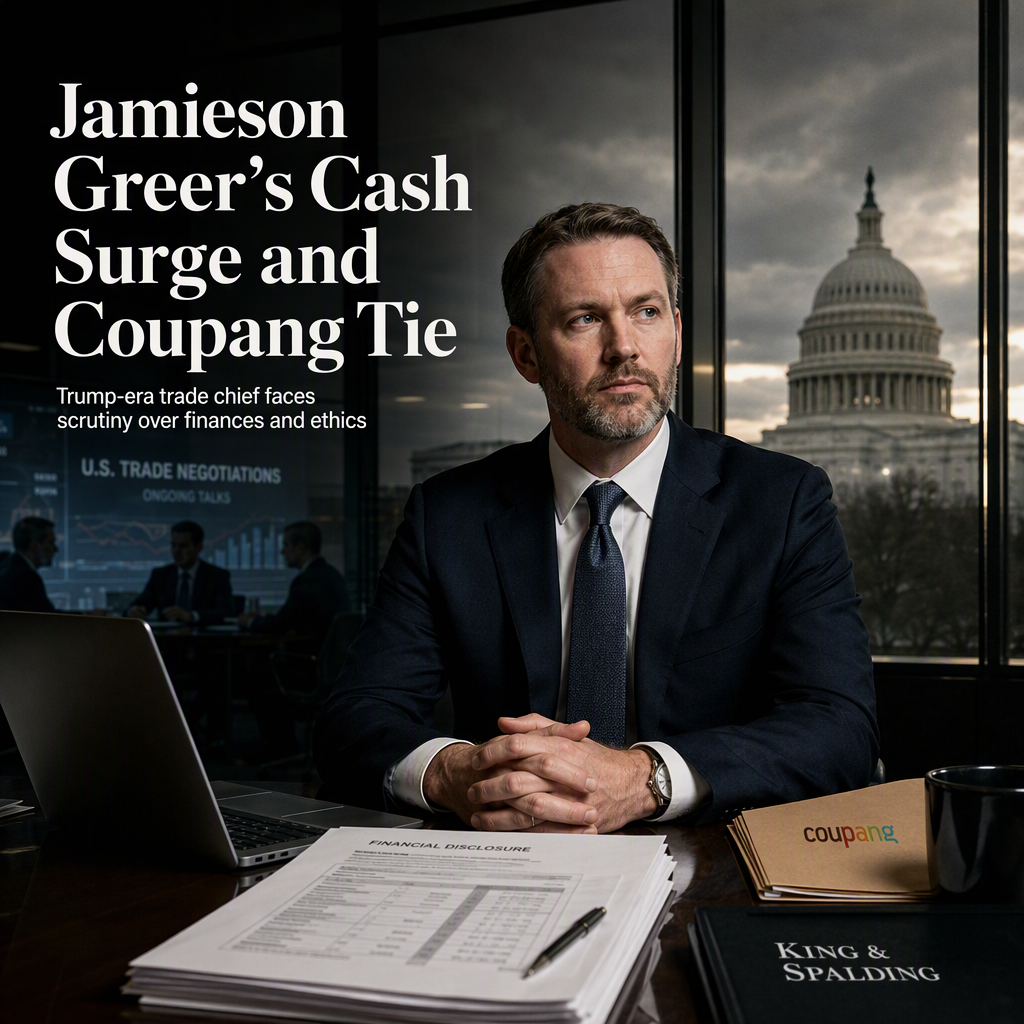
Jamieson Greer, the U.S. trade representative under President Donald Trump, reported cash, retirement accounts, and other investments totaling between $1.17 million and $3.75 million in his 2025 annual financial disclosure, according to a CNBC analysis of the 16-page filing from the Office of Government Ethics [1]. This disclosure provides new insight into Greer's finances after he left his partnership at King & Spalding law firm to join the administration in February 2025 [1].
Greer received $652,610 in salary and bonus from King & Spalding in 2025, and his nominee disclosure listed an anticipated performance-based bonus for 2024 valued between $250,001 and $500,000, to be paid before he entered government service [1]. Previously, he reported about $1.5 million in salary and bonus from the firm [1]. Notably, Greer's cash holdings increased, with an account labeled "U.S. bank #2" rising from $250,001-$500,000 in his nominee filing to $500,001-$1 million in the new disclosure, generating $15,001-$50,000 in interest [1]. Federal disclosures report assets in broad ranges, making precise changes in Greer's wealth indeterminate; the asset total does not reflect his net worth, as his personal residence is not valued, though he reported a mortgage of $1 million to $5 million at a 2.375% interest rate [1].
The disclosure also revealed a previously unreported timeline involving Coupang, the South Korean e-commerce giant. Greer's nominee disclosure shows he received a $10,000 honorarium from Coupang in May 2024 [1]. On April 24, 2025, he met with Coupang at the U.S. Trade Representative's office during a day of trade talks, shortly after meeting South Korean trade minister Ahn Duk-geun [1]. Coupang has become a trade flashpoint, with U.S. investors accusing Seoul of unfairly targeting the company after a major data breach, though the South Korean government disputes these claims [1].
Before taking office, Greer pledged to avoid certain matters involving former clients for one year unless cleared by ethics officials. Public records reviewed by CNBC do not clarify whether USTR treated Coupang as a former client under this commitment or if Greer received authorization to participate in the meeting. His nominee filing describes the Coupang payment as an "honorarium," while other companies are separately identified as legal services clients [1]. USTR and Coupang did not respond to CNBC's requests for comment [1].
CONCLUSION
Jamieson Greer's financial disclosure highlights increased cash holdings and a previously unreported honorarium from Coupang, raising questions about his interactions with the company during trade talks. The lack of clarity regarding ethics clearance for his participation in Coupang-related matters may draw further scrutiny. Market implications are moderate, particularly for stakeholders monitoring U.S.-South Korea trade relations and compliance issues.