
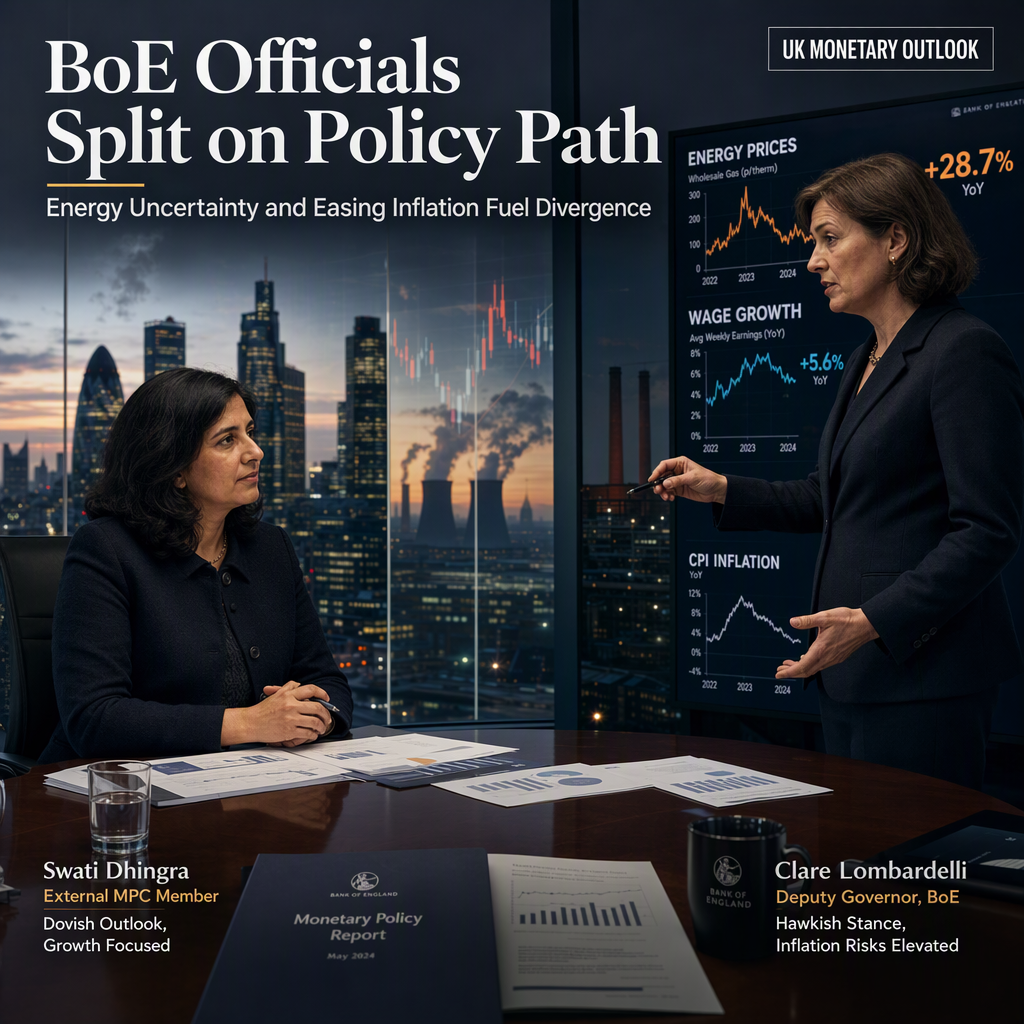
Two senior Bank of England (BoE) officials offered differing perspectives on the UK’s monetary policy outlook in recent remarks. Monetary Policy Committee member Swati Dhingra adopted a dovish stance, emphasizing that financial conditions have already contributed significantly to tightening, with signs of easing price pressures and a weakening UK labour market. Dhingra downplayed concerns about long-term inflation, noting that medium-term inflation expectations in the UK are broadly similar to those in the Eurozone and are 'not a cause for alarm' [1]. She also highlighted the absence of broad-based price rises seen in 2022 and suggested that the BoE is comfortable with current policy settings, with risks now tilted more toward growth than renewed inflation. Dhingra further speculated that advances in Artificial Intelligence could eventually help reduce services inflation, an area closely watched by the BoE [1].
In contrast, BoE Deputy Governor Clare Lombardelli signaled a more hawkish outlook, stating that policy is 'increasingly likely to need to tighten if elevated energy prices persist, absent clear evidence of disinflation or weaker activity.' Lombardelli pointed out that wage growth remains too high to be consistent with the BoE’s inflation target and stressed that the key issue is not just the spot price of energy, but how higher energy prices interact with the broader economy and their transmission effects. She clarified that monetary policy remains restrictive, balancing lower inflation with the risks of lower demand, and that the decision to raise the bank rate will depend on these complex interactions [2].
Despite these contrasting tones, both officials’ comments had little immediate impact on the British Pound. GBP/USD traded slightly lower, down 0.08% to around 1.3230 following Dhingra’s remarks [1], and remained rangebound near 1.3250 after Lombardelli’s comments [2].
Looking ahead, Dhingra’s remarks suggest a preference for patience and a focus on growth risks, while Lombardelli’s comments highlight the potential for further tightening if energy-driven inflation persists. The divergence underscores ongoing uncertainty within the BoE regarding the appropriate policy response to evolving inflation and energy market dynamics.
CONCLUSION
Comments from BoE officials reveal a split between dovish and hawkish outlooks, reflecting uncertainty over the future path of UK monetary policy. While Dhingra sees current conditions as sufficient for now, Lombardelli warns of possible tightening if energy risks remain. The market reaction was muted, with GBP/USD showing little movement in response to the statements.