
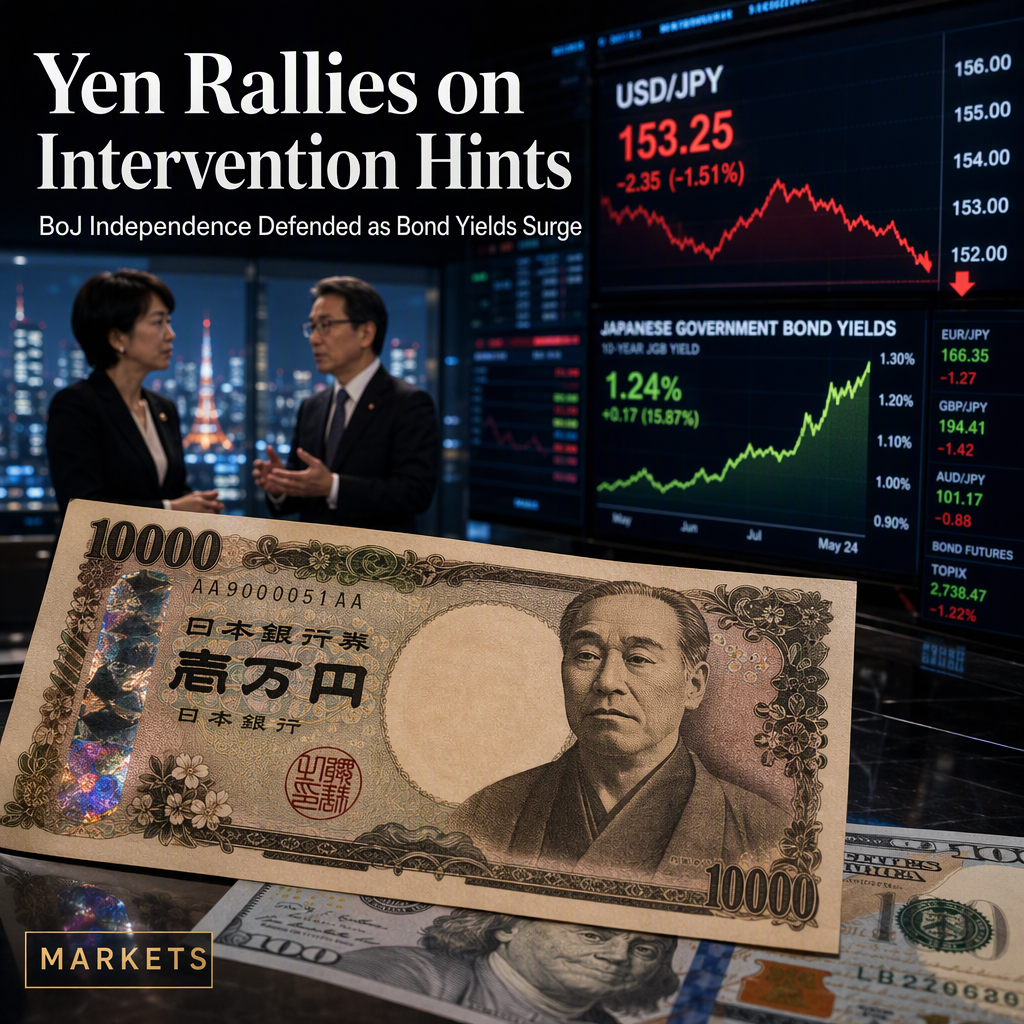
On June 21, 2024, the Japanese Yen strengthened against the US Dollar, paring earlier losses as Japanese government bond yields surged, narrowing the gap with US Treasury yields. The USD/JPY pair retreated to the mid-157.00s, down from three-week highs above 159.00 earlier in the week [1]. This recovery was supported by comments from Japan’s Finance Minister Satsuki Katayama, who emphasized that Prime Minister Sanae Takaichi 'very much respects the independence of the BoJ,' indicating that the government will not interfere with the central bank’s plans to accelerate its monetary tightening cycle [1].
Katayama also reiterated her willingness to 'take bold action on the Yen,' marking the second time she has signaled potential intervention in the Forex markets. This stance has kept investors alert, especially as the Dollar-Yen pair approached the 160.00 level, which Japanese authorities consider the threshold for tolerable Yen weakness [1].
Japanese Government Bond yields provided additional support to the Yen, with the 10-year JGB yield reaching a fresh 30-year high at 3.112% and the 30-year JGB hitting highs at 4.223% before pulling back below 4.20% [1]. Despite these developments, the US Dollar remained resilient, buoyed by a hawkish repricing of Federal Reserve policy following strong US business activity data and assertive comments from Fed officials. Anna Paulson, president of the Philadelphia Fed, stated that 'modest' rate increases are likely needed to bring inflation to target, while John Williams of the New York Fed said it is 'sensible to expect another rate increase by year-end.' Markets are nearly fully pricing in at least a 25-basis-point rate hike in the fourth quarter, which is expected to limit any significant reversal in the US Dollar [1].
CONCLUSION
The Japanese Yen’s recovery was driven by rising domestic yields and signals of potential government intervention, while the US Dollar remains supported by hawkish Fed expectations. Market participants are closely watching both Japanese policy actions and US rate decisions, with the Yen’s strength likely contingent on further developments in bond yields and central bank strategies.