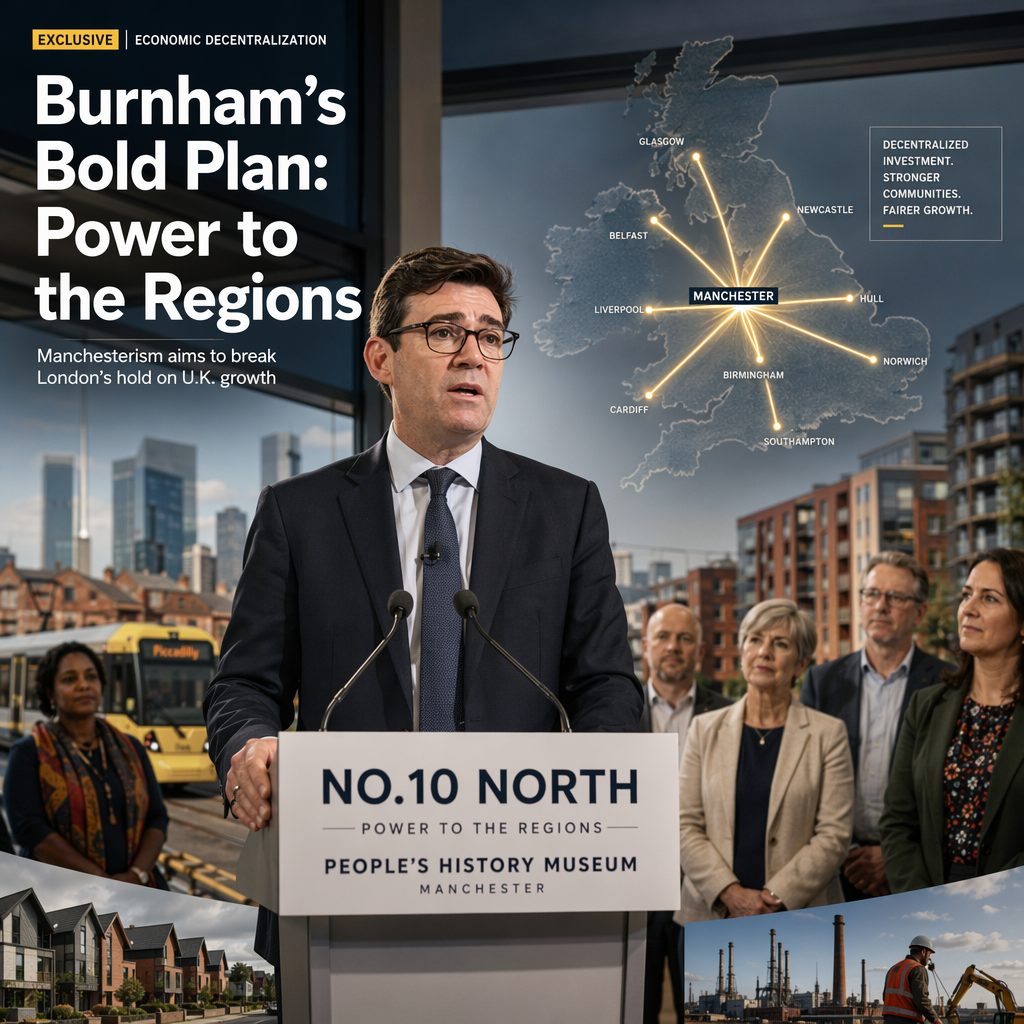
Andy Burnham, the former mayor of Greater Manchester and the strong favorite to become the next U.K. prime minister, announced a sweeping plan to decentralize economic power in the United Kingdom by granting greater autonomy to local leaders. In a speech delivered at the People’s History Museum in Manchester, Burnham described his proposal as a 'circuit-breaker' for the British state, emphasizing that 'growth cannot be ordered from the top down' but must be 'nurtured from the bottom up' [1].
Burnham outlined a 10-year plan aimed at achieving 'good growth in every postcode,' targeting the longstanding concentration of wealth and power in London and the south of England. His approach, termed 'Manchesterism,' seeks to harness both private and public investment in key sectors such as transport, housing, and infrastructure. He also pledged to create new industrial jobs, improve educational opportunities, and reform the U.K.'s privatized water and energy utilities, which he described as inefficient and expensive [1].
A notable aspect of Burnham's plan is the proposed relocation of part of the prime minister’s office from London’s 10 Downing Street to Manchester, establishing a new government office called 'No. 10 North.' This office would oversee regional development nationwide and serve as 'the nerve center of a rewired Britain.' Additionally, regional mayors would be granted increased authority over housing, welfare, and education [1].
While Burnham's speech was praised for its vision and his track record in revitalizing Manchester, it was criticized for lacking specifics on funding sources, and he did not take questions from journalists. Burnham recently won a special election for a seat in Parliament on June 18 and was sworn in on June 22, the same day outgoing Prime Minister Keir Starmer announced his resignation. Burnham is currently the only contender in the Labour Party leadership race [1].
CONCLUSION
Andy Burnham’s proposal signals a significant shift toward decentralization and regional empowerment in the U.K. economy. While the plan has been met with optimism regarding its potential to address regional disparities, the lack of detail on funding and implementation leaves key questions unanswered for markets and stakeholders.