
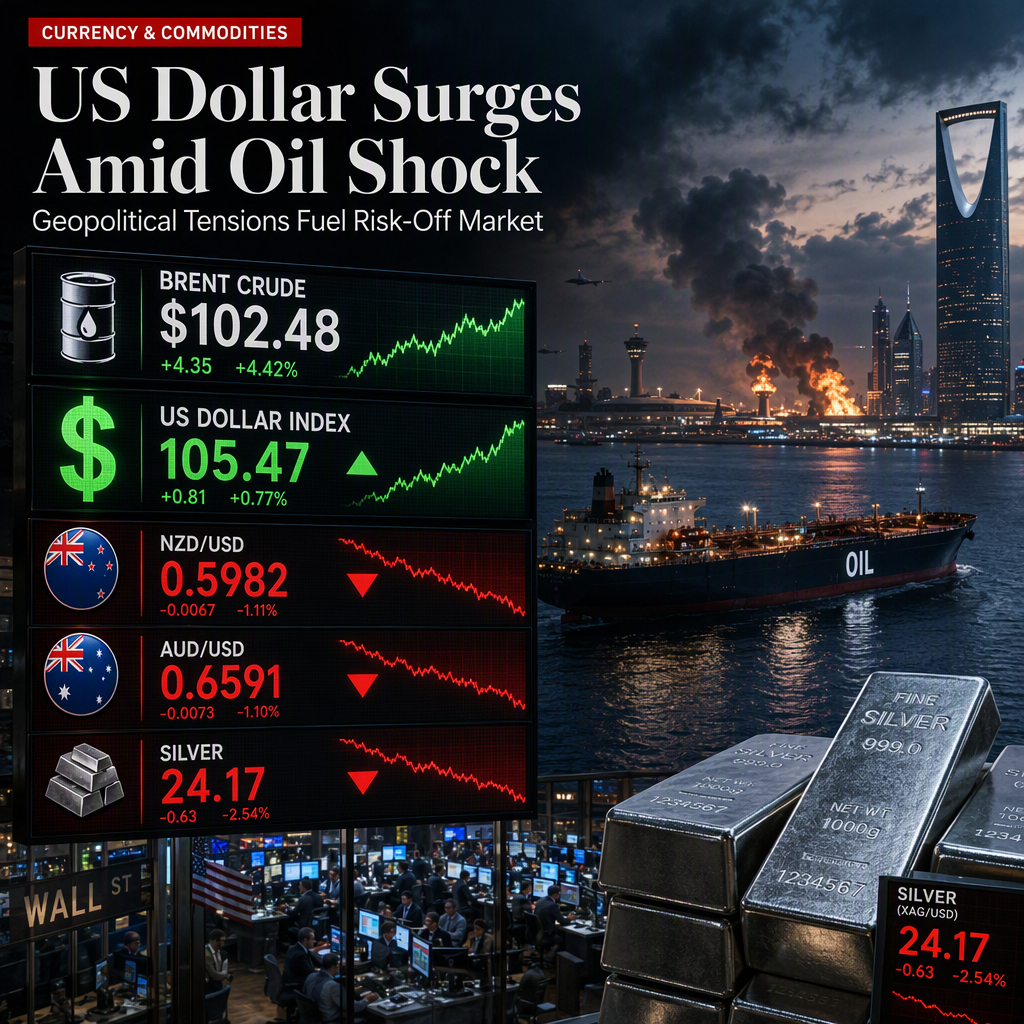
A surge in oil prices, triggered by new attacks on Saudi Arabian airports by the Iran-backed Houthis, has heightened concerns over Middle East supply disruptions and pushed Brent Crude above $101.50–$102.00, more than 5% above Tuesday's lows [1][3]. This escalation has led to higher shipping costs and a broad deterioration in market sentiment, fueling a rally in US Treasury yields and strengthening the US Dollar across major currency pairs [1][3].
The New Zealand Dollar (NZD) reversed earlier gains and turned negative against the US Dollar (USD), with NZD/USD trading at 0.5596 and approaching 18-month lows at 0.5580. Technical indicators such as the Relative Strength Index (14) around 40 and a near-zero MACD suggest bearish momentum, with further downside targets at 0.5530 and 0.8490 if support breaks [1]. The NZD was the strongest against the Australian Dollar but lost ground against most other majors [1].
Similarly, the Australian Dollar (AUD) fell 0.23% to around 0.6950 against the USD, underperforming amid risk-off sentiment. The AUD was the weakest against the Swiss Franc and lost ground to most major currencies [2]. S&P 500 futures declined by 0.27% to near 7,780, reflecting diminished risk appetite. US 10-year Treasury yields rose 0.7% to near 5.33%, and analysts at Danske Bank warned of the risk that 10-year and 30-year yields could reach 6% as investors demand higher term premia [2]. The Reserve Bank of Australia is not expected to hike rates in November, with money markets pricing only a 27% chance of a move to 4.85% [2].
Silver (XAG/USD) also suffered, dipping to $59.30 after being capped near $60.60 earlier in the day. The metal is under pressure as higher yields and a stronger US Dollar reduce its appeal, with technicals pointing to further downside toward $56.50 if support at $59.00 fails [3]. The US 10-year yield remains above 5.30%, and the 30-year note is above 5.7%, just below 24-year highs, indicating weak speculative demand for precious metals [3].
Overall, the combination of geopolitical tensions, surging oil prices, and rising US yields has created a risk-off environment, strengthening the US Dollar and weighing heavily on risk-sensitive assets and commodities.
CONCLUSION
Geopolitical tensions and higher oil prices have triggered a flight to safety, boosting the US Dollar and Treasury yields while pressuring the New Zealand and Australian Dollars and silver. Market sentiment remains risk-averse, with technicals and analyst commentary suggesting further downside for risk assets if current trends persist.