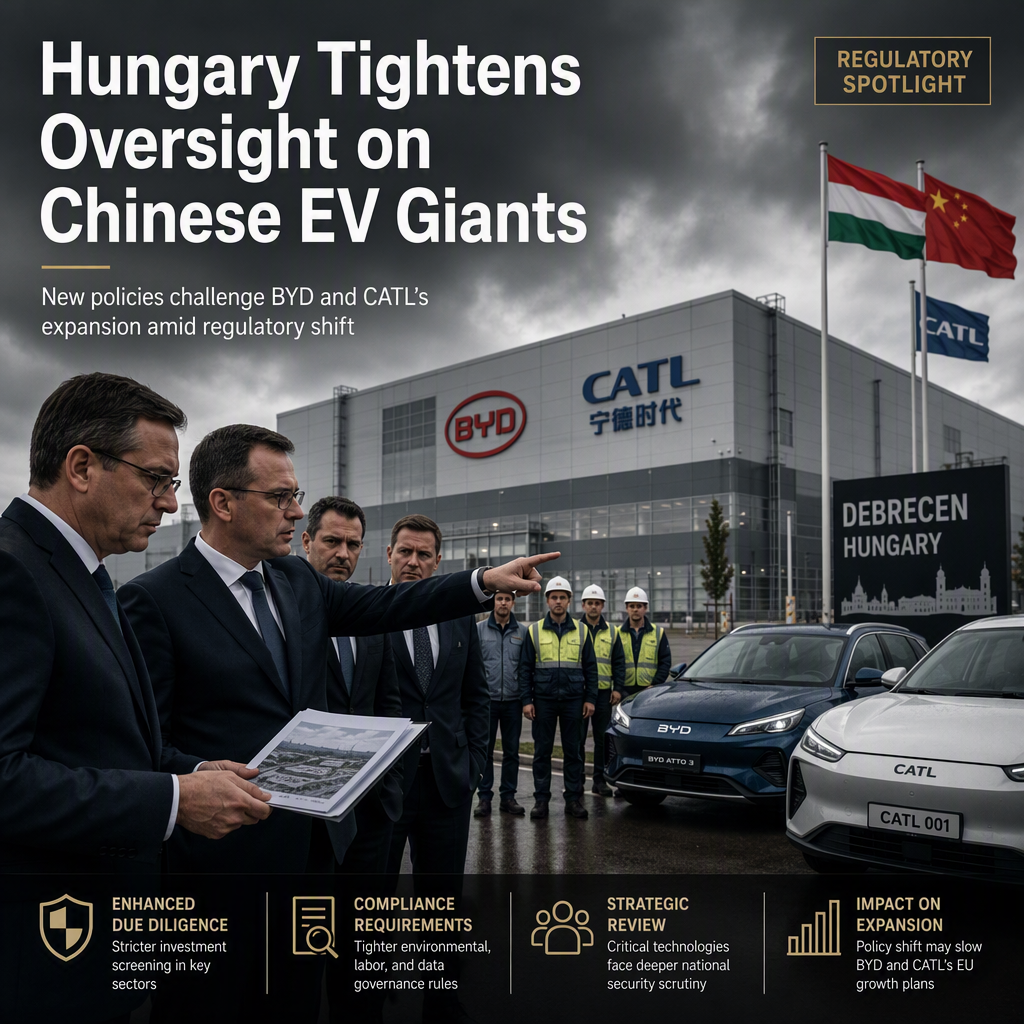
Hungary's newly installed government, led by Prime Minister Peter Magyar since May, has initiated a significant policy shift by increasing regulatory pressure on Chinese electric vehicle (EV) and battery manufacturers, notably BYD and CATL [1]. The administration is actively reviewing previously approved funding and investment deals that were characterized as opaque, and is simultaneously tightening environmental regulations for factories operating in the country [1].
These measures are directly impacting the operations and expansion plans of Chinese EV and battery companies that have established or are planning investments in Hungary [1]. The government's actions have raised concerns among foreign investors regarding the evolving regulatory environment, particularly as Hungary had previously served as a key hub for Chinese investment in the European automotive and battery sector [1].
The new policies reflect Hungary's broader strategic realignment away from the pro-China stance of former Prime Minister Viktor Orban, with the current government seeking closer alignment with European Union standards on transparency and environmental protection [1]. The heightened scrutiny comes amid growing attention to China's expanding influence in the European automotive and battery industries [1].
No specific market reactions, analyst opinions, or forward-looking statements were provided in the article [1].
CONCLUSION
Hungary's government is tightening oversight of Chinese EV and battery companies, signaling a shift toward stricter transparency and environmental standards. This policy change introduces new uncertainties for foreign investors and could impact the future operations of firms like BYD and CATL in Hungary.