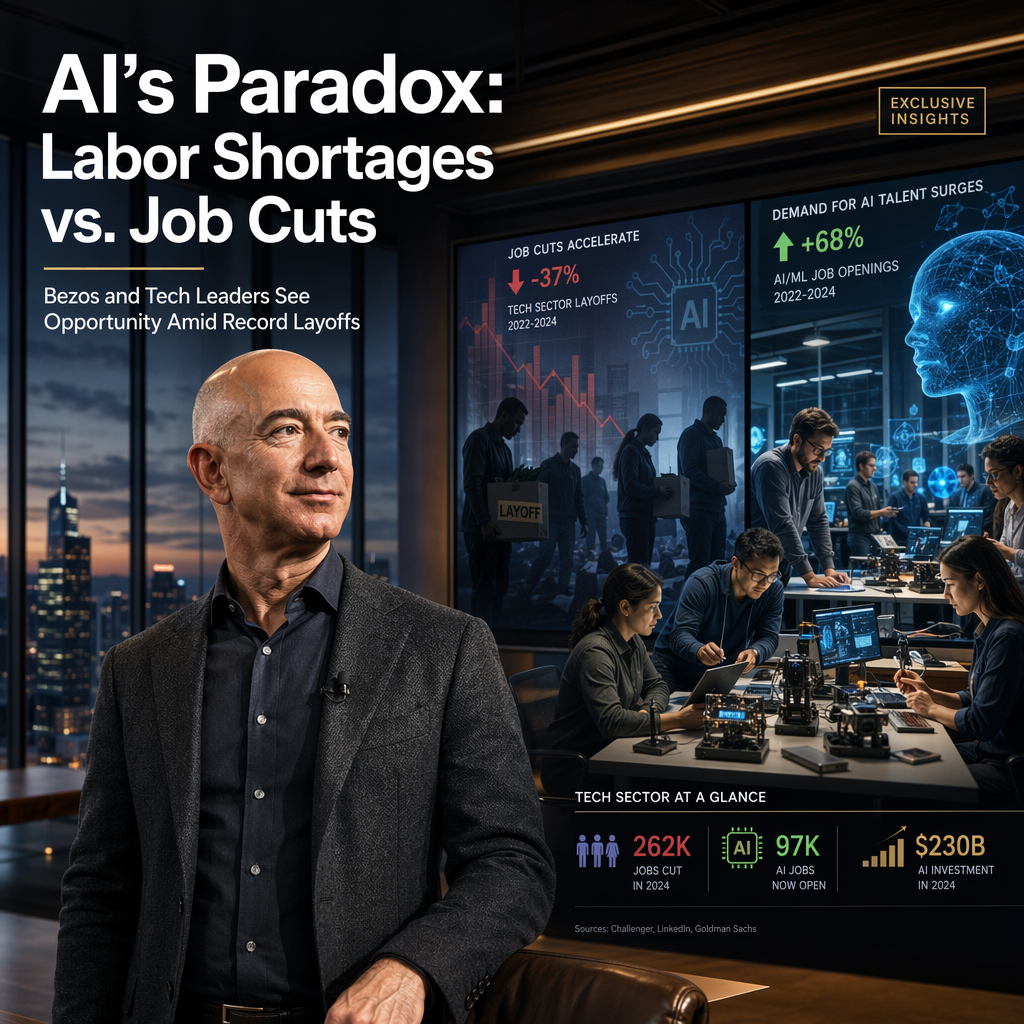
Amazon founder Jeff Bezos stated at the VivaTech technology conference in Paris that artificial intelligence (AI) will not replace human workers across the economy, but instead will create labor shortages due to the acceleration of innovation and the realization of new ideas previously deemed too difficult to execute [1]. Bezos emphasized that concerns about AI making humans redundant are misplaced, arguing, "AI is going to create a labor shortage. We have an endless set of things to invent… We are limited not by our imaginations but by what we can actually do" [1].
Bezos' optimistic outlook comes amid significant workforce reductions in the tech sector, with companies citing AI as a primary reason for job cuts. According to a report by Challenger, Gray & Christmas, about 40% of the 97,006 job cuts announced by companies in May were attributed to AI, amounting to 38,579 cuts—the highest monthly total linked to AI since tracking began in 2023 [1]. Andy Challenger, chief revenue officer at the firm, noted, "AI is now the leading reason companies give for cutting jobs and the primary industry citing it is technology" [1].
The tech sector announced 38,242 job cuts in May, the highest for the sector since August 2024. So far in 2026, firms within the sector have announced 123,653 cuts, a 66% increase from the same period in 2025, leading all other sectors in job cuts this year [1]. Amazon itself announced 16,000 job cuts in January as part of its investments in AI [1].
Despite these figures, Challenger explained that "AI isn't yet the jobpocalypse some predicted. Like spreadsheets and email before it, the technology will ultimately make workers more productive, but our data shows companies are already acting on it, citing AI for more cuts than any other reason" [1]. The pace and nature of AI's impact on the workforce remain open questions, with the labor market being reshaped by technology in real time [1].
CONCLUSION
Jeff Bezos projects that AI will ultimately create more opportunities and labor shortages, even as current data shows significant job cuts attributed to the technology, especially in the tech sector. The market is closely watching how quickly and extensively AI will reshape the workforce, with productivity gains expected but near-term disruptions evident.