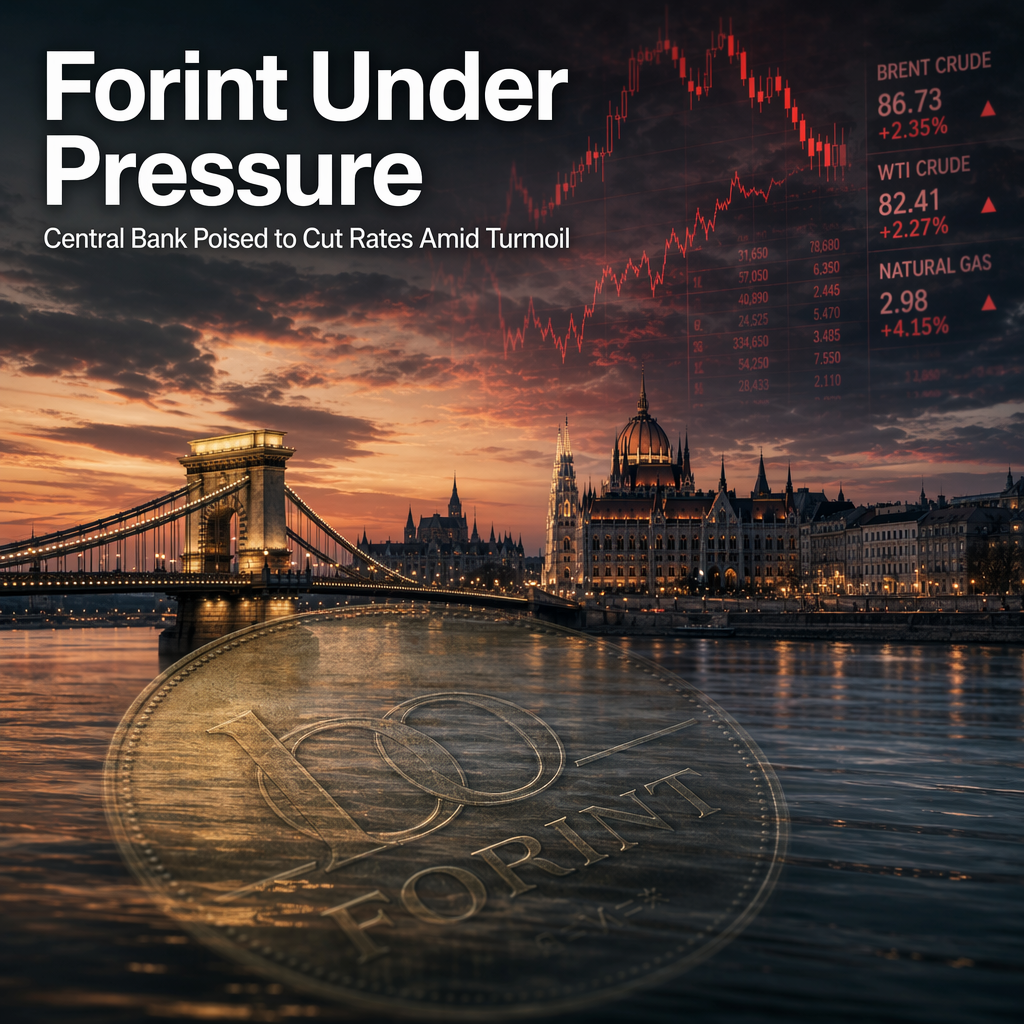
Escalating US-Iran tensions have triggered a risk-off environment in global markets, putting pressure on Central and Eastern European (CEE) assets, particularly the Hungarian forint (HUF) [1]. ING’s Frantisek Taborsky notes that the regional data calendar is light, with few releases expected to challenge the prevailing global narrative. The forint has been hit hardest among CEE currencies, reflecting crowded long positioning and anticipation of further central bank easing [1]. Société Générale identifies the HUF as July’s main laggard in the region, with a total return of -1.8% versus the euro and EUR/HUF moving back above 363 on Friday [2]. This weakness is attributed to diverging monetary policy paths in Hungary, Czechia, and Poland, which have eroded the forint’s carry appeal, compounded by higher energy prices [2].
Both ING and Société Générale report that the Hungarian central bank (Magyar Nemzeti Bank, MNB) is widely expected to cut rates by 25 basis points to 5.75% this week, marking a second consecutive meeting of easing [1][2]. ING highlights that forward guidance will be crucial, especially regarding whether recent FX pressure has influenced the bank’s outlook [1]. Société Générale adds that money markets are discounting a higher or stable rate path for Czechia and Poland over the next six months, further diminishing the attractiveness of the forint [2].
In Turkey, inflation expectations are the final key release before the Central Bank of Turkey meeting, where rates are expected to remain at 37% and funding at the upper end of the corridor [1]. Meanwhile, ING’s Chris Turner discusses broader euro dynamics, noting that Brent crude prices above $90 have driven a narrowing in EUR/USD two-year swap spreads, supporting the euro. ING still expects EUR/USD to slip below 1.14, targeting 1.1380 this week, and flags a risk of a surprise European Central Bank rate hike, potentially earlier than September [3].
Higher energy prices have not only pressured the forint but also shaped the near-term path for the euro, with ING’s macro team suggesting that the ECB might use the opportunity to implement a second rate hike sooner than expected, although this is considered more of a risk than a baseline scenario [3].
CONCLUSION
The Hungarian forint has come under significant pressure due to risk-off sentiment from US-Iran tensions, diverging regional monetary policies, and rising energy prices, with markets widely anticipating a 25bp rate cut by the MNB to 5.75%. The erosion of carry appeal and further central bank easing are likely to keep the forint weak in the near term. Broader euro dynamics are also influenced by energy prices and potential ECB policy shifts, adding to market volatility.