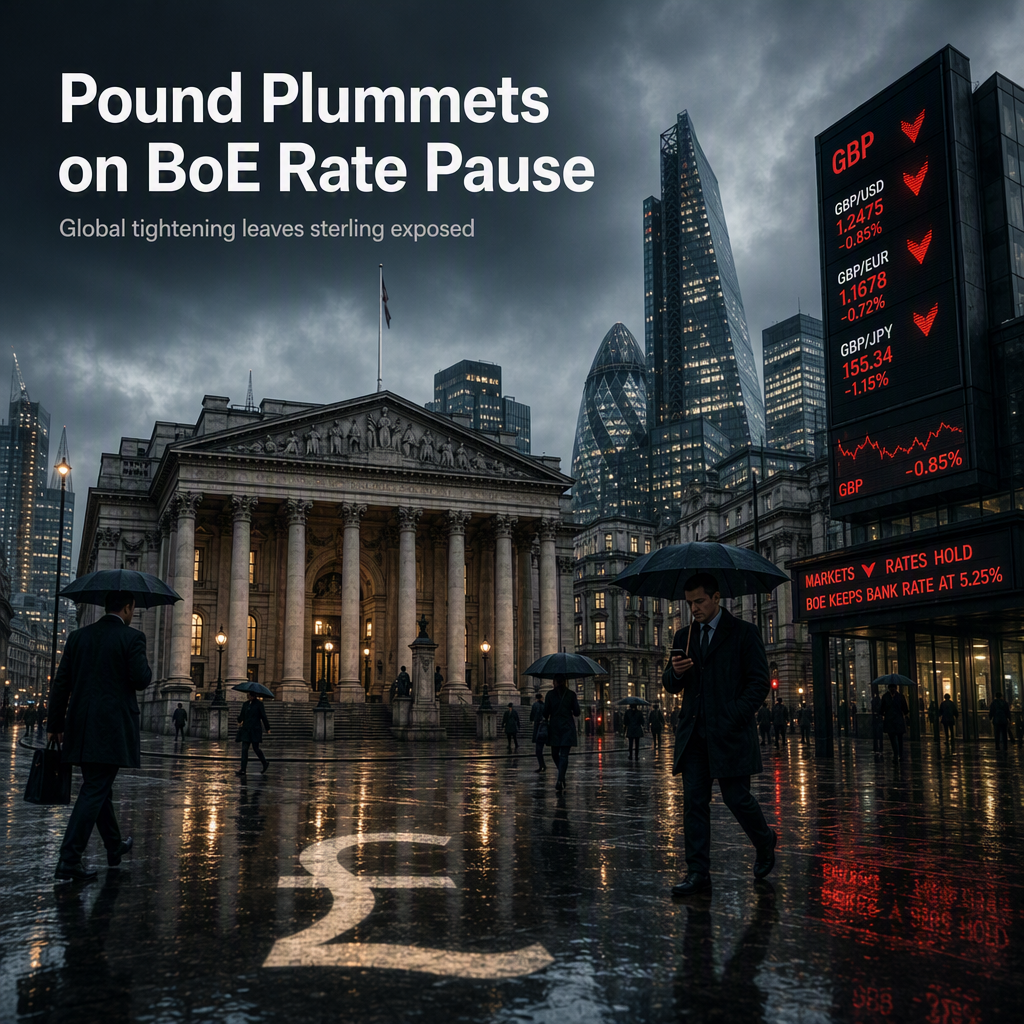
On Thursday, the Bank of England (BoE) left its Bank Rate unchanged at 3.75%, marking the sixth consecutive meeting without a change, despite a 6-3 split among Monetary Policy Committee (MPC) members, with Megan Greene, Catherine L Mann, and Huw Pill advocating for a 25 basis point hike to 4% [1][4]. The decision was accompanied by a somewhat hawkish tone in the meeting minutes, with Governor Andrew Bailey warning that risks to inflation remain to the upside and suggesting that further tightening may be considered if the Middle East conflict persists and second-round effects increase. However, Bailey clarified that there is "little evidence so far" of material second-round inflation effects [1][4]. Bailey did not address the press after the decision [1].
The British Pound (GBP) reacted sharply to the BoE's dovish stance, falling vertically against its peers. As of writing, GBP traded marginally lower near 1.3375 against the US Dollar (USD) and was the weakest major currency against the New Zealand Dollar (NZD), with a daily decline of 0.55% against NZD and 0.22% against the Euro (EUR) [4]. The EUR/GBP pair appreciated more than 20 pips from daily lows, reaching session highs above 0.8580 and approaching two-month highs just above 0.8600 [1]. Analysts at ING expect the BoE's dovish risks to feed into a weaker sterling against both the Dollar and the Euro, with a year-end EUR/GBP target of 0.87 [1].
Meanwhile, the US Dollar corrected after a three-day winning streak, with the US Dollar Index (DXY) trading 0.2% lower near 100.15 as investors digested the Federal Reserve's (Fed) updated dot plot, which showed that 16 of 18 members anticipate at least one more rate hike this year [2][4]. NBC Economics strategists noted broad support for more restrictive monetary policy for a significant period, with no expectation of a return to the 3.5%-3.75% range until the end of 2029 [4]. The Fed's hawkish stance has contributed to a massive selloff in the Swiss Franc (CHF), which plunged more than 2% in five days, reaching 16-month lows against the USD. The SNB is expected to keep its benchmark rate at 0%, further widening the policy divergence with the Fed [3].
In the Eurozone, the final Harmonised Index of Consumer Prices (HICP) confirmed price pressures accelerated at a 0.4% monthly pace in August, up from 0.2% in July, while the year-over-year figure was revised down to 3.2% from the previous estimate of 3.3%. Core inflation remained unchanged at 0.2% monthly and 2.4% year-over-year, maintaining pressure on the European Central Bank (ECB) to continue tightening [1].
Strategists at Societe Generale see the CHF, GBP, and NZD as preferred funding currencies for carry traders, reflecting a market preference to stay positioned against these currencies as long as the Fed retains a hawkish bias [3]. ING analysts reiterate that EUR/GBP remains their preferred way to play GBP weakness beyond the near term [1].
CONCLUSION
The Bank of England's decision to keep rates unchanged at 3.75% triggered a sharp selloff in the British Pound, which underperformed against all major peers. Analysts expect continued GBP weakness, especially against the Euro, as global central banks maintain a tightening bias. The divergence in monetary policy, particularly between the Fed and other central banks, is driving significant currency moves and shaping carry trade strategies.