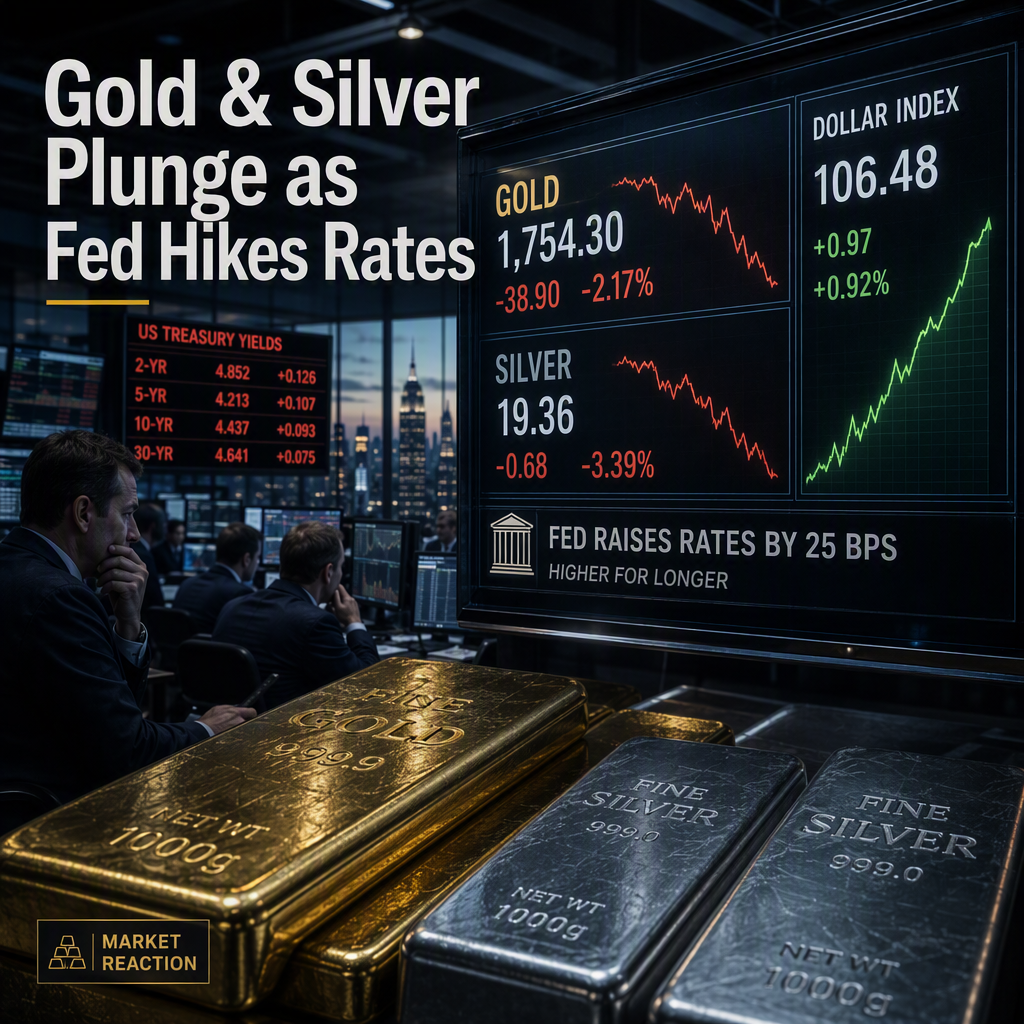
On Wednesday, both Gold (XAU/USD) and Silver (XAG/USD) experienced significant declines following the US Federal Reserve's Federal Open Market Committee (FOMC) decision to raise the federal funds target range by 25 basis points to 3.75%-4.00% in a unanimous 12-0 vote, as widely expected [1][2]. Spot Gold closed with losses, trading around $4,250 after reaching an intraday high of $4,366, marking fresh one-month lows [1]. Silver traded at $62.68, down 1.56% on the day [2].
The FOMC statement highlighted that inflation remains elevated, economic activity is expanding at a solid pace, and the unemployment rate has changed little [1][2]. Policymakers anticipate at least one more rate hike before year-end, with 12 out of 18 officials expecting one more 25 bps hike, four expecting two hikes, and only two members anticipating no further moves this year [1]. The Summary of Economic Projections (SEP) showed inflation is expected to be 3.7% at the end of 2026 versus 3.6% in June, and core inflation is seen at 3.4% versus 3.3% [1].
Fed Chairman Kevin Warsh described the decision as the "right" one, emphasizing that monetary conditions were not restrictive enough and that inflation remains too high. He stated the economy is strong enough for policymakers to focus on price stability, with the labor side of the Fed’s mandate "in good shape" [1][2]. His hawkish remarks fueled speculation that the Fed could deliver up to two more interest rate hikes before year-end [1].
The US Dollar strengthened notably, with the US Dollar Index (DXY) advancing above the psychological 100.00 mark and the USD showing gains against all major currencies, most strongly against the New Zealand Dollar (+0.78%) [1][2]. The benchmark 10-year US Treasury yield rebounded toward 5.00% [2]. Technical analysis for Gold shows it remains under pressure below key moving averages, with mounting selling interest and immediate support at $4,235, while further declines below $4,200 could open the door toward $4,000 [1]. Silver’s near-term bias is bearish, holding above the 50-day SMA at $62 but well below the 100-day and 200-day SMAs at $66 and $73, respectively. RSI near 45 and negative MACD readings indicate soft momentum [2].
Higher interest rates and rising bond yields typically weigh on non-yielding assets like Gold and Silver by increasing the appeal of interest-bearing assets. However, Silver’s decline was limited as the quarter-point hike was widely expected [2].
CONCLUSION
The Fed's hawkish stance and rate hike triggered sharp declines in both Gold and Silver, with the US Dollar and Treasury yields strengthening in response. Market sentiment remains bearish for precious metals, as further rate hikes are anticipated and technical indicators reinforce downside risks. Investors should monitor upcoming Fed actions and inflation data for potential shifts in market direction.