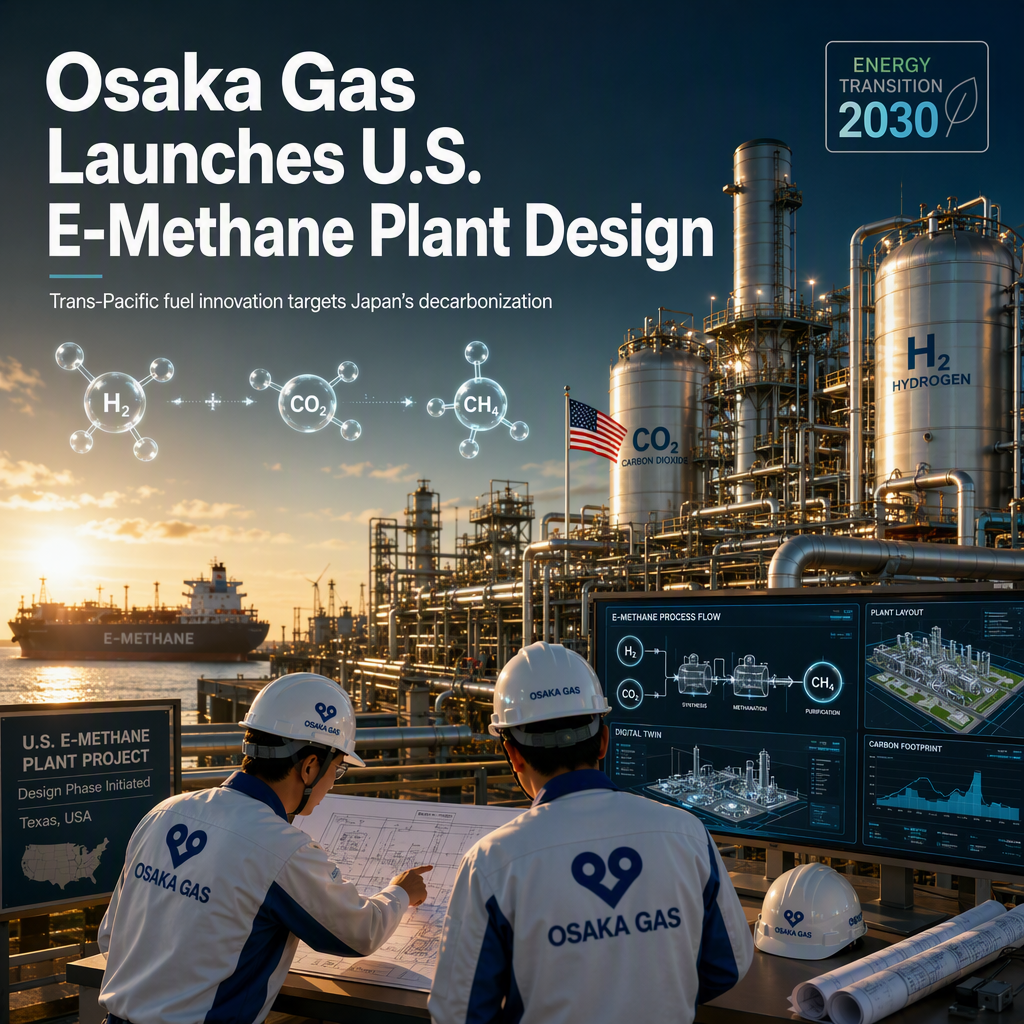
Osaka Gas announced that it has begun basic design work on a planned U.S. facility dedicated to producing synthetic methane, also known as e-methane, which serves as a renewable-energy-assisted alternative to natural gas [1]. The project is intended to export e-methane, produced from hydrogen and CO2, to the Japanese market, with the company targeting the start of shipments from the U.S. to Japan in fiscal 2030 [1].
E-methane is highlighted as a promising solution for decarbonizing Japan's existing natural gas infrastructure, as it can be distributed and utilized with minimal changes to current pipelines and equipment [1]. The U.S. facility, backed by Osaka Gas, marks a significant advancement toward commercial-scale production and international export of synthetic fuel, aligning with Japan's broader energy transition strategies to reduce dependence on fossil fuels [1].
While the announcement did not disclose financial details, project costs, or investment figures, Osaka Gas reaffirmed its commitment to deploying e-methane at scale to help Japan meet its domestic decarbonization targets [1]. The company expects that synthetic gas imports will help offset Japan's natural gas imports and provide price stability amid volatile LNG markets [1].
The initiation of the design phase underscores Japan's ongoing efforts to develop alternative fuels, with Osaka Gas positioning itself as a leader in e-methane technology and trans-Pacific supply chains. The company emphasized that the ability to export from the U.S. will be crucial for ensuring long-term fuel security and meeting demand from Japanese utilities and industry [1].
CONCLUSION
Osaka Gas's move to begin the design phase for a U.S.-based e-methane plant signals a strategic step in Japan's energy transition and decarbonization efforts. While financial specifics remain undisclosed, the project is expected to enhance Japan's energy security and price stability by diversifying fuel sources and reducing reliance on traditional natural gas imports.