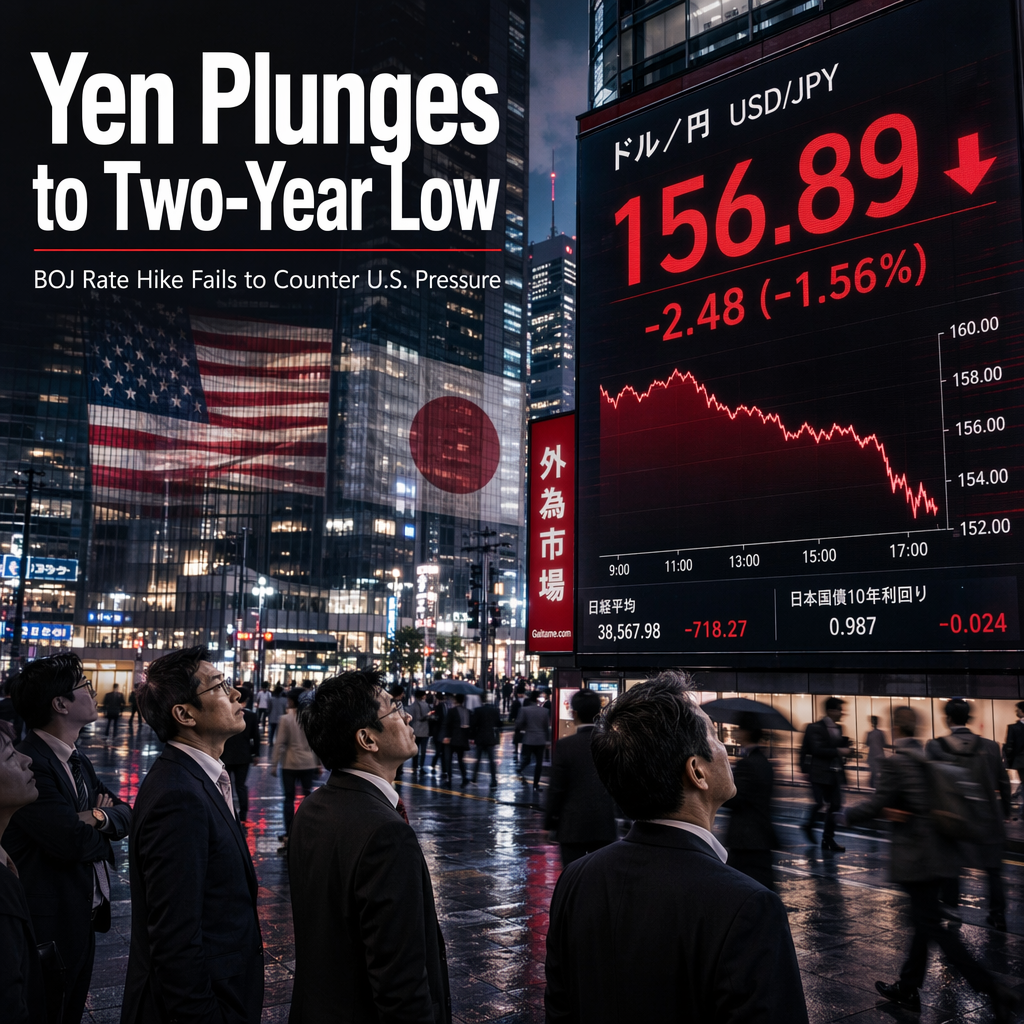
The Japanese yen fell sharply against the U.S. dollar on Wednesday, erasing all gains achieved through government and Bank of Japan (BOJ) interventions since April, and reaching its weakest level in nearly two years following the U.S. Federal Reserve's decision to keep interest rates unchanged [1]. The BOJ had raised its policy interest rate to 1% on Tuesday, marking the highest level in 31 years and a significant departure from its long-standing ultra-loose monetary policy [1][2]. However, the rate hike had been widely anticipated by markets, limiting its ability to support the yen, especially as the rate gap between Japan and the U.S. persists [1].
The decision to raise rates came amid mounting market pressure and was reportedly influenced by U.S. Treasury Secretary Scott Bessent, who urged Japanese officials to act in order to avoid economic and financial disruptions [2]. This external pressure, combined with concerns over inflation risks and rising bond yields, contributed to the BOJ's move, despite initial reluctance from Japanese Prime Minister Sanae Takaichi [2]. A government member described as the 'BOJ shadow governor' played a pivotal role in advocating for the hike [2].
Financial analysts noted that previous interventions by the Japanese government and BOJ in April and May only provided temporary support for the yen, with those gains now fully reversed [1]. Technical analysis indicates that the yen has broken key support levels since mid-2024, and with the Fed maintaining its policy stance, upward momentum for the yen remains limited [1]. Market sentiment is described as bearish, with traders closely monitoring for further interventions or policy shifts [1].
The BOJ's rate hike is seen as an effort to stabilize the currency and address inflationary pressures, particularly as oil prices continue to weigh on the yen's purchasing power [2]. However, questions remain about the broader impact of higher rates on long-term yields and the Japanese economy [2]. Market participants are watching for further signals from both the BOJ and the Japanese government as the central bank seeks to balance inflation control with economic growth [1][2].
CONCLUSION
The yen's decline to a two-year low underscores the limited impact of the BOJ's rate hike amid persistent U.S.-Japan rate differentials and external pressures. Market sentiment remains bearish, with traders awaiting further policy signals as the BOJ navigates inflation risks and economic growth challenges.