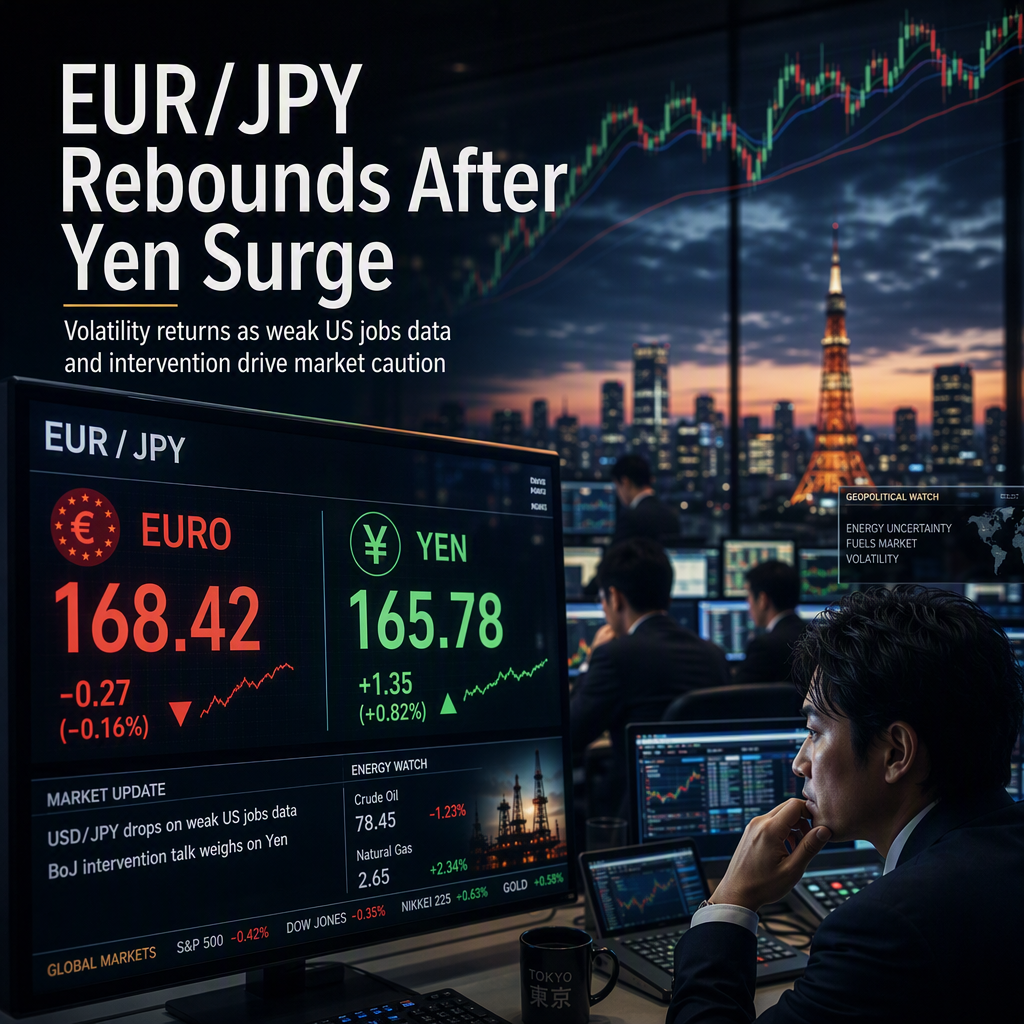
On Friday, the EUR/JPY currency pair experienced volatility, initially dropping as the Japanese Yen surged following a surprisingly weak United States employment report. Despite this sudden appreciation of the Yen, EUR/JPY managed to recover much of its losses later in the session, though it remained down overall for the day [1]. The Yen's strength was further supported by the memory of a rare coordinated Yen-buying intervention conducted by Japan and the United States the previous Friday, which has made traders hesitant to sell the Yen, especially as the US Dollar fell over 1% against the Yen during the early American session [1].
The Yen's recent movement comes after it drifted away from the 40-year low it reached in July, a decline previously driven by Japan's deteriorating terms of trade due to higher and uncertain crude oil prices. These conditions were exacerbated by geopolitical tensions affecting energy flows through the Strait of Hormuz, a critical route for Japan's energy imports [1].
On the European side, the European Central Bank (ECB) maintained a cautious stance by leaving interest rates unchanged at its latest meeting. Market expectations now point to only one additional rate hike before the end of the year, with a reduced likelihood of a second increase [1].
From a technical perspective, EUR/JPY was trading at 182.00, below both the 20-period Simple Moving Average (SMA) at 182.17 and the 100-period SMA at 184.70, indicating a mildly bearish near-term bias. Immediate resistance levels are noted at 182.13 and 182.17, with further resistance at 182.69 and 184.70. On the downside, support is seen at 181.76 and 181.30, with a breach of these levels likely to reinforce the bearish outlook [1].
CONCLUSION
The EUR/JPY pair remains under pressure despite recovering from session lows, as the Yen benefits from both recent intervention and weak US employment data. Market sentiment is cautious, with technical indicators suggesting a consolidative to mildly bearish outlook in the near term. The ECB's cautious policy stance and ongoing geopolitical risks continue to influence the cross.