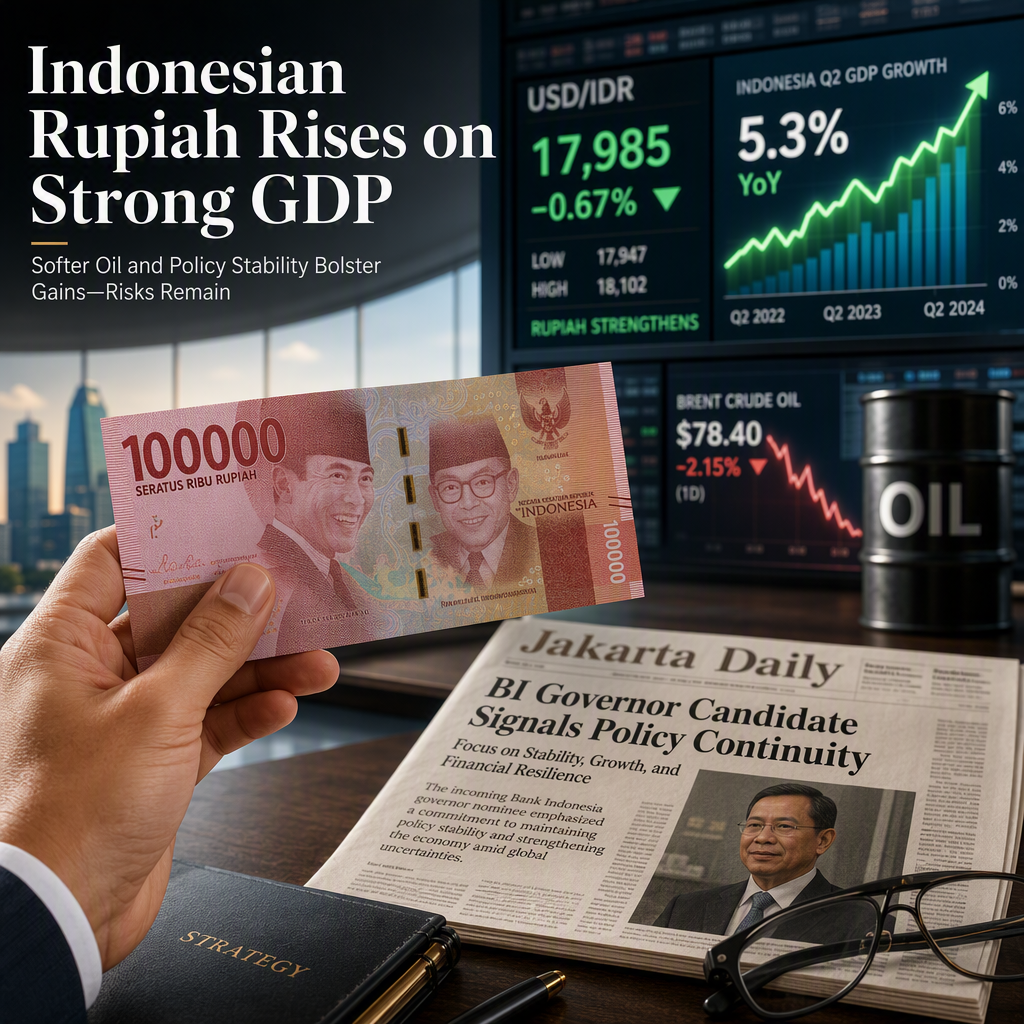
The Indonesian Rupiah (IDR) saw modest gains as the USD/IDR currency pair slipped 0.1% to 17,918, remaining below the key psychological level of 18,000. This movement was attributed to softer global crude oil prices and a stronger-than-expected Q2 GDP report for Indonesia, which rose 5.3% year-over-year, surpassing the Bloomberg consensus of 5.1%. This growth was driven by resilient domestic demand, particularly stronger investment activity, with household consumption and government spending also remaining firm. For the first half of the year, the economy expanded by 5.5%, slightly below the government's full-year target range of 5.6-6.0% [1].
Inflation data also provided support for the Rupiah, as July's Consumer Price Index (CPI) rose 2.9% year-over-year, below the Bloomberg consensus of 3.2% and down from 3.3% in June. This was the softest inflation reading in three months and brought the figure closer to the midpoint of Bank Indonesia's (BI) 1.5-3.5% target range [1].
On the policy front, local media reported that President Prabowo is preparing to submit a shortlist of candidates to replace Perry Warjiyo as BI Governor, with Acting Governor Destry Damayanti widely viewed as the frontrunner. Markets see her as likely to preserve policy continuity. Parliament is expected to review the nominations after returning from recess on 14 August, with the approval process anticipated to take one to two weeks [1].
Commerzbank analysts noted that while greater clarity regarding the next BI Governor and restored confidence in BI's independence should support the IDR in the coming weeks, several headwinds may limit further appreciation. These include the risk of an MSCI downgrade to frontier market status, concerns that the fiscal deficit could breach the statutory 3% of GDP ceiling, and ongoing geopolitical uncertainty [1].
CONCLUSION
The Indonesian Rupiah has benefited from strong Q2 GDP growth and softer oil prices, with inflation trending lower and policy continuity expected at Bank Indonesia. However, structural and geopolitical risks may cap further gains, keeping market sentiment cautiously optimistic.