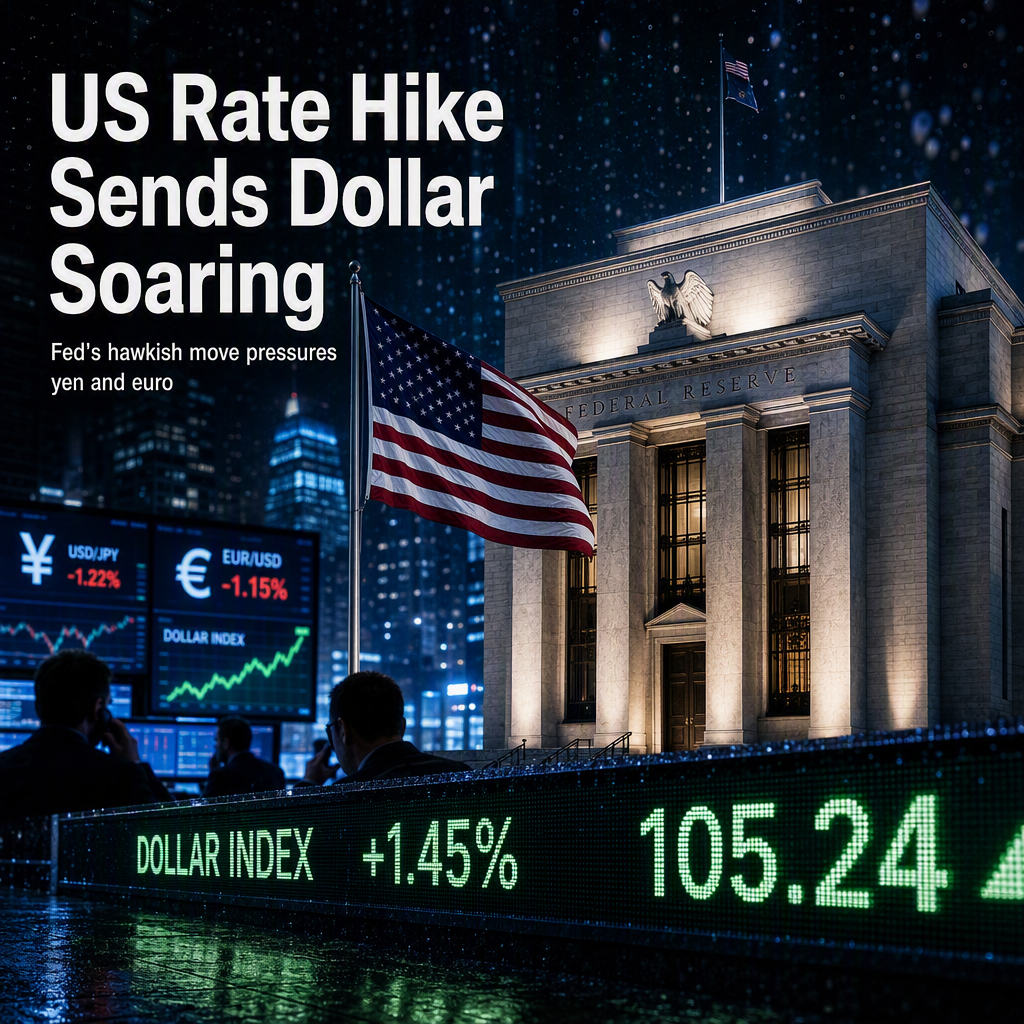
The US Federal Reserve raised its benchmark interest rate by 25 basis points to a target range of 3.75% to 4.00% at its September policy meeting, marking the first rate hike in three years and matching market expectations [2][3]. Fed Chair Kevin Warsh stated that the decision was driven by inflation remaining 'too high' and persisting 'for too long,' describing the move as a 'sober' and 'responsible decision' [2][3]. Warsh signaled that further rate increases remain possible before the end of the year, with money markets pricing in a roughly 49.8% probability of another hike at the October meeting, according to the CME FedWatch tool [2]. The FXS Fed Sentiment Index surged by +26.07 points to 151.79, indicating a distinctly hawkish shift in policy expectations [2].
The Federal Reserve's hawkish stance and rate hike triggered a broad strengthening of the US Dollar. The US Dollar Index (DXY) extended its winning streak for the sixth consecutive day, trading around 100.30 during Asian hours on Thursday and holding above the 100 mark [1][2]. Technical analysis shows the DXY remains bullish, trading above both the 50- and nine-day EMAs, with a 14-day RSI at 63.58 approaching overbought territory [2].
The Japanese yen weakened sharply, slipping into the 156-range against the dollar, as Asian currencies broadly depreciated following the Fed's move and hawkish outlook [1]. Market participants are now focused on the upcoming Bank of Japan (BOJ) meeting, with traders watching for any signals of policy adjustments in response to the yen's sharp depreciation [1].
The Euro also weakened, with the EUR/USD pair declining to around 1.1460 during Asian trading hours [3]. Technical analysis indicates a bearish near-term bias for EUR/USD, as the pair remains decisively below the 100-day moving average and in oversold territory, suggesting continued downside pressure [3]. While the European Central Bank (ECB) raised its key interest rates by 25 basis points last week, ECB President Christine Lagarde signaled caution about further tightening, noting that Eurozone inflation will remain elevated but that the ECB may be less inclined to match the aggressive tightening path implied by market pricing [3].
Analysts highlighted that the Fed's decisive hike and hawkish tone should help restore confidence in its commitment to fighting inflation and support the dollar, while the ECB's more cautious stance may limit the euro's recovery [3].
CONCLUSION
The US Federal Reserve's first rate hike in three years, coupled with a hawkish policy outlook, has strengthened the US dollar and pressured both the yen and euro. Markets are now watching for further signals from the Fed and the upcoming Bank of Japan meeting, while the ECB appears more cautious about additional tightening. The Fed's actions have reinforced its inflation-fighting credentials, supporting the dollar and weighing on risk-sensitive currencies.