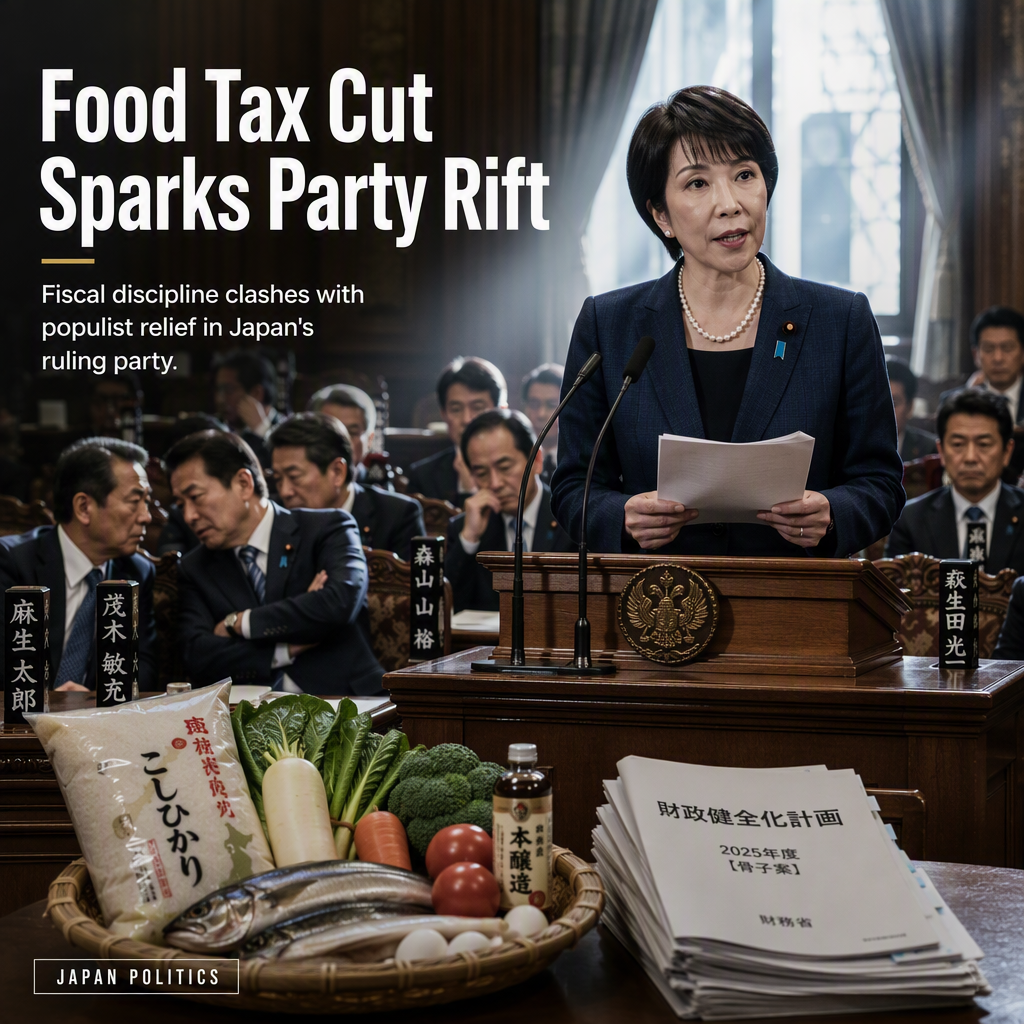
Japanese Prime Minister Sanae Takaichi is encountering increasing resistance from members of her own Liberal Democratic Party regarding her proposal to reduce the consumption tax on food items [1]. The plan, described as populist, aims to provide relief to consumers amid rising living costs but has sparked concerns within the ruling party about the lack of discussion on how the tax cut will be funded [1].
Opponents within the party argue that the absence of a clear funding mechanism for the tax reduction could jeopardize Japan's fiscal discipline and negatively affect government revenue [1]. Critics warn that, while the measure may be popular with the public, it risks undermining the country's long-term fiscal health if implemented without a sustainable financial plan [1].
The internal debate underscores broader anxieties about Japan's fiscal sustainability and the difficulty of balancing short-term populist measures with responsible economic management [1]. No specific figures, dates for implementation, or market reactions are provided in the article [1].
CONCLUSION
Prime Minister Takaichi's proposed food tax cut has ignited significant debate within the ruling party, reflecting concerns over fiscal responsibility and government revenue. The outcome of this internal dispute may influence Japan's approach to balancing populist policies with long-term economic stability.