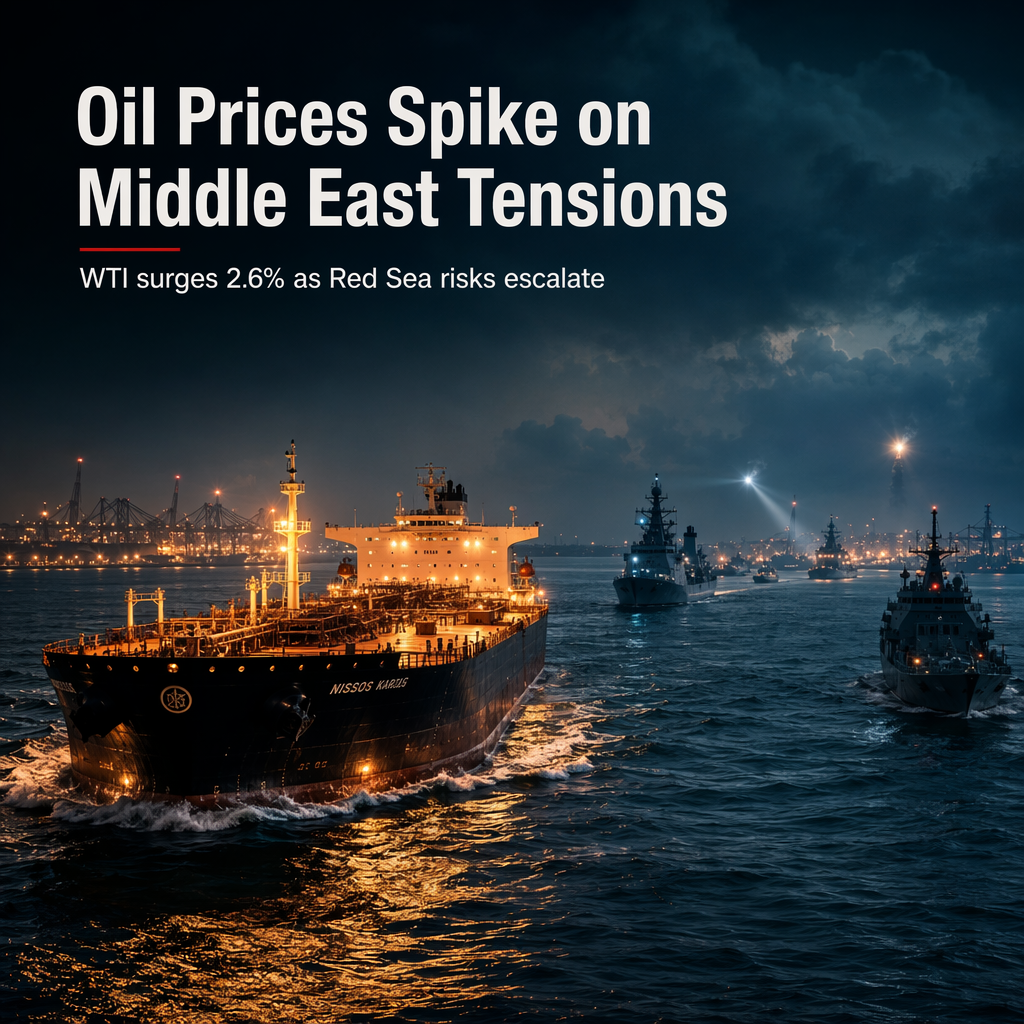
West Texas Intermediate (WTI) crude oil rose 2.6% to trade around $84.40 on Tuesday, driven by escalating concerns over global oil supply disruptions amid ongoing geopolitical tensions in the Middle East [1]. The market's focus remains on the aftermath of US airstrikes on Iran, which have continued for ten consecutive days. US President Donald Trump stated that Iran would 'pay' for the deaths of three US service members, while the Iranian Islamic Revolutionary Guards Corps (IRGC) claimed responsibility for strikes on US military installations in Bahrain and Kuwait [1].
Tensions intensified further after the Iran-backed Ansar Allah rebels in Yemen announced a maritime embargo against Saudi Arabia in the Red Sea, heightening fears over regional energy flows and the security of shipping through the Strait of Hormuz, a critical chokepoint for global oil exports [1]. The UK navy also reported attacks on vessels near the Strait of Hormuz, reinforcing concerns about potential supply disruptions [1].
BNY Mellon analysts noted that the ongoing strikes have maintained a geopolitical premium in oil prices, with Brent crude reaching $88.45 per barrel and US gasoline prices climbing above $4 per gallon [1]. They warned that any disruptions to shipping through the Strait of Hormuz could further tighten global oil supplies and elevate geopolitical risk [1]. Additionally, gold prices edged higher alongside crude, reflecting broader risk-off sentiment and inflationary pressures [1].
Deutsche Bank highlighted that while there is some hope for diplomatic resolution—citing statements from Iran's foreign ministry about receiving ideas from mediators—escalating rhetoric from Ansar Allah and ongoing regional tensions continue to dominate market sentiment [1]. Investors are now awaiting the American Petroleum Institute (API) crude oil inventory report for further market direction [1].
CONCLUSION
WTI crude oil prices surged on heightened fears of supply disruptions due to escalating US-Iran tensions and new maritime threats in the Red Sea. Despite some diplomatic overtures, the market remains focused on immediate geopolitical risks, with analysts warning of further price volatility if shipping through the Strait of Hormuz is disrupted.