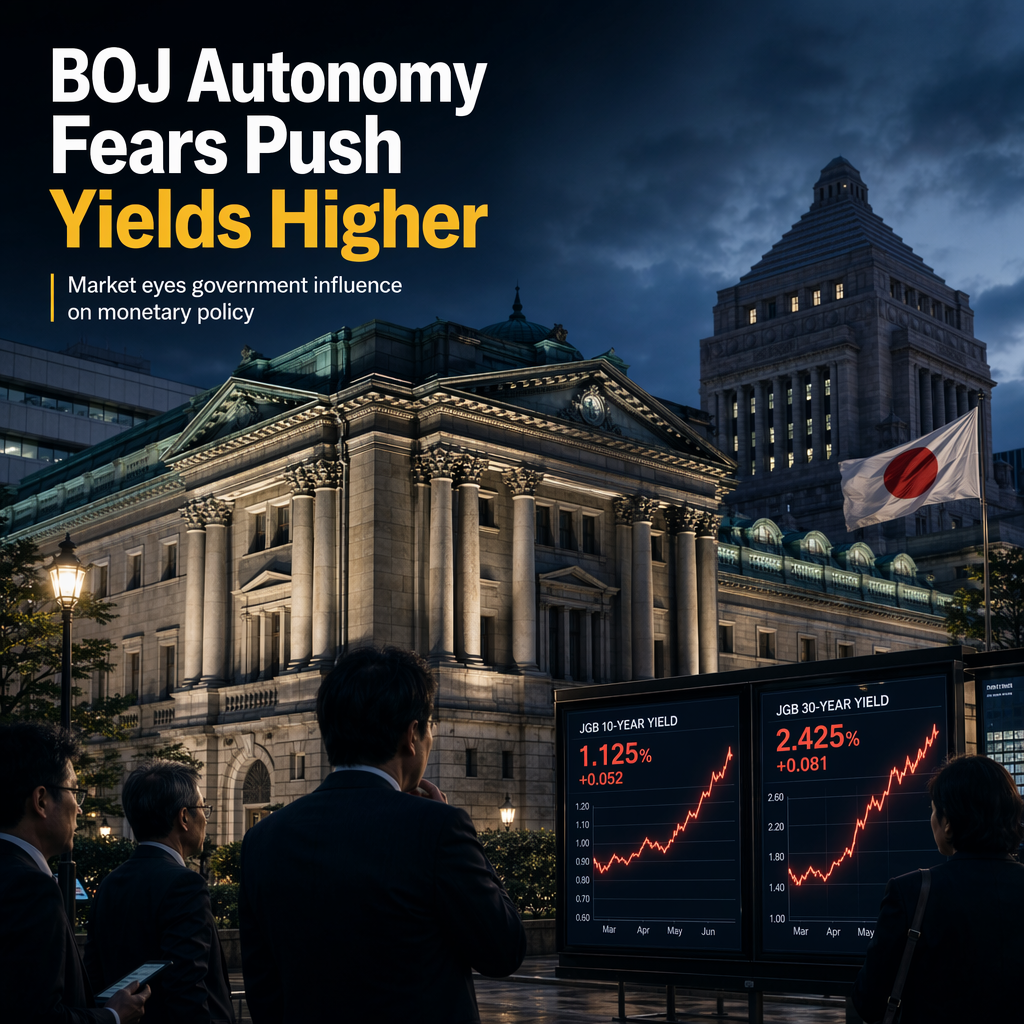
Questions regarding the independence of the Bank of Japan (BOJ) have led to a rise in yields on long-term Japanese government bonds (JGBs) [1]. Market participants are expressing concern that the BOJ could be slow to address inflation if government preferences influence monetary policy decisions [1].
The catalyst for these concerns is a recent draft of a basic economic policy document, which has created the impression that the government may intervene in the central bank's policy-making process [1]. While Japanese law mandates 'autonomy' for the BOJ, it also allows for some degree of government influence, adding to market uncertainty [1].
As a result, investors are reassessing the risk profile of long-term JGBs, leading to an uptick in yields as they factor in the possibility that the BOJ may delay rate hikes or other measures to combat inflation if government influence persists or increases [1]. Market participants are closely monitoring both the language used in policy documents and any statements from government officials regarding the BOJ's autonomy, as these will shape expectations for future monetary policy and the trajectory of JGB yields [1].
CONCLUSION
Rising concerns about the BOJ's independence have pushed up long-term Japanese government bond yields as investors weigh the risk of delayed monetary tightening. The market is expected to remain sensitive to further signals from policymakers regarding central bank autonomy.